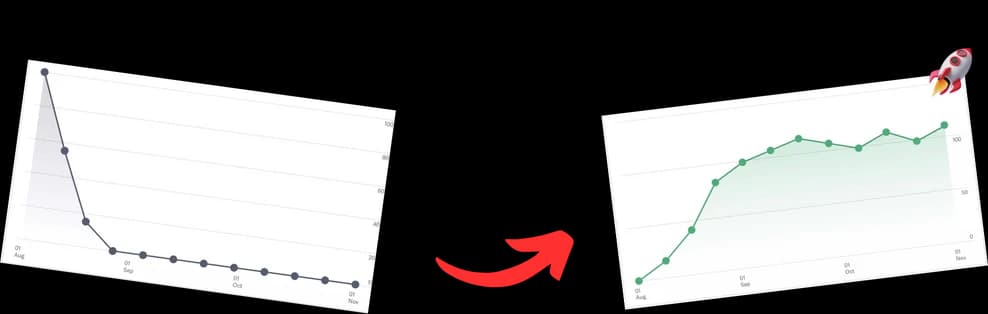
You've posted consistently. You've improved your editing. You've watched other creators in your niche pass you by anyway.
That usually means the problem isn't effort. It's the system behind the effort.
youtube audience growth gets framed as a motivation problem far too often. People tell you to upload more, grind harder, and trust the process. That advice breaks down fast when every video feels like a fresh gamble. Sustainable growth comes from a tighter loop: pick better topics, package them clearly, help YouTube understand them, distribute them with intent, and study the response so the next video starts stronger.
YouTube is still one of the biggest audience opportunities on the internet. Its user base grew from about 200 million monthly users in 2010 to 2.74 billion in 2024, a 13x increase, according to Business of Apps' YouTube statistics. The opportunity is huge. The competition is too. That's exactly why random uploads stop working.
Find Your Unfair Advantage with Audience Research
The biggest mistake I see is creators starting with format instead of demand. They ask, “Should I make tutorials, commentary, or shorts?” before they've answered a more useful question: what does a specific viewer already want solved, understood, or decided?
If your channel feels stuck, don't widen your niche. Narrow the problem. Broad channels rarely lose because the creator lacks talent. They lose because each upload talks to a different person with a different intent.

Start with problems, not content ideas
The channels that grow fastest usually know exactly where the viewer is stuck. That's more useful than a demographic profile.
Build your research around these four questions:
-
What is the viewer trying to do right now
Not “who are they,” but “what are they trying to achieve today?” Learn guitar faster, fix bad lighting, choose a camera, understand taxes, pass an exam. -
What is blocking them
Confusion, fear of wasting money, too many options, poor results from previous attempts, lack of structure. -
What proof do they trust
Step-by-step walkthroughs, screen recordings, before-and-after examples, side-by-side tests, templates, mistakes to avoid. -
What would make them click immediately
A stronger outcome, a clearer use case, a more specific audience angle, or a more believable promise.
Here's a simple research stack that works without overcomplicating the process:
- Competitor sorting: Go to comparable channels and sort their videos by popular. Look for repeated themes, not one-off hits.
- Comment mining: Read comments on top videos and note confusion, objections, and follow-up questions.
- Forum language: Reddit, Facebook groups, Discord communities, and niche forums reveal the exact words viewers use.
- Search behavior: Use YouTube search trends and intent patterns to see whether interest clusters around tutorials, comparisons, reviews, or fixes.
Look for gaps in angle, not just topic
A lot of creators think “content gap” means finding keywords nobody covers. In practice, the better gap is usually an underserved angle.
A topic may already be crowded, but the audience slice might not be. “Beginner home studio setup” is broad. “Home studio setup for spoken-word creators with bad room acoustics” is sharper. Same category, better positioning.
Practical rule: Don't ask whether a topic is saturated. Ask whether your angle is easy to classify and easy to care about.
One source on YouTube growth argues that audience growth often comes from helping YouTube classify your content correctly, and that clear structure and consistent topic area help recommendations reach the right viewers, not just keyword matches, as discussed in this breakdown of an underrated YouTube growth strategy.
Build one viewer card before you script anything
Keep this lightweight. One page is enough.
| Viewer field | What to write |
|---|---|
| Current situation | What they've already tried |
| Desired result | What “success” looks like for them |
| Main frustration | What keeps failing or feeling hard |
| Trusted evidence | What proof they believe |
| Click trigger | What headline angle gets attention |
If you can't describe one clear viewer, your next video will probably be too generic. Audience research isn't busywork. It's where youtube audience growth starts getting predictable.
Build a Content Engine Not a Content Treadmill
Once you know who you're serving, the next problem is sustainability. Plenty of creators can come up with five good ideas. Fewer can build a channel where the tenth, twentieth, and fiftieth video all reinforce the same audience promise.
That's the difference between a content engine and a content treadmill. A treadmill keeps you busy. An engine compounds.

One YouTube expert puts this bluntly. Topic choice is “80% of the game”, because strong editing won't rescue a subject with weak audience demand, as quoted in Jason Scott Montoya's collection of YouTube growth advice.
Use pillars, then build clusters under them
Most creators make the mistake of treating each upload like a standalone event. That forces you to reinvent your process every week.
A better setup is:
- Pillars are your big recurring themes.
- Clusters are multiple videos that attack the same pillar from different viewer intents.
- Formats are the repeatable delivery styles that fit your time and skill.
Here's what that can look like:
| Pillar | Cluster examples | Good format fit |
|---|---|---|
| Budget filmmaking | lighting fixes, cheap lenses, audio cleanup | tutorials, comparisons |
| Fitness for beginners | first workout plan, common form issues, motivation traps | coaching-style explainers |
| Creator business | pricing, clients, offers, positioning | screen-share breakdowns, case commentary |
This structure does two things. It reduces ideation stress, and it trains YouTube to associate your channel with a consistent audience problem.
Match the format to your production reality
A lot of burnout comes from copying a format you can't maintain.
If you're a solo creator with limited time, don't build your whole growth plan around cinematic b-roll heavy uploads unless that's your actual edge. Educational talking-head videos, annotated screen recordings, voiceover explainers, live problem-solving, and product walkthroughs can all perform when the topic is strong and the structure is clear.
Use this filter before committing to a format:
- Can you produce it repeatedly without resentment
- Does the format help the viewer understand the promise faster
- Can you make variations without feeling repetitive
- Does it let you publish at a pace you can sustain
The best format isn't the most impressive one. It's the one you can repeat while keeping the topic quality high.
Build a weekly system that reuses thinking
You don't need more hustle. You need fewer decisions.
A simple workflow looks like this:
-
Research one cluster at a time
Pull comments, search intent, and competitor angles into one note. -
Write packaging before the script
Draft title ideas and thumbnail concepts early. If the idea isn't clickable, the script won't save it. -
Record in batches when possible
Batch intros, talking-head segments, or screen tutorials if your setup allows. -
Create follow-up paths
Every video should logically connect to another one on your channel.
This is also where monetization reality matters. Some niches have greater commercial potential than others, so it helps to study broader platform economics alongside your creative strategy. The roundup of Sup Growth insights on creator pay is useful for thinking about where content can support an actual business, not just attract views.
A real content engine makes each upload easier to plan because the audience signal gets clearer over time. That's how you grow without chaining yourself to a publishing schedule you hate.
Master YouTube SEO to Work Smarter Not Harder
Good YouTube SEO isn't about stuffing keywords into every field. It's about making your video easier to understand for two audiences at once: the viewer and the system deciding who should see it.
That means every upload needs clear packaging, clean structure, and metadata that reflects real intent. If your title promises one thing, your intro delays it, and your chapters are missing, you're making discovery harder than it needs to be.

Package for intent first
Creators obsess over keywords and ignore the click decision. Search and suggested both reward clarity.
A strong video package usually has these traits:
- The title names the outcome or question clearly
- The thumbnail adds tension, contrast, or specificity
- The opening seconds confirm the promise fast
- The description supports the topic naturally instead of repeating awkward phrases
If the video is educational, be especially careful with vague titles. “My thoughts on editing” is weak. “How to edit faster without ruining pacing” gives both the viewer and YouTube more to work with.
Chapters do more than improve navigation
This is the underused lever many creators skip. Chapters help viewers jump to what they need, but they also help classify the content inside long videos.
That matters because one source on YouTube growth notes that audience growth is often driven by helping YouTube correctly classify your content, and that clear structure, including chapters, helps the platform understand your target audience and recommend the video accordingly, as covered in this guide to YouTube SEO optimization.
A practical chapter workflow looks like this:
| Step | What to do | Why it matters |
|---|---|---|
| Review the video | Identify topic transitions | Prevent vague or random timestamps |
| Name chapters clearly | Use plain language tied to viewer intent | Improves comprehension and scannability |
| Keep sequence logical | Move from problem to solution to next step | Supports retention |
| Check search phrasing | Favor terms viewers actually use | Strengthens discoverability |
Write chapter labels like mini promises
Bad chapter labels are generic. “Intro,” “Part 2,” “More tips,” “Final thoughts.” Those help nobody.
Better chapter labels say what the viewer gets:
- camera settings for low light
- why your audio sounds hollow
- fixing the first minute of your video
- choosing a thumbnail angle that fits the topic
Tools can be particularly time-saving for those who publish a lot of long-form content. TimeSkip is one option. It's a Chrome extension that generates SEO-oriented YouTube chapters and timestamps from the video so you can review and paste them into your upload workflow instead of building them manually.
Here's a useful walkthrough on the topic before you optimize your next upload:
Use metadata to reinforce, not rescue
Your description, tags, and title should support the same story. They should not fight each other.
“Audience growth is often driven by helping YouTube correctly classify your content.”
That's the mental model to keep. Metadata doesn't rescue weak demand. It sharpens strong intent.
Use this quick pre-publish check:
- Title says the main outcome
- Thumbnail creates a reason to click
- Description explains what the viewer will learn
- Chapters break the video into meaningful topic units
- First minute gets to the promised value quickly
The creators who work smarter usually aren't gaming SEO. They're reducing ambiguity.
Amplify Your Reach with Smart Distribution
A lot of creators waste the release window because they treat publishing like the finish line. It isn't. It's the handoff.
The first stretch after a video goes live is where your packaging, timing, and early audience match start feeding YouTube signals it can use. If that launch is messy, the video often gets introduced to the wrong viewers or gets weak engagement from people who clicked out of obligation instead of interest.
Give each upload room to breathe
One of the clearest avoidable mistakes is stacking uploads too close together. A source on YouTube publishing notes that uploading multiple videos at once can split the algorithm's attention and reduce the reach of both, and recommends spacing uploads by at least an hour so each gets a clean initial distribution window, as explained in this article on YouTube mistakes that hurt growth.
That advice lines up with what many creators learn the hard way. If you publish two videos back to back, you're not doubling momentum. You're often dividing it.
Think in waves, not blasts
Most promotion fails because it looks like spam. Dropping the same link everywhere isn't distribution. It's noise.
A better approach is to create small, channel-specific entry points:
-
Email list
Don't just send the link. Lead with the problem the video solves and why it matters now. -
LinkedIn or X post
Pull out one contrarian takeaway, one mistake, or one short framework from the video. -
Short-form teaser
Clip a moment that stands on its own. Curiosity beats summary. -
Communities
Share only when the video directly answers a question people are already discussing.
Here's the trade-off. External traffic can help if it's relevant and interested. Irrelevant traffic can hurt if people bounce immediately. That's why blind promotion is often worse than selective promotion.
Publish with a creator identity people recognize
Distribution gets easier when people know what kind of creator you are before they click. Channels with clearer positioning earn faster trust because viewers can connect the new upload to an existing expectation.
If your branding feels vague, it helps to study how other people make their identity legible across content themes, visuals, and messaging. These individual branding examples are useful because they show how recognizable positioning travels across platforms without sounding robotic.
Don't promote every video the same way. Promote it according to the promise it makes and the audience that promise fits.
A simple first-day distribution checklist
| Moment | Action |
|---|---|
| At publish | Confirm title, thumbnail, description, and comments are clean |
| Shortly after | Share to your warmest audience first |
| Later | Post one native takeaway on a second platform |
| Same day | Reply to comments that reveal confusion or buying intent |
| End of day | Note where the highest-quality traffic came from |
Smart distribution doesn't mean louder promotion. It means cleaner targeting during the window when early response matters most.
Turn Viewers into Fans with Retention Tactics
A viewer clicks because of the promise. They stay because the video keeps cashing that promise in.
Most retention problems start at the top. The intro takes too long. The creator opens with channel branding. The viewer has to wait for context they were already hoping you understood. By the time the useful part arrives, they're gone.
The first minute decides the relationship
Think about two versions of the same tutorial.
In the weak version, the creator says hello, thanks people for watching, explains their background, previews everything loosely, and finally starts. The viewer feels drag.
In the stronger version, the creator opens with the exact outcome, shows the problem, then moves immediately into the first useful step. The viewer feels progress.
That's the whole game in the opening stretch. A strong start usually includes:
- A fast restatement of the promise
- Proof that you understand the problem
- A roadmap only if it adds clarity
- Immediate movement into the substance
Use transitions to stop silent drop-offs
Most drop-offs don't happen because the topic is bad. They happen because the viewer loses orientation.
When you finish one point, don't drift into the next. Bridge it. Say what changed and why it matters. If you're teaching, show the consequence of getting the previous step wrong. If you're reviewing something, compare it to an alternative. If you're telling a story, raise the next question before attention dips.
Good retention comes from momentum. The viewer should keep feeling that the next minute will answer the next useful question.
Place your calls to action where trust is highest
Creators often ask for too much too early. Subscribe prompts in the first seconds can work for established personalities, but for most channels they interrupt the value exchange.
A better sequence is:
- Hook
- Deliver a meaningful win
- Introduce the next step
- Then ask for the action that fits the moment
That action might be subscribing, watching a related video, downloading something, or leaving a comment. The point is alignment. If the viewer just got value, the CTA feels natural.
Tight editing is really promise management
A high-retention video doesn't need nonstop jump cuts. It needs discipline.
Cut repeated explanations. Remove side points that don't support the main outcome. Keep examples, but choose examples that clarify rather than entertain for their own sake. When viewers can feel that every segment earns its place, they trust the channel more.
That trust is what turns one useful video into repeat viewing. And repeat viewing is when youtube audience growth starts becoming a fan-building process instead of a traffic chase.
Use Analytics to Fuel Your Next Breakthrough
Creators get stuck when they treat analytics as a report card. The useful mindset is different. Analytics are instructions.
A video underperforming doesn't just tell you that something failed. It usually points to where the mismatch happened. Weak click response suggests packaging trouble. Early drop-off often points to the intro or a title-video mismatch. Strong retention on a narrow topic can reveal a cluster worth expanding.

Read the signals in sequence
Start with the viewer journey instead of isolated metrics.
-
Impressions to clicks
Did the title and thumbnail earn attention? -
Clicks to early watch time
Did the opening confirm the promise fast enough? -
Mid-video retention
Did the structure keep people oriented and interested? -
End behavior
Did viewers have a logical next step on your channel?
If one part is weak, don't overhaul everything. Diagnose the specific handoff that broke.
Use retention graphs like an editing coach
The audience retention graph is one of the most practical tools in YouTube Studio. Dips often show friction. Flat stretches can signal strong pacing. Spikes can mean viewers rewatched a useful segment or skipped ahead to something highly relevant.
The most effective habit is to review those patterns right after publishing cycles and log them in a simple note. One line per video is enough: what got clicks, where people dropped, what held attention, and what topic deserves a follow-up.
If you want a clearer breakdown of how to read those reports without drowning in dashboards, this guide on YouTube analytics explained for creators is a useful reference.
Build the loop
| Stage | Question |
|---|---|
| Publish | What promise did this video make |
| Review | Where did viewers respond or leave |
| Diagnose | Was it topic, packaging, structure, or timing |
| Adjust | What will change in the next upload |
| Repeat | Did that change improve the next result |
The best channels don't guess less because they're smarter. They guess less because they document more.
If you want a faster way to tighten one of the most overlooked parts of youtube audience growth, take a look at TimeSkip. It helps creators generate YouTube chapters and timestamps quickly, which makes long-form videos easier to move through and easier to classify accurately. For busy channels, that can turn chaptering from a skipped task into a repeatable part of the publishing system.