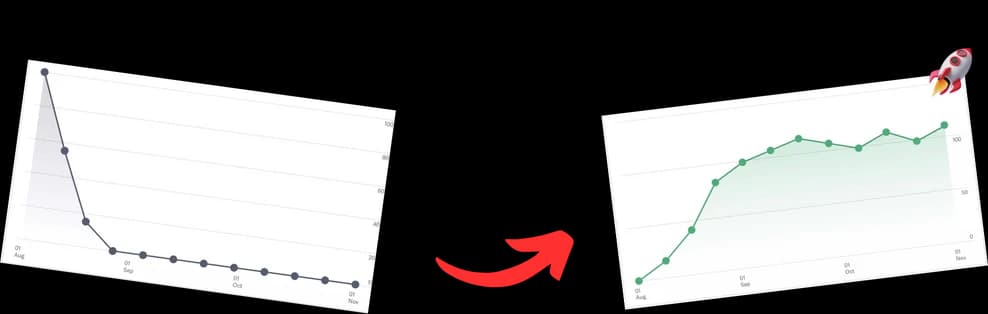
Think of a YouTube title analyzer as your personal data scientist for crafting killer video titles. Instead of throwing spaghetti at the wall and hoping something sticks, these tools give you a data-backed look at what makes a title work—or fall flat. They analyze everything from your keyword choices and character count to the emotional punch of your words, helping you move from pure guesswork to making strategic, informed decisions.
Why Your Video Title Is Your Most Crucial Asset

Let's be real: your video's success often comes down to a single line of text. In the endless sea of content people scroll through, your title is the billboard that either grabs their attention or gets completely lost in the noise. It’s your content's hardest-working salesperson, on the job 24/7 to earn that all-important click.
That split-second decision a viewer makes—to watch or to keep scrolling—is almost entirely based on your title. It's the gatekeeper to your views. It has to set the right expectation, promise a valuable solution, or just spark enough curiosity to stop them in their tracks.
The Algorithm and The Audience
Here’s the thing, though. You aren’t just writing for people. You’re also writing for the YouTube algorithm. Your title is one of the strongest signals you can send to YouTube about what your video is about and, crucially, who it's for. A well-crafted title helps the algorithm categorize your content and serve it up to the perfect audience.
This is exactly where a YouTube title analyzer becomes an indispensable part of your toolkit. Instead of just going with your gut, these tools give you objective, actionable feedback. They help you nail down:
- Keyword Strength: Are you actually targeting phrases people are searching for?
- Click-Through Potential: Is your title compelling enough to stand out when sandwiched between two of your competitors' videos?
- Format and Readability: Is your title easy to scan and will it get cut off on mobile devices?
From Guesswork to Growth
For any creator who's serious about growth, this data-driven approach isn't just a "nice-to-have" anymore. It's essential. In fact, some studies show that properly optimized titles can boost click-through rates (CTR) by 20-50% compared to ones that are just thrown together.
Your title and thumbnail are a one-two punch. The thumbnail grabs the eye, but the title provides the context and seals the deal. When they work together perfectly, your CTR can go through the roof. A killer title can make a good thumbnail absolutely irresistible.
At the end of the day, a title analyzer helps you refine this tiny but mighty piece of your video to maximize its impact. It turns title creation from a frustrating guessing game into a repeatable, strategic process. By focusing on data, you can significantly improve your YouTube click-through rate and give every video the best possible shot at getting discovered. It's the first and most critical step in turning a casual browser into your next loyal subscriber.
Understanding the Metrics Inside a Title Analyzer
Opening up a YouTube title analyzer for the first time can feel like you've just stepped into an airplane cockpit—a dashboard blinking with numbers, scores, and gauges. It might look a little intimidating, but each metric is actually telling a specific story about your title’s potential.
Think of it this way: these tools aren't just guessing. They're using real data to predict how your title will perform out in the wild. Let's decode the most common metrics you'll run into.
SEO Score: Getting Found in the First Place
The SEO Score is your compass for discoverability. It’s all about measuring how well your title is set up to appear in YouTube and Google search results. A higher score here means the algorithm has a much better idea of what your video is about, which dramatically increases its chances of being recommended to the right people.
This score is usually a blend of a few critical factors:
- Keyword Relevance: Does your title actually contain the words people are searching for? A good analyzer will look at the search volume and competition for your keywords.
- Keyword Placement: Keywords that show up closer to the beginning of a title tend to carry more weight. The tool checks to see if you’ve front-loaded your most important search term for maximum impact.
For example, a title like "Beginner's Sourdough Bread Recipe (Easy No-Knead Method)" will almost always score higher on SEO than "My First Time Baking Bread." Why? Because it targets specific, high-intent phrases people are actually typing into the search bar. Getting hands-on with a tool like lunabloomai's Title Analyzer App can give you a real feel for how these factors are weighed.
CTR Potential and Sentiment: The Human Element
While SEO gets your video found, the CTR (Click-Through Rate) Potential score is what gets it clicked. This metric zeroes in on the human side of things—how compelling, intriguing, or emotionally resonant your title is. It's the "curiosity factor" translated into a number.
A title can have a perfect SEO score but a terrible CTR score. This means you're showing up in search results, but nobody is interested enough to click. Balancing both is the secret to sustained channel growth.
You'll also often see a Sentiment Analysis score. This feature gauges the emotional tone of your title: is it positive, negative, or neutral? Titles with a stronger sentiment tend to grab more attention. For instance, "The WORST Money Mistake You're Making" uses negative sentiment to create urgency, which can drive way more clicks than a neutral title like "Common Financial Mistakes."
Format and Readability: The Nuts and Bolts
Finally, a good analyzer will look at the structure of your title. These technical details seem small, but they make a huge difference in how viewers experience your content on the platform.
- Character Count: YouTube cuts off long titles, especially on mobile. Most tools will recommend keeping your titles under 60-70 characters to make sure nothing important gets hidden.
- Word Count: The sweet spot is usually between 5 to 7 words. That's long enough to provide context but short enough for someone to scan and understand instantly.
- Readability: This is a simple measure of how easy your title is to comprehend. Straightforward, direct language nearly always wins against something complex or vague.
To give you a clearer picture, I've broken down the most common metrics into a table.
Key Metrics in a YouTube Title Analyzer Explained
This table breaks down the common scores and data points you'll find in title analysis tools and explains what they mean for your video's performance.
| Metric/Score | What It Measures | Why It Matters |
|---|---|---|
| SEO Score | How well the title is optimized for search engines like YouTube and Google, based on keywords and placement. | Higher scores increase the likelihood your video will appear in relevant search results, boosting discoverability. |
| CTR Potential | The "clickability" or curiosity factor of a title, analyzing its power to attract human interest. | A high CTR score means more people who see your title will actually click to watch, driving initial traffic. |
| Sentiment Analysis | The emotional tone of the title (positive, negative, or neutral). | Titles with strong sentiment often create urgency or excitement, leading to higher engagement and click-through rates. |
| Character Count | The total number of characters in the title, typically flagging anything over the 60-70 character recommended limit. | Keeps your title fully visible on all devices, preventing key information from being cut off in search results. |
| Readability Score | How easy the title is to read and understand quickly. | Simple, clear language is more scannable and accessible, which appeals to a broader audience. |
These metrics aren't just abstract numbers; they're direct feedback on how both algorithms and real people will perceive your video before they've watched even a single second. For a deeper dive into how these data points fit into your overall channel strategy, it's worth exploring how YouTube analytics explained can offer a broader perspective.
A Practical Walkthrough for Crafting a Winning Title
Alright, theory is one thing, but let's get our hands dirty and see how a YouTube title analyzer actually works in the real world. I’m going to walk you through the exact process I use, starting with a super common—and frankly, boring—video idea and transforming it into a title that practically begs to be clicked.
Our starting point: "Baking Sourdough Bread."
Simple, right? Too simple. It tells people what the video is about, but it’s completely forgettable. It doesn't spark any curiosity, promise a unique benefit, or signal that you're the expert they need to learn from. If you were to plug this into an analyzer, you'd see a pretty dismal SEO score (it's way too broad) and an even worse CTR potential. There's just no hook.
Starting the Transformation
First things first, let's brainstorm some keyword variations. Nobody just searches for "sourdough bread." What are they really looking for? A little digging shows that people are searching for things like "easy sourdough recipe for beginners," "no-knead sourdough bread," and "how to get a perfect sourdough ear."
See the difference? Each one of these targets a specific person with a specific problem. They don't just want bread; they want it to be easy, perfect, or tailored for their first attempt. This is where the analysis really kicks in. We can pop each of these into a tool to see which one hits that sweet spot of good search volume without insane competition.
Right away, we’ve got a couple of much stronger contenders:
- "Easy Sourdough Recipe for Beginners"
- "How to Bake Perfect Sourdough Bread"
Both of these are massive improvements. They're more specific, they match what people are actually typing into the search bar, and they’ll definitely score higher on the SEO front than our original title. But we can do better.
Layering in the Human Element
Now it's time to work on that CTR score. A good SEO score gets you found, but a good CTR score gets you clicked. This means adding words that trigger curiosity, create intrigue, or promise a can't-miss outcome. I’m talking about "power words" like "Simple," "Foolproof," "Secret," or "Mistakes."
Let's take our two titles and level them up.
- Original: "Easy Sourdough Recipe for Beginners"
- Level Up: "The ONLY Easy Sourdough Recipe for Beginners You'll Ever Need"
And the other one:
- Original: "How to Bake Perfect Sourdough Bread"
- Level Up: "My 3 Secrets to Baking Perfect Sourdough Bread Every Time"
These new versions make a bold promise. They don't just offer a recipe; they offer the definitive recipe or spill exclusive secrets. The analyzer's sentiment and CTR scores would shoot way up for these. They create a sense of authority and urgency that makes a viewer feel like they’ll be missing out if they scroll past.
It’s all about finding that perfect balance between searchability, clickability, and emotional punch.
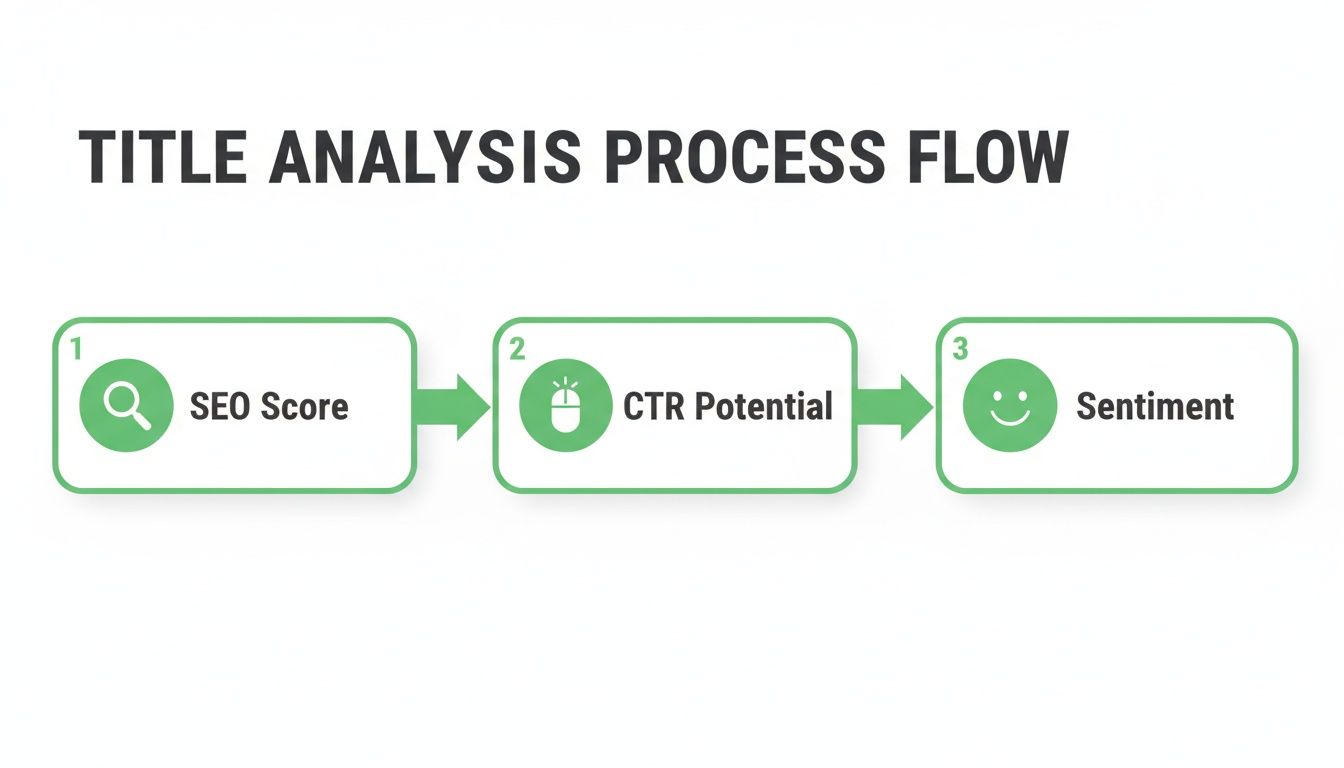
This is a great way to visualize the process. A winning title has to clear all three hurdles: it needs to be discoverable (SEO), compelling (CTR), and emotionally resonant (Sentiment) to really take off.
Making the Final Decision with Data
After running a few of these variations through a youtube title analyzer, you can lay the scores out and compare them side-by-side.
Let's say "My 3 Secrets to Baking Perfect Sourdough Bread Every Time" scores a 92/100 for SEO and an 88/100 for CTR. At the same time, "The ONLY Easy Sourdough Recipe" gets an 85 for SEO but a killer 95 for CTR.
This is where you have to make a strategic choice. Are you playing the long game for search traffic? That higher SEO score might be your best bet. Or are you trying to catch fire in the recommendation engine? In that case, the title with the sky-high CTR score is probably the way to go.
By using a tool, you're no longer just guessing. You’re turning a creative gut feeling into a calculated, data-backed decision that gives your video the best possible chance to succeed.
Proven Title Formulas That Analyzers Love

You don't need to reinvent the wheel every time you sit down to write a title. Staring at a blinking cursor is no fun. The good news is, certain title structures have proven their worth over and over again because they tap directly into what makes viewers tick.
A good YouTube title analyzer will consistently give these formulas high marks. Why? Because they nail that sweet spot between SEO-friendly keywords and genuine human curiosity. Think of these as a creative launchpad, giving you a solid structure to build from when inspiration is running low.
The Ultimate Guide or Definitive Answer
This is the "end of the road" formula. It positions your video as the last one a viewer will ever need on a topic, screaming authority and promising a complete solution. This approach is a natural fit for educational content, in-depth tutorials, or any complex subject your audience wants to master.
Analyzers love this one because it's a magnet for strong, long-tail keywords. The promise of "ultimate" or "complete" also signals massive value, which can give your predicted CTR a nice little bump.
- Example: "The Ultimate Guide to Apartment Gardening (Start to Finish)"
- Why it works: It appeals to viewers who want a one-stop-shop for information. You're saving them from having to piece together advice from a dozen different videos.
The Common Mistakes Formula
Few things grab our attention like the fear of messing up. This title formula plays on the psychological trigger of loss aversion—we are hardwired to avoid mistakes. You instantly become the expert who can help them dodge common pitfalls.
This structure is absolute gold for tutorials, product reviews, or any advice-based content. It creates a sense of urgency, making viewers feel they need to click to avoid potential failure or frustration.
Titles that highlight mistakes are incredibly effective because they tap into our universal desire to improve. A viewer sees "5 Mistakes to Avoid When Buying a Used Car," and their immediate thought is, "I need to know what those are before I go to the dealership."
Question-Based Titles
A well-phrased question is a powerful hook. It pulls the viewer in directly, forcing them to reflect on their own situation and search for the answer you're about to provide. It’s conversational and immediately engaging.
The key is to ask a question your target audience is already asking themselves. A YouTube title analyzer can help you tweak the phrasing to match what people are actually searching for, boosting your SEO without losing that curiosity-driven spark.
- Example: "Are You Making This Common Investment Mistake?"
- Example: "Is Your Gaming PC Holding You Back?"
- Why it works: This approach creates an instant personal connection. It opens a loop in the viewer's mind that they feel compelled to close by hitting "play."
Starting with one of these battle-tested formulas gives you a huge strategic advantage. You’re not just writing a title; you’re engineering a specific response. Toss these templates into an analyzer, plug in your keywords, and see how quickly you can craft a headline that makes both the algorithm and your audience happy.
Integrating Title Analysis into Your Wider SEO Strategy
Nailing a high-scoring title is a huge win, but it's a mistake to think it works in isolation. A great title only unlocks its true power when it becomes the keystone for your entire video's SEO. Think of it as the captain of the team—it sets the direction, and every other element needs to follow its lead to send a unified message to YouTube's algorithm.
This is where you build a powerful feedback loop. The primary keywords you painstakingly perfected with a title analyzer can't just sit in the title. You need to strategically echo them throughout your video’s metadata, creating a consistent signal that reinforces your topic and relevance at every turn.
Creating Algorithmic Harmony
The goal is simple: make it ridiculously easy for YouTube to know exactly what your video is about and who it's for. When your title, description, and tags are all singing from the same hymn sheet, you remove all the guesswork for the algorithm. This alignment dramatically boosts your odds of ranking in search and, more importantly, getting picked up by the recommendation engine.
Here’s how it works in practice:
- Your Title: The main keyword needs to be front and center. For example: "Easy Sourdough Recipe for Beginners".
- Your Description: The very first sentence or two should naturally weave in that exact keyword phrase.
- Your Tags: Your first and most important tag should be a direct match to that primary keyword.
- Spoken Words: Mentioning your primary keyword out loud within the first 30 seconds of the video gives the algorithm yet another powerful signal.
To really get ahead, you have to understand how title analysis fits into the bigger picture of optimizing for the YouTube platform itself.
From Title to Total Optimization
This cohesive approach turns a single optimized element into a full-blown strategy. For instance, once you’ve locked in your title, your very next move should be weaving its core ideas into your video description. Don't just stuff keywords in there. Write a genuinely helpful, human-friendly summary that happens to include them. This helps the algorithm and gives viewers a compelling reason to stick around.
A siloed approach to YouTube SEO is a recipe for missed opportunities. When your title says one thing and your tags point somewhere else, you're sending mixed signals. A truly optimized video has every element working in concert, reinforcing the same message.
This integrated method isn't just theory; it's proven to work. Channels that actively use analytics to guide their strategy report 40-60% higher view counts compared to those just publishing content on a whim.
By making title analysis the starting point of a comprehensive optimization process, you build a rock-solid foundation for every video you publish. For a step-by-step guide on how all these pieces fit together, grab our comprehensive YouTube SEO checklist and make sure you're not leaving any views on the table.
Got Questions About YouTube Title Analyzers?
Once creators start playing around with a YouTube title analyzer, a few questions almost always come up. Getting a handle on these common sticking points is the key to using these tools confidently and turning all that data into actual channel growth. Let's break down the big ones.
How Often Should I Update Old Video Titles?
This is a great question. A solid rule of thumb is to give your library a once-over every three to six months. You're looking for the hidden gems—videos with a low click-through rate that you know, deep down, are packed with quality content.
A title analyzer can be your secret weapon here, helping you spot a fresh keyword angle or a more compelling emotional hook you missed the first time around.
But, a word to the wise: don't touch the titles on your top-performing videos. You could accidentally mess with the algorithmic magic that's already working for you. A data-driven tweak can absolutely breathe new life into older, forgotten content, but you should always let your winners run.
Can a YouTube Title Analyzer Actually Guarantee More Views?
Let's be real—no single tool can ever guarantee views. At the end of the day, your content's quality is what matters most. What a title analyzer does is stack the deck in your favor, dramatically increasing your probability of success.
Think of it like this: you're swapping pure guesswork for data-backed decisions. The tool helps you zero in on what people are actually searching for and write a title that makes them want to click. It’s all about giving your awesome content the best possible shot at getting seen by the right people.
A title analyzer doesn't make your video better. It just makes sure your video's first impression is as powerful as it can possibly be. It's often the difference between a great video nobody sees and a great video that finds its audience.
Should I Prioritize a High SEO Score or a High CTR Score?
Ah, the classic dilemma. The truth is, you need a healthy balance of both. A high SEO score is what gets you found in search, while a high CTR score is what gets people to actually click when your video pops up on their homepage or in their suggestions.
The right balance really depends on your video's goal.
- For search-focused videos (like tutorials or "how-to" guides), you'll want to lean more heavily on that SEO score. Discoverability is everything.
- For entertainment-driven content (like vlogs or comedy bits), the CTR score is your king. You have to grab their attention instantly.
The absolute best titles manage to do both—they weave strong, relevant keywords into a phrase that’s just too intriguing to ignore.
Ready to stop guessing and start optimizing? TimeSkip helps you create SEO-rich video chapters in seconds, boosting your video's visibility from the inside out. Install the free Chrome extension and get two video generations on us. Discover how TimeSkip can elevate your YouTube SEO strategy today.