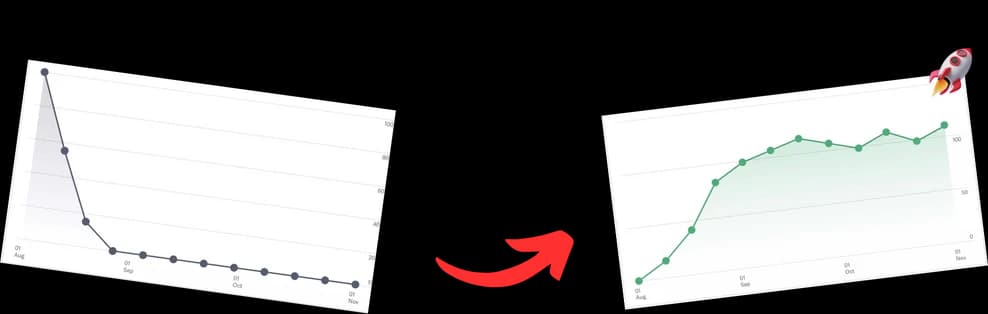
A great script for a YouTube video is the blueprint for success. It's what separates the channels that fizzle out from the ones that see consistent, explosive growth.
Without a script, you're flying blind. You might have a great idea, but it's easy to ramble, lose your train of thought, and—worst of all—bore your audience right out of the video. A solid script is your strategic foundation, making sure every single second of your video has a purpose.
Why Your Script Is the Key to YouTube Growth
Think of it this way: a good script is your best tool for telling the YouTube algorithm exactly what your video is about and why people should watch it. The algorithm pays close attention to two critical metrics, and a script directly impacts both.
- Audience Retention: A tight, well-paced script keeps people hooked. No dead air, no confusing tangents. This prevents the dreaded early drop-off that tells YouTube your video isn't delivering on its promise.
- Total Watch Time: When you structure a compelling narrative, viewers simply stick around longer. More watch time is one of the strongest signals you can send to the algorithm, leading to more visibility and recommendations.
Scripted Content Drives Engagement
That raw, off-the-cuff style can feel authentic, but it often comes at a cost. Without a plan, your message can get muddy, and viewers can tell when you're just winging it. A script shows you respect their time by delivering a clear, concise, and impactful message.
The data backs this up. Scripted content is on the rise because it consistently keeps viewers watching longer than unscripted videos.
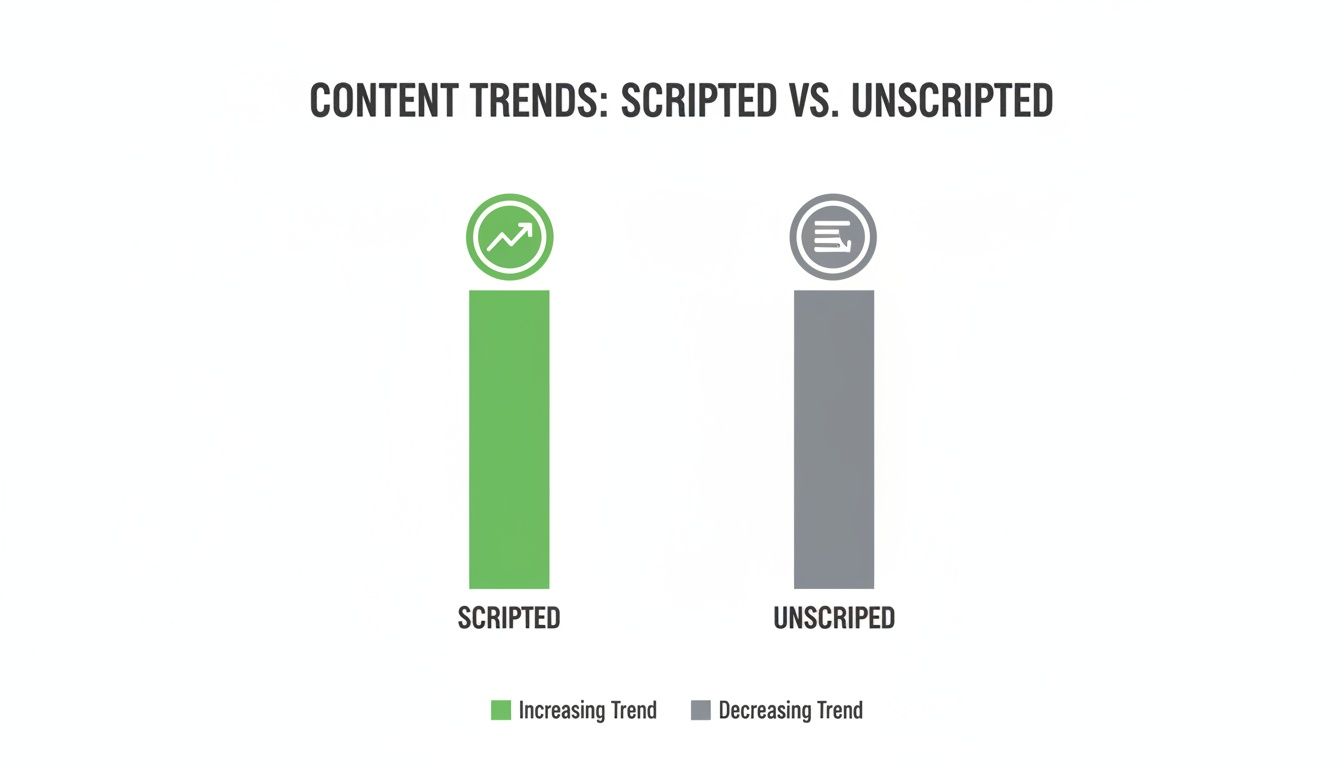
As you can see, a structured approach leads to sustained engagement, while unscripted content often struggles to hold an audience's attention.
Let's look at a quick comparison to see how this plays out in terms of performance.
Scripted vs Unscripted Video Performance Snapshot
| Metric | Scripted Video | Unscripted Video |
|---|---|---|
| Audience Retention | Consistently higher, with a flatter drop-off curve. | Sharp initial drop-off, lower overall retention. |
| Clarity of Message | Clear, concise, and easy to follow. | Often rambling, with a muddled core message. |
| Viewer Engagement | Higher likelihood of likes, comments, and shares. | Lower engagement due to viewer confusion or boredom. |
| SEO Potential | High; easy to integrate keywords and structure for chapters. | Low; keywords are incidental, not strategic. |
The difference is stark. A script doesn't just make your video better; it makes it perform better across every important metric.
Maximize Your Reach Through Scripting
Beyond just keeping viewers happy, a script unlocks a massive SEO advantage. When you intentionally plan your video in distinct sections, you're setting yourself up for video chapters—an absolute goldmine for discoverability.
A script isn’t just about what you say; it’s about designing an experience that the YouTube algorithm can understand and promote. Planning for chapters and keywords from the beginning is a non-negotiable part of modern YouTube strategy.
By thinking about your video's structure from the get-go, adding timestamps becomes incredibly easy. This isn't just a minor tweak; videos with SEO-optimized chapters can see a visibility boost of up to 220%. That's a game-changer for getting found on both YouTube and Google. If you want to see the full picture, check out these eye-opening YouTube statistics.
This simple step, planned during the scripting phase, transforms your video from a piece of content into a searchable asset that works for you long-term.
The Pre-Writing Ritual for a Winning Video
Before you ever type a single word of your script, the most important work has to happen. So many creators make the mistake of jumping straight into writing, but that’s like trying to build a house without a blueprint. The final product ends up feeling aimless and weak. This pre-writing ritual is the foundation you need for a video that actually performs.
It all starts with a simple question: What is the one thing you want a viewer to do or feel after watching?
Every truly great video has one core objective. If you try to educate, entertain, and sell a product all at once, you’ll just end up confusing your audience and watering down your message.
Define Your Video’s Core Objective
Is your goal to teach someone a very specific skill? Are you sharing a compelling story? Or are you trying to guide viewers over to your website? Nailing down this primary goal becomes your North Star, making sure every single element of your script for a youtube video serves a clear purpose.
Once you know your "why," the focus immediately shifts from what you want to say to what your audience desperately needs to hear. This means getting inside their head and understanding their actual pain points, questions, and curiosities.
Your video isn't for you; it's for them. The best scripts solve a specific problem or answer a burning question your ideal viewer is already searching for.
For example, if you're a fitness coach, your audience probably isn't just looking for generic "workout tips." They're typing things like "10-minute ab workout for beginners" or "how to fix shoulder pain from lifting" into the search bar. Getting this specific is how you find your winning video ideas. This pre-writing stage, where your script is born, is the most essential first step in the whole process. Even professional video production services will tell you that a rock-solid plan is the bedrock of a successful project.
Uncover Topics with Built-In Demand
Guessing is the enemy of growth on YouTube. You have to validate that people are actually looking for the topic you want to cover. This is where keyword research becomes your best friend.
But good keyword research is more than just grabbing popular terms; it’s about understanding search intent. Use tools like Google Trends or even just YouTube’s search bar autocomplete to see the exact phrases people are typing in. Look for the questions and problems they're trying to solve.
Here’s how you can put this into practice:
- Start broad: Think of a general topic, like "homebrewing coffee."
- Drill down: Search for something more specific on YouTube, like "how to brew pour-over coffee."
- Analyze the top videos: Look at the titles and thumbnails. Are they tutorials, reviews, or comparisons? This tells you what format is resonating for that particular topic.
- Find long-tail keywords: Along the way, you'll probably uncover gems like "best grind size for V60" or "pour-over coffee mistakes." These are golden opportunities for creating focused, high-value content.
This research phase is a non-negotiable part of any serious YouTube video production workflow. It ensures you’re not just shouting into the void about topics nobody cares about. By building your script on a foundation of a clear goal, deep audience understanding, and data-backed keywords, you’re not just hoping for success—you’re engineering it.
Anatomy of a Script That Hooks and Holds Viewers
Every great video you've ever watched follows a surprisingly simple, powerful structure. It’s not magic; it’s a deliberate formula designed to grab attention and, more importantly, keep it. A solid script for a youtube video is really built on four core pillars that walk the viewer from their first click to the final second.
This structure just works. Why? Because it respects the viewer's time. It makes a promise upfront, delivers on that promise, and then gives them a clear next step.
The Critical First Ten Seconds: The Hook
You’ve got about ten seconds. That’s it. That’s your window to convince someone to stick around.
Your hook isn't just an introduction; it’s a direct pitch for your viewer's most valuable asset: their attention. A weak hook is the number one reason for a massive drop-off rate, so nailing this part is everything.
For instance, a tutorial could kick off with a dramatic "before and after" shot. A vlog might open with a shocking or hilarious moment that actually happens later in the video, creating an open loop that viewers just have to see closed.
Here are a few hook techniques that flat-out work:
- Ask a Provocative Question: Start with a question that's already bouncing around in your viewer's head. Something like, "Are you sick of your videos getting zero views?"
- State a Bold Claim: Make a confident statement that sparks immediate curiosity. For example, "This one tiny tweak to my script doubled my audience retention overnight."
- Tease the End Result: Show the finished product or the final outcome right at the start. This is a killer move for any DIY, cooking, or transformation video.
The hook has one job and one job only: get them to watch the next thirty seconds.
The Introduction: Setting Expectations
Okay, you've got their attention. Now the intro sets the stage. This is where you quickly and clearly tell them what the video is about and what they'll get out of watching it. No long, rambling stories about yourself—get straight to the value.
A great intro builds trust. For example, in a video titled "5 Beginner Camera Mistakes," the intro should be something like, "In the next ten minutes, I'm going to show you the five most common mistakes new photographers make and exactly how to fix them. By the end, you'll be taking better photos today."
Your introduction has to answer the viewer’s unspoken question: “Is this video worth my time?” Be direct, be clear, and establish your authority on the topic immediately.
This is a make-or-break moment for engagement. If viewers feel confident you're going to deliver on your title's promise, they’re way more likely to stay. Honestly, improving this section alone can do wonders for your numbers. To really go deep on this, check out our guide on improving your YouTube audience retention.
The Body: Delivering on Your Promise
Now for the main course. The body is where you deliver the core information, the story, or the entertainment you promised. The secret to a killer body section isn't just about what you say, but how you say it. It’s all about organization and pacing.
Don't just dump a list of facts on your audience. Guide them on a journey from one point to the next.
For a tutorial, that might mean breaking a complex process into simple, bite-sized steps. For a vlog, it's about structuring your story with a clear beginning, middle, and end to keep the momentum going. Always use smooth transitions to connect different ideas or segments so the video flows naturally.
The CTA and Outro: Guiding the Next Step
Finally, the call to action (CTA) and outro tell your audience exactly what you want them to do next. Don't be timid here. If you want them to subscribe, ask them to subscribe and give them a reason why (e.g., "for more videos just like this one").
Keep your outro brief and to the point. Thank the viewer for watching and hit them with your CTA one more time. Try to avoid those long, drawn-out end screens that just encourage people to click away before the video is even over. Often, a simple "Thanks for watching, and I'll see you in the next one" is all you need.
Writing a Script That Actually Sounds Human
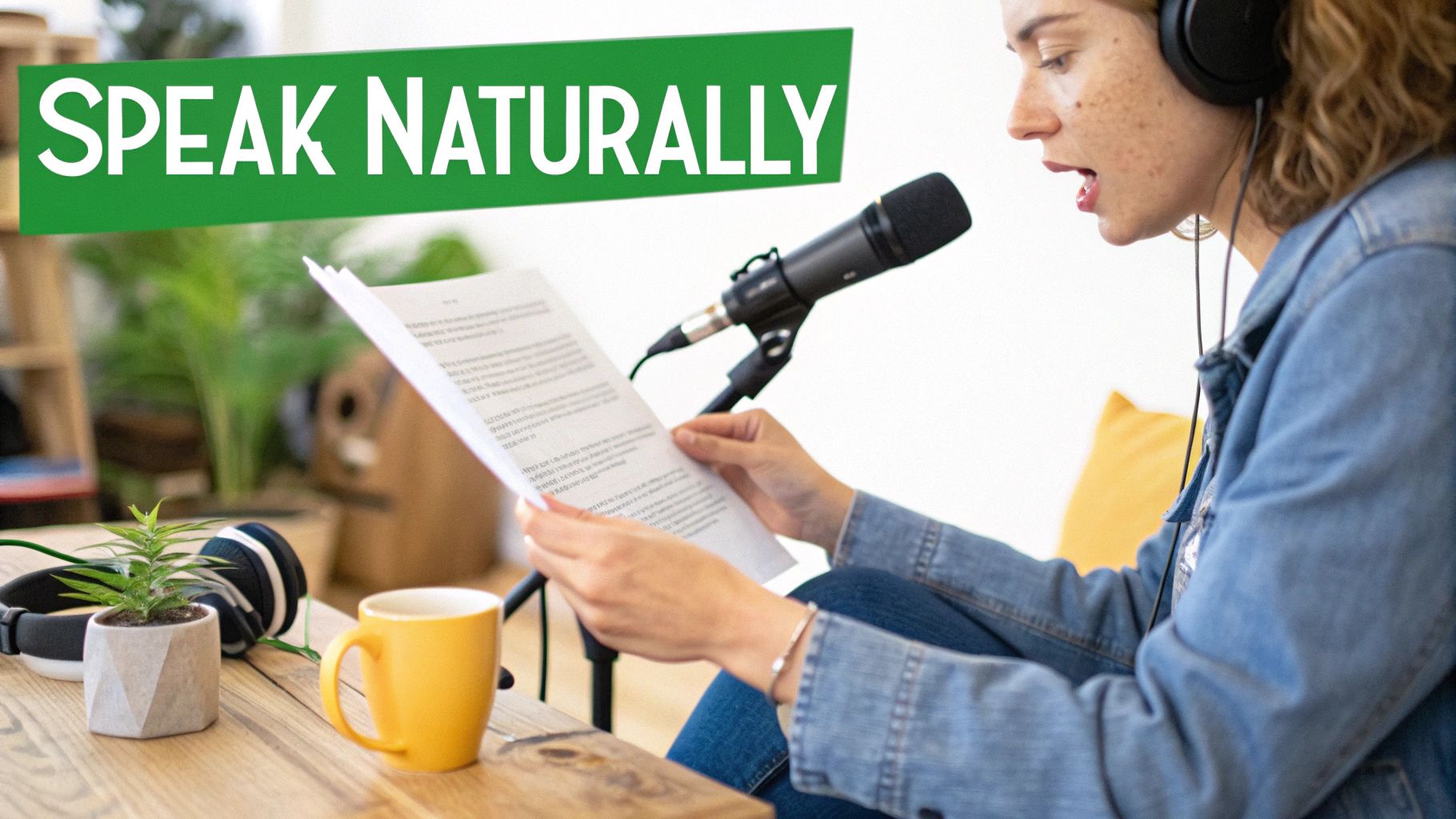
Here’s the biggest mistake I see new creators make: they write an essay. But a script for a YouTube video isn't meant to be read on a page; it's meant to be spoken out loud. This one tiny shift changes absolutely everything.
Your goal is to sound like the expert friend, the one people come to for great advice, not a professor giving a lecture. To nail that vibe, you have to toss out your formal writing habits and embrace a more conversational tone.
Ditch the Formalities
Think about how you talk to your friends. You use contractions like "don't" instead of "do not" and "you're" instead of "you are." These simple swaps instantly make your delivery feel more natural and less like you're reading from a teleprompter.
Keep your sentences short. Punchy. Easy to follow. Long, winding sentences with a bunch of clauses might look smart in a report, but they’re a nightmare to say naturally on camera. If you can’t say a thought in one breath, it’s too complicated.
For example, instead of writing this:
"In order to successfully execute this particular technique, it is imperative that you first ensure all preliminary steps have been completed correctly."
Just say this:
"To get this right, you have to nail the first few steps. It's that simple."
See the difference? The second one is direct, clear, and sounds like something a real person would actually say.
Find Your Authentic Voice
Your personality is your superpower on YouTube. Don't lose it by trying to sound like someone else. Write in your own voice, using the words and phrases you’d use in a normal, everyday conversation.
Got a dry sense of humor? Let it shine. Are you a total geek about a certain detail? Let that passion come through in your word choice. Authenticity is what builds a real connection with your viewers—something that stiff, formal writing just can't do. To make sure your script really hits the mark, think about the core principles in the E-E-A-T Manifesto for Content Creators.
Here are a few quick tips to make your script sound more like you:
- Read It Out Loud: This is non-negotiable. If a sentence feels clunky or awkward when you say it, rewrite it. This one trick will catch 90% of your weird phrasing before you ever hit record.
- Tell a Personal Story: Share a quick, relevant anecdote. Talking about your own wins (or fails!) with the topic adds a layer of relatability and proves you’re not just pulling facts from thin air.
- Use Simple Language: Ditch the jargon. Unless it’s absolutely necessary for your niche, avoid overly technical terms. Your job is to make complex topics feel simple and accessible, even for a total beginner.
Your audience chose to watch a video, not read a textbook. When you craft a script that feels like a genuine conversation, you're respecting their choice and creating content people will actually enjoy watching.
Weaving SEO Directly into Your Script
Let's be real: a brilliant script is only half the job. If your audience can't find your video, all that hard work might as well be for nothing. That’s why you need to start thinking like an SEO pro while you're writing.
Effective video SEO goes way beyond just jamming your main keyword into the title. It's about weaving your target phrases into the actual dialogue. When YouTube's algorithm listens to and transcribes your video, it checks what you say against your title and metadata. A perfect match sends a massive signal of relevance, pushing you up in the search results.
Think in Chapters, Not Just Paragraphs
One of the most potent SEO tools you have is YouTube chapters. These little timestamps do more than just improve the viewer experience—they act as mini-headlines that both YouTube and Google can index separately.
So, instead of writing one long, continuous script, start outlining your video in logical sections. Each section becomes a potential chapter. This forces you to structure your content with real clarity, making it a breeze for viewers to skip around and for search engines to understand what each part is about.
For instance, a script for a youtube video about "Beginner Photography Tips" could easily be broken down into these chapter-friendly sections:
- Understanding the Exposure Triangle
- Choosing the Right Lens
- Simple Composition Rules to Follow
- Editing Your First Photo
When you build your script around clear, keyword-rich segments like these, generating optimized timestamps after you've filmed is practically effortless.
How to Integrate Keywords Naturally
Your mission is to sprinkle your primary and secondary keywords throughout your dialogue so it sounds completely natural. You never want to sound like a robot stuck on repeat.
The trick is conversational integration. Let's say your main keyword is "cold brew coffee recipe."
- Good: "Today, I’m showing you my favorite foolproof cold brew coffee recipe."
- Bad: "This cold brew coffee recipe is the best cold brew coffee recipe you'll find."
Think of your script as the perfect opportunity to answer the specific questions your audience is typing into the search bar. When you frame it like that, you'll find your keywords just flow into the conversation.
A well-planned script lets you hit all your important search terms without sacrificing that human, conversational tone you're aiming for. For a much deeper dive, our guide on how to find the best keywords on YouTube covers advanced strategies that can give you a serious leg up.
Turn Your Script into a Powerful SEO Asset
Beyond YouTube itself, your script can be a powerhouse for driving traffic straight from Google. Once your video is live, publish the polished script as a blog post on your website and embed the video right at the top.
This simple act of repurposing your content creates a brand-new, indexable asset that can rank for keywords your video might miss. It effectively doubles your chances of being discovered. Some people prefer reading, others prefer watching—by serving both, you create multiple paths back to your content and compound your reach over time. Your script isn't just dialogue; it's a versatile SEO tool waiting to be deployed.
Frequently Asked Questions About YouTube Scripting
Once you start scripting, you'll find that a lot of questions pop up. That's totally normal. Getting a handle on these common hurdles is the key to creating a workflow that's both efficient and effective for your channel.
Let's tackle some of the most common questions creators have when they first put pen to paper (or fingers to keyboard) for a script for a youtube video.
How Long Should My Video Script Be?
There’s no single magic number here, but a great rule of thumb is to aim for about 150 words per minute of video you plan to create. So, if you're shooting for a 10-minute video, you'd want a script that's around 1500 words long.
But treat that as a starting point, not a hard-and-fast rule. Your own speaking pace is what really matters. If you’re filming a dense, technical tutorial, you might speak more slowly and deliberately. On the other hand, a fast-paced news breakdown could easily push you closer to 180 words per minute.
The best way to figure this out is to test it yourself. Grab a 150-word chunk from one of your scripts and time how long it takes to read it out loud at a natural, comfortable pace. That gives you a personal words-per-minute metric you can use to plan future scripts with much more accuracy.
Should I Write a Full Script or Just Use Bullet Points?
This really boils down to your personal style and how comfortable you are on camera. Both methods have their own strengths, and what works for one creator might not work for another.
-
Full Word-for-Word Script: This is an absolute lifesaver when you're just starting out or if your video is packed with complex data and specific details. It guarantees you won't miss a single crucial point, helps you cut out the rambling, and gives you total control over the video's timing. It's the safest way to deliver a sharp, polished message.
-
Detailed Bullet Points: If you're a bit more seasoned or you're creating something like a vlog, a bullet-point outline can feel much more spontaneous and authentic. It gives you structure without making you sound like you're reading from a teleprompter, which leaves more room for your personality to shine through.
A lot of top-tier creators actually land somewhere in the middle. They'll write a full script for the really important parts—the hook, the intro, and the final call to action—but switch to detailed bullet points for the main body. This hybrid approach offers the best of both worlds: a rock-solid structure with a conversational, flexible delivery.
How Do I Make My Script Sound Less Robotic?
The trick is to write for the ear, not for the eye. You have to write like you actually speak.
A great place to start is using contractions everywhere. Write "it's," "you're," and "can't" instead of the more formal "it is," "you are," and "cannot." Keep your sentences short and to the point. If you find yourself running out of breath trying to say a sentence out loud, it's too long. Chop it up.
Honestly, the single most powerful technique is to read every line out loud as you write it. If a phrase feels clunky or weird coming out of your mouth, it's going to sound ten times weirder on camera. Don't be afraid to add little performance notes directly in your script, like [pause for a beat] or [really emphasize this], to guide yourself during filming.
Ready to take your script's SEO power to the next level? With TimeSkip, you can automatically generate perfectly optimized chapters and timestamps in just a few seconds. Stop the guesswork and start getting your videos ranked. Try it for free and see just how easy it is to boost your visibility and watch time. Get started at https://timeskip.io.