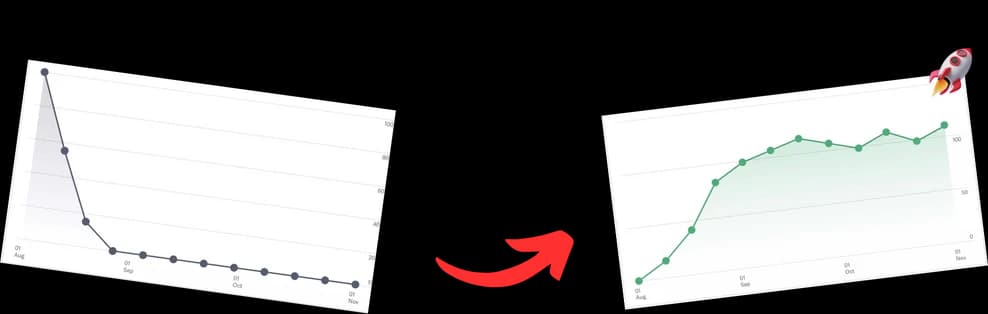
To really wrap your head around any YouTube algorithm change, you’ve got to rewind the clock. Back in the early days, the formula for success was dead simple: more clicks meant more visibility. That was it. This created a kind of "wild west" where the loudest, most provocative thumbnails and titles won, pushing content quality to the back seat. The main goal was just to get someone—anyone—to click.
From Clicks to Clocks: The First Big Shift

Think of it like a restaurant owner who only tracks how many people walk through the door. It wouldn't matter if they took one bite and sprinted out; a "visit" was a "visit." That's exactly how early YouTube worked. A view was just a click, whether the person watched for two seconds or the full twenty minutes.
This model was fundamentally broken. It rewarded misleading content—what we all know and hate as "clickbait"—that promised the world and delivered next to nothing. Viewers got frustrated, and YouTube quickly realized this approach was a dead end. You can't build a loyal audience or attract serious advertisers on a platform built on flimsy, low-quality interactions. The system had to grow up.
The Dawn of Watch Time
The real turning point came when YouTube started asking a smarter question. Instead of "How many people clicked?" they asked, "How long did they actually stick around?" This pivot from clicks to clocks was the first major evolution of the recommendation engine we know today.
Way back in 2012, YouTube rolled out one of its most important updates ever, shifting its focus from raw view counts to watch time. Before this, videos were ranked almost entirely by clicks, which led to that flood of deceptive content. By prioritizing how long people were truly engaged, YouTube finally started rewarding quality and substance over flashy tricks.
This one change sent a massive shockwave through the creator community.
The new focus on retention fundamentally re-wrote the definition of a "successful" video. It was no longer about snagging the initial click; it was about holding a viewer's attention for the entire journey.
This had an immediate ripple effect, boosting certain kinds of content while burying others. All of a sudden, a 10-second clip with a million views but terrible retention was less valuable than a 15-minute tutorial with fewer views but kept people glued to their screens.
Who Won and Who Lost
This shift was a total game-changer for certain niches. Creators making longer, more immersive videos suddenly found the algorithm working for them, not against them. The biggest winners were:
- Gaming Channels: Those long "Let's Play" videos and detailed walkthroughs became algorithm gold. Viewers would settle in for hours, racking up incredible amounts of watch time and signaling to YouTube that this was the good stuff.
- Educational and Tutorial Creators: How-to guides, DIY projects, and deep-dive explainers are naturally built for retention. If someone genuinely wants to learn how to fix a leaky faucet, they’re probably going to watch the whole video. You can learn more about how to boost viewer retention in our detailed article.
- Vloggers and Storytellers: Channels that built a compelling narrative and a real connection with their audience thrived. Viewers who were invested in a creator's story were far more likely to watch entire videos, one after another.
On the flip side, creators who depended on short, shocking, or misleading clips saw their channels nosedive. The age of pure clickbait was over, and the era of meaningful engagement had officially begun. This foundational change set the stage for the complex, satisfaction-driven algorithm we have now, influencing every single update that followed.
Why Viewer Satisfaction Became The New Goal
The shift to pure watch time was a massive improvement, but it wasn't the final stop. While it did a great job pushing out the worst of the low-effort clickbait, it accidentally created a new, sneakier problem: the algorithm started rewarding long videos, even if viewers weren't actually enjoying them.
The next logical move was for the algorithm to get smarter—to think more like a human.
So, YouTube started asking a much better question: "Are people leaving this video feeling satisfied?" It's like a TV network suddenly realizing that just counting eyeballs isn't enough. They needed to know if people were actually buzzing about the show, talking about it online, and telling their friends to watch.
Raw viewing minutes just weren't cutting it anymore. The algorithm needed proof that the time spent was actually time well spent. This was the moment viewer satisfaction took over as the main goal.
How YouTube Decodes Viewer Enjoyment
Okay, but how do you measure something as fuzzy and subjective as "satisfaction"? You can't just ask the algorithm how it feels. Instead, YouTube started tracking a new batch of engagement signals that went way beyond just keeping someone on the page.
These signals hinted at a real emotional response and a genuine connection to the content. The algorithm began to seriously weigh actions like:
- Likes and Dislikes: The most direct up-or-down vote on a video's quality.
- Shares: This is a huge one. When someone shares a video, they're putting their own reputation on the line to recommend it. It's one of the strongest satisfaction signals you can get.
- Comments: A lively discussion in the comments shows that a video didn't just get watched; it got people talking and built a sense of community.
- "Not Interested" Feedback: This is the other side of the coin. When a user tells YouTube they're not interested, it's a powerful negative signal that helps the algorithm stop showing the wrong videos to the wrong people.
This change meant that a bloated 30-minute video with lukewarm engagement could now get completely outranked by a punchy 10-minute video that racked up tons of shares, likes, and fired-up comments. Quality, not just quantity, was finally getting the spotlight it deserved.
Let's look at how this rebalanced the scales for creators.
How YouTube Measures Success Before vs After The Satisfaction Shift
This table breaks down the fundamental change in what the algorithm valued. You can see a clear move from passive consumption to active, positive engagement.
| Metric Focus | Primary Signal (Pre-Shift) | Primary Signal (Post-Shift) | Impact on Creators |
|---|---|---|---|
| Viewer Behavior | Total Watch Time (Minutes) | Likes, Shares, Comments, Survey Responses | Prioritizes videos that spark conversation and positive feedback. |
| Content Quality | Video Length | Viewer Retention & Engagement Rate | Favors content that holds attention and generates interaction, not just long videos. |
| Audience Feedback | Implicit (View Duration) | Explicit (Likes, Shares, "Not Interested") | Gives direct viewer feedback more weight in recommendations. |
| Discovery Goal | Keep users on the platform | Keep users on the platform and happy | Rewards creators who build genuine communities, not just those who game watch time. |
This shift was a game-changer. It forced creators to think less about how to keep someone watching and more about how to make them feel good about having watched.
The Crackdown On "Borderline Content"
This new focus on satisfaction handed YouTube a powerful new weapon for cleaning up the platform. The algorithm could now spot and demote content that, while not technically breaking any rules, still left viewers with a bad taste in their mouths. This was the start of the "borderline content" crackdown.
Things really kicked into high gear in early 2019, when a major algorithm update specifically took aim at this gray-area content. By prioritizing positive satisfaction signals, the system slashed views on these problematic videos by a staggering 70%. Creators who relied on shock tactics or misleading thumbnails saw their channels nosedive as the algorithm learned to spot genuine, positive engagement. You can read more about how this shift impacted creators in this detailed overview of the YouTube algorithm from Hootsuite.
The algorithm learned that viewer satisfaction is about more than just what people watch; it’s about how they feel after watching. This change directly rewards creators who build authentic communities and penalizes those who chase hollow metrics.
This is exactly why understanding your audience is so important now. The best way to figure out what your viewers want is to dive into your channel's data. If you're not sure where to start, our guide on how YouTube analytics works will get you up to speed.
Ultimately, this move rewarded authenticity and community-building above everything else. Channels that fostered real connections and made content that people genuinely loved were now the ones being pushed into the spotlight. The message from YouTube was crystal clear: make content that leaves your viewers happy, and the algorithm will take care of the rest.
Navigating The Modern Multi-Format Algorithm
Welcome to the new YouTube. If you're still thinking in terms of a single, all-powerful "algorithm," it's time for a reset. The platform today is less like one big machine and more like a collection of different neighborhoods, each with its own culture and rules. What makes a video go viral in the Shorts feed could be the very thing that tanks your long-form content.
I like to think of a channel as a restaurant. Your long-form videos are the fine dining menu—meant for viewers who want to sit down, take their time, and really dig into a complex topic. Shorts are your food truck window, slinging quick, addictive bites to a crowd that's always on the move. And live streams? That's the exclusive chef's table, creating a real-time, community-focused event. Each one serves a totally different appetite and is judged by a different set of standards.
This is why a Short that explodes with millions of views doesn't automatically send viewers flocking to your 20-minute deep-dives. The algorithms are separate. Success in one format doesn't just grant you a free pass in another. You have to treat them like different platforms that just happen to share the same address.
The Rise Of AI And Hyper-Personalization
Powering this multi-format world is an incredibly sophisticated AI that's personalizing feeds like never before. It's no longer just looking at one video at a time; it's sizing up your entire channel's health and how it connects with specific pockets of the audience. The system is building a complex profile on every single viewer, sorting them into "watch history clusters" to predict what they’ll want to see next with spooky accuracy.
Because of this, the algorithm now cares about more abstract concepts to figure out your channel's long-term value. The metrics that really move the needle today are:
- Session Depth: How many of your videos does a viewer watch in one sitting? This is a massive signal to YouTube that your channel is great at keeping people around.
- New-Viewer Attraction: Are you bringing fresh faces to the platform? For YouTube's own growth, this is pure gold.
- Format Consistency: Do you consistently deliver on the promise of each format? A channel that absolutely nails one format is seen as more valuable than one that's just mediocre at three.
In this new era, consistency is king—far more valuable than a one-off viral hit. The algorithm is looking to reward channels that can be counted on to satisfy a specific audience, time and time again.
This simple flowchart breaks down the core loop of how YouTube now thinks about viewer behavior.

As you can see, solid watch time is the fuel for viewer satisfaction. That satisfaction is what drives the engagement signals—likes, comments, shares—that the algorithm is constantly hunting for.
Adapting To The Multi-Format Reality
To win now, you absolutely must optimize for each format on its own terms. The frenetic, high-energy world of Shorts demands a completely different creative muscle than the slow-burn storytelling of long-form video. This separation really kicked into high gear around the 2024-2026 period, with Shorts views skyrocketing to over 70 billion daily and viewer satisfaction surveys starting to carry more weight than raw watch time in some cases.
This means your content strategy has to be flexible. Knowing how to cut clips from YouTube videos has become a crucial skill, allowing you to repurpose your best long-form moments into killer Shorts that can act as a bridge between your audiences.
If you're looking for inspiration, our guide on fresh ideas for YouTube Shorts is a great place to start. By building out distinct—but connected—strategies for each format, you're not just making content; you're aligning your entire channel with how YouTube actually works today.
Actionable Strategies To Thrive Today
Knowing the why behind a YouTube algorithm change is one thing. Turning that knowledge into actual, measurable channel growth is something else entirely. This is where we stop analyzing and start acting. To really succeed right now, you need to align every part of your content with what the algorithm wants: satisfied viewers who stick around.
It all begins before anyone even clicks play. Your title and thumbnail aren't just fancy packaging; they're a promise. The algorithm loves videos that deliver on that promise, something we call click-through rate (CTR) satisfaction. A high CTR with terrible retention is a massive red flag to YouTube, telling it your packaging was just clickbait.
Master Your First Impression
Your goal is to spark curiosity, not cause confusion. Your title needs to be packed with the right keywords, but it has to read like a human wrote it. It should tell the viewer exactly what they’ll get out of watching—solving a problem, answering a burning question, or satisfying an interest.
The thumbnail then needs to back this up visually. Think high-contrast images, a clear focal point, and expressive faces (they work wonders). Avoid cramming it with text; a few strong words that support the title are far more powerful.
Here’s a quick framework for creating killer combos:
- Problem and Solution: The title highlights a common pain point (e.g., "Why Your Houseplants Keep Dying"), and the thumbnail shows a lush, happy plant.
- Question and Answer: The title asks something intriguing (e.g., "Is This the Fastest Way to Edit Videos?"), and the thumbnail teases the incredible result.
- Before and After: A timeless storytelling trick that screams value and transformation at a single glance.
Getting this title-and-thumbnail synergy right is the first—and most important—step to making both your viewers and the algorithm happy.
Engineer Engagement From The Ground Up
Meaningful engagement—the kind that signals real viewer satisfaction—doesn't just happen. You have to bake opportunities for it right into your video's DNA. Simply asking "What do you think? Let me know in the comments!" at the very end is old news.
Instead, sprinkle engagement prompts throughout your content. Pose a thought-provoking question right after your hook. Ask viewers to share their own experiences related to a point you just made. This creates a genuine conversation, not just a one-way broadcast.
Your goal should be to create content so valuable that sharing it makes your viewers look smart, helpful, or entertaining to their own social circles. Shares are one of the most powerful endorsements you can receive.
To truly build a sustainable strategy, you need a solid grasp of the importance of video content marketing as a whole. It's the foundation for everything you do on a platform like YouTube.
Structure Your Content for Maximum Retention
Once you've earned that click, the real work begins. Your video's structure is everything when it comes to holding attention and racking up watch time. Every great long-form video, even a simple how-to, follows a proven narrative path.
Use this blueprint to keep your viewers glued to the screen:
- The Hook (First 15-30 seconds): Get straight to the point. Tell them the value of the video immediately. Tease the best part, present a juicy problem, or show a sneak peek of the final result so they know they're in the right place.
- The Build-Up (The Core Content): Deliver your main points in a logical, easy-to-digest sequence. Use plenty of visual aids, on-screen text, and pattern interrupts (like a quick camera angle change or some B-roll) to keep their eyes from glazing over.
- The Payoff (Conclusion): This is where you make good on the promise from your hook. Summarize the key takeaways and give them a clear, satisfying wrap-up. Don't leave them hanging.
- The Next Step (Call to Action): Tell them what to do next. This is the perfect spot to point them to another one of your videos on a related topic, which helps build that "session depth" the algorithm absolutely loves.
When you treat every video as a complete experience with a clear beginning, middle, and end, you're aligning your content perfectly with the algorithm's mission. This isn't just about making videos; it's about building a reliable channel that the system is practically forced to promote.
How To Improve Retention With Video Chapters

For anyone creating long-form content, viewer drop-off is the silent killer of channel growth. You can spend hours crafting the perfect hook and delivering incredible value, but holding someone's attention through a 20, 30, or even 60-minute video is a huge ask.
This is where video chapters change the game entirely. They're more than just timestamps; they're a direct line of communication to both your audience and the YouTube algorithm, serving as a powerful tool to improve both the viewing experience and your video's discoverability.
Giving Viewers Control
Imagine a viewer searching for a specific software tutorial. They click on your comprehensive 45-minute guide. Without chapters, they’re left to scrub randomly through the timeline, getting frustrated and probably clicking away within the first minute. That’s a negative signal to the algorithm—a failed viewing session.
Now, picture that same video with chapters. The viewer instantly sees a menu of topics: "Installation," "Setting Up Your First Project," "Advanced Tips." They can jump right to the part they need, get their answer, and leave satisfied.
This simple change flips a potential bounce into a successful interaction. You've just told the algorithm that your content is user-friendly and valuable, which is exactly what YouTube wants to promote.
By letting people navigate to the most relevant parts, you're not losing watch time; you're gaining qualified watch time. A viewer who watches a crucial 5-minute chapter is far more valuable than one who bounces after 30 seconds of confused scrubbing.
Chapters as an SEO Superpower
The benefits don't stop with the viewer experience. Chapters are a massive asset for your video's SEO. Every chapter title you create acts like a keyword-rich signpost, giving Google and YouTube a much deeper understanding of what your video covers.
This has a direct impact on how your content shows up in search. Well-crafted chapters can unlock some serious advantages:
- Google Search Rankings: Your video can appear in search results with "Key Moments," letting users jump straight from Google to a specific chapter in your video.
- YouTube Search Visibility: Chapter titles are indexed by YouTube's search engine, which means your video can rank for a much wider range of specific, long-tail search queries.
- Increased Click-Through Rate: When a user sees your video is neatly organized and directly answers their question, they're far more likely to click on it over a competitor's.
This extra layer of optimization is a must for long-form content, which can often touch on dozens of sub-topics. Without chapters, all those valuable segments stay hidden from search engines.
Automating The Process for Maximum Efficiency
The only real downside to chapters has always been the time it takes to create them. Manually re-watching a long video, pinpointing key moments, and then writing descriptive, keyword-optimized titles is a tedious task that most busy creators just can't fit in.
This is where automated solutions become a lifesaver. Tools like TimeSkip.ai can generate SEO-optimized chapters with a single click, analyzing your video and producing a full set of chapters you can copy directly into your description.
This eliminates hours of manual work, making a best-practice SEO strategy accessible to everyone. By pairing AI-powered analysis with smart keyword suggestions, it ensures every chapter is working to boost your visibility and retention. It's a simple addition that can lead to a significant boost in organic reach and total watch time—a critical tactic for adapting to any YouTube algorithm change.
Got Questions About the YouTube Algorithm? We've Got Answers.
Anytime YouTube tweaks its algorithm, the creator community lights up with rumors and half-truths. It’s like trying to navigate a new city with an old, crumpled map—frustrating and easy to get lost. So, let's cut through the noise and tackle some of the most persistent questions creators have about how this whole thing actually works.
I want to give you direct, no-fluff answers here. Think of this as your field guide for separating fact from fiction so you can get back to making smart, confident content decisions.
How Often Does The Algorithm Change?
This is the million-dollar question, isn't it? The answer is both incredibly simple and maddeningly complex: constantly.
YouTube's "algorithm" isn't a single entity. It's a massive, interconnected network of machine-learning systems that are always being refined. While the big, press-release-worthy shifts only happen every few years, tiny, invisible adjustments are being made every single day.
It's less like a giant software update you have to install and more like a river. The river's ultimate destination (viewer satisfaction) never changes, but the currents, eddies, and flow are constantly shifting based on new data. Trying to chase every single ripple is a surefire way to burn out. Instead, just focus on the fundamentals we've been talking about: viewer satisfaction, retention, and making content that's a perfect fit for its format.
Should I Delete Videos That Bombed?
The short answer is a hard no. Seriously, don't do it.
Deleting a video with low views won't magically give your channel a boost. All you're really doing is throwing away valuable data that both you and the algorithm can learn from. A video that underperforms today could still find its perfect audience months or even years from now. It happens all the time.
A "failed" video isn't a penalty; it's a data point. It tells you what your audience didn't resonate with, which is just as valuable as knowing what they absolutely love.
Every single video, no matter its view count, adds to YouTube's understanding of your channel's niche and who you're trying to reach. The only time you should ever even think about deleting a video is if it contains dangerously outdated information or breaks YouTube's rules. Otherwise, just let it be.
Do Subscribers Still Matter?
Yes, absolutely. But their role in the ecosystem has definitely changed. Back in the day, your sub count was the ultimate vanity metric. Now, it's more about building a reliable core audience—a test group, really—that the algorithm can lean on when you publish something new.
Your most dedicated subscribers, the ones with the notification bell smashed, are usually the first people to see your new uploads. Their initial behavior—how long they watch, whether they like or comment—sends a massive early signal to the algorithm about your video's quality.
Here’s why they’re still a huge asset:
- The Launch Crew: Subscribers give you that first wave of views, which helps the algorithm decide if your video has what it takes to be shown to a wider, non-subscribed audience.
- Community Core: They are the lifeblood of your comments section, sparking conversations that signal healthy engagement.
- Your Best Feedback: This group is your most honest and direct source for feedback on what's working and what's not.
So while subs are no longer the only thing that matters for discovery, a healthy, engaged subscriber base is a critical advantage for long-term growth. They're the engine that gets your content off the starting line.
Why Did My Views Suddenly Drop?
It's a scary feeling, I know. But a sudden dip in views is rarely a sign that the algorithm has a personal vendetta against you. More often than not, it's tied to external factors or subtle platform-wide shifts. For example, some creators have noticed view discrepancies connected to YouTube's ongoing battle with ad-blocking software.
Other times, it's just the natural ebb and flow of audience interest. Maybe your last video was on a massive trending topic that blew up, setting an impossibly high bar for your next one. The key is not to panic and tear up your entire strategy based on one or two videos. Look for patterns over weeks, not days, and always, always go back to your analytics to get the real story.
Ready to stop guessing and start optimizing? TimeSkip generates SEO-friendly chapters for your videos in seconds, helping you boost retention and rank higher in search. Try TimeSkip for free and see the difference it makes.