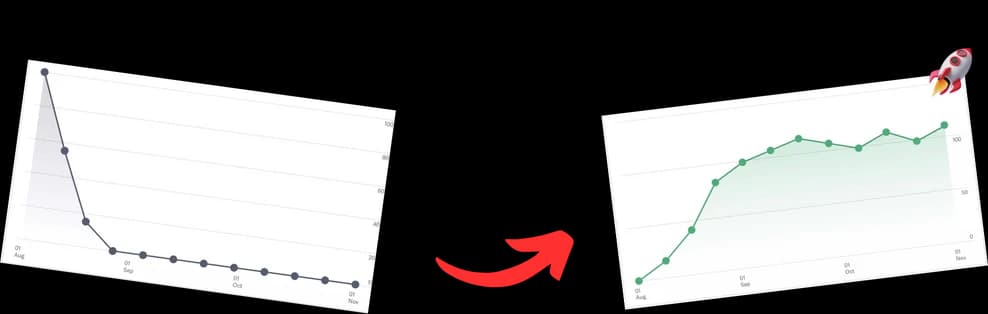
A real, lasting youtube watch time increase doesn't come from chasing viral hits or fleeting view counts. It’s built on a solid foundation of three things: engineering content that actually holds attention, diving deep into your retention data, and promoting your videos in a way that encourages people to stick around.
The goal isn't just to get clicks; it's to create a library of content that the YouTube algorithm falls in love with and can't stop recommending.
Why Watch Time Is Your Most Valuable Metric
It’s easy to get caught up in vanity metrics. Seeing your subscriber count tick up or a video hit a certain number of views feels good, but those numbers don't paint the full picture of your channel's health. The one metric that truly moves the needle for the YouTube algorithm—and your channel's long-term growth—is watch time.
This isn't about how many people start your video; it’s about how long they stay glued to the screen.
Think of the YouTube algorithm as an engine that runs on audience satisfaction. When someone watches a big chunk of your video, it sends a crystal-clear signal: this content is valuable. The algorithm sees this as a positive user experience and, in turn, is far more likely to push that video out to a wider audience on the homepage, in suggested videos, and even in search results.
"Our algorithm doesn’t pay attention to videos; it pays attention to viewers. So, rather than trying to make videos that’ll make an algorithm happy, focus on making videos that make your viewers happy." - YouTube
Before we get into the nitty-gritty of how to increase watch time, let's set the stage with a quick overview of the core strategies we'll be covering. Think of these as the fundamental pillars for building a high-retention channel.
Key Pillars for Increasing YouTube Watch Time
| Strategy Pillar | Primary Goal | Key Action |
|---|---|---|
| Content Engineering | Create videos that are inherently engaging from start to finish. | Optimize intros, mid-roll pacing, and outros to keep viewers hooked. |
| Audience Retention Analysis | Understand precisely where and why viewers are dropping off. | Dive into YouTube Analytics to identify patterns and fix retention dips. |
| Strategic Promotion | Encourage longer, multi-video viewing sessions across your channel. | Design smart playlists and use promotional tools to guide viewers. |
| Discovery Optimization | Attract the right viewers who are more likely to watch longer. | Craft compelling thumbnails/titles and use SEO-optimized chapters. |
Each of these pillars works together to create a powerful growth loop. By focusing on them, you're not just making a single video better; you're building a system that consistently delivers value and keeps people watching.
The Shift to Mobile-First Viewing
This laser focus on watch time is even more critical when you consider how people watch videos today. The rise of mobile has completely changed the game. As of early 2025, mobile devices aren't just part of the YouTube ecosystem—they are the ecosystem.
An incredible 90% of YouTube's global visits now come from mobile. This has led to more frequent, on-the-go viewing sessions, with a staggering 63% of global watch time now happening on phones and tablets. You can learn more about how these YouTube trends impact content strategy. This mobile-first reality means you have to create content that grabs viewers instantly, no matter where they are.
The Foundation for Sustainable Growth
When you make increasing watch time your north star, it has a direct, positive impact on every other aspect of your channel's success. It’s the engine that powers visibility, monetization, and your community.
- Algorithmic Favor: Longer viewing sessions are the clearest signal you can send that your content is high-quality. This leads to more impressions and organic reach.
- Monetization Potential: To even be considered for the YouTube Partner Program, you need 4,000 public watch hours in a 12-month period. High retention is the straightest line to hitting that goal.
- Community Building: Viewers who spend more time with you are the ones who feel a real connection. They’re far more likely to subscribe, leave a comment, and become the loyal fans who support your channel long-term.
Ultimately, a strategy centered on a youtube watch time increase is what separates a casual content creator from a serious channel builder. When you master the art of audience retention, you create a sustainable growth flywheel that will pay off for years to come.
Turning Analytics into Actionable Insights
Your YouTube Studio dashboard is so much more than a place to see your view count tick up. It's a treasure map. Hidden inside those graphs and percentages is the raw, unfiltered feedback you need to drive a serious YouTube watch time increase. The trick is learning to read the story your audience tells you with every click, pause, and skip.
Don't just glance at the average view duration and move on. The real gold is buried in the Audience Retention graph. This chart is a moment-by-moment visualization of viewer engagement, showing you exactly where people are hooked and, more importantly, where they decide to bounce. Nailing this is the first step in turning passive viewers into loyal subscribers.
This whole process really boils down to three key stages: Structuring your content, analyzing its performance, and then promoting it.
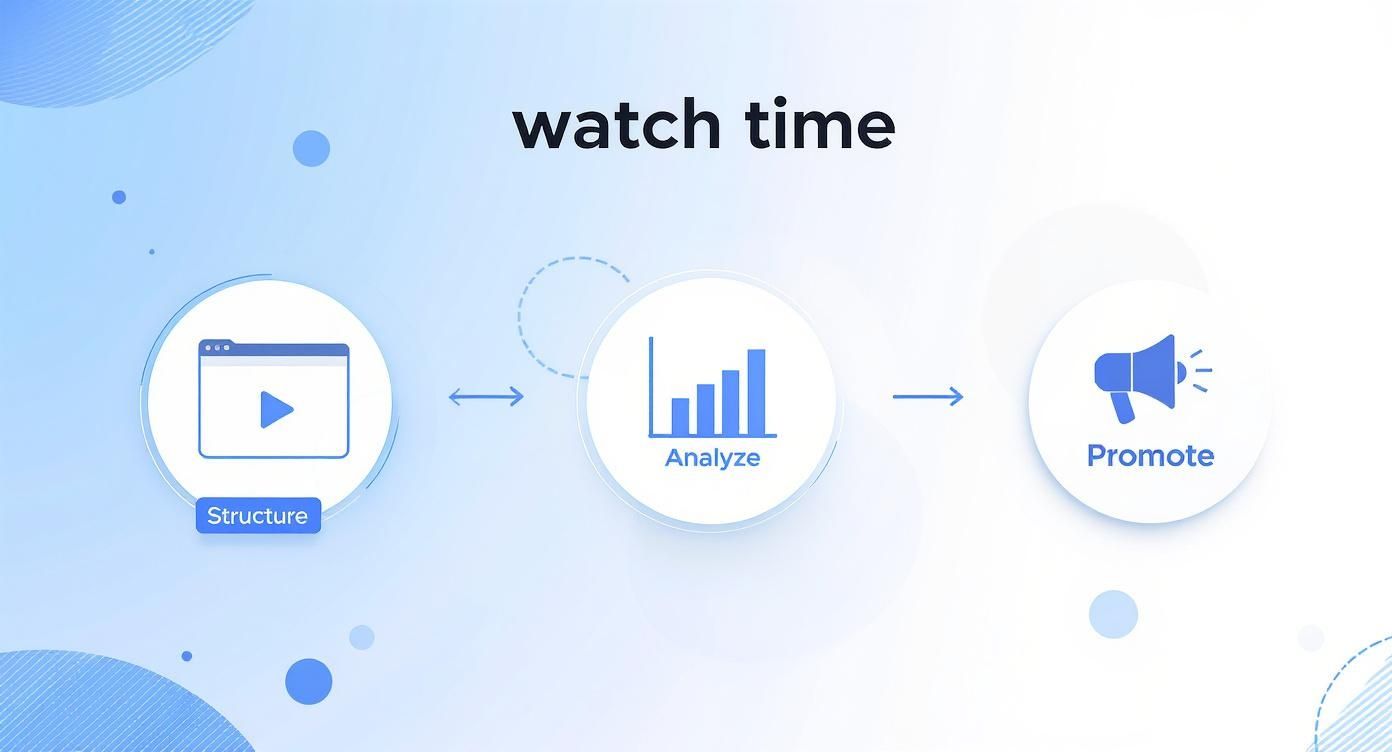
As you can see, analyzing your data is the critical bridge between making a video and getting people to actually watch it.
Reading the Audience Retention Story
Think of yourself as a detective. Every line on that retention graph is a clue, and it’s your job to piece them together. You'll typically spot four key patterns, and each one tells you something different about how your video is landing with viewers.
Once you learn to spot these, you can pinpoint exactly what’s working and what’s sending people away.
-
Continuous Segments (Plateaus): See a nice, flat line? That’s a great sign. It means viewers are locked in, and the audience size is holding steady. Dig into these sections. Is it your storytelling? A slick visual style? The way you broke down a complex topic? Whatever it is, do more of it.
-
Spikes (Peaks): A spike means people are actually rewinding to watch a specific moment again. This is incredibly powerful feedback. It could be a crucial tip, a great joke, or just a really well-edited sequence. Find these moments and figure out how to replicate that magic.
-
Dips (Valleys): Uh oh. A sudden dip is a "viewer exodus point." This is where you lost them. For whatever reason, a chunk of your audience got bored or confused and clicked away. These moments are your single biggest opportunity for improvement.
-
Sudden Drop-offs: The steepest drop almost always happens in the first 30 seconds. This is all about your hook. If you see a massive nosedive right at the start, it means your intro isn't grabbing attention, or your thumbnail and title promised something the video didn't immediately deliver.
Aim for a retention rate over 60-70% in the first 30 seconds. For the entire video, hitting 40-50% average view duration is solid. Anything above 60% means you've created something special.
From Data Points to Creative Decisions
Okay, so you've identified the patterns. Now comes the important part: asking "why?" This is where you connect the dots between the data on the screen and the actual content in your video.
For a complete breakdown of all the metrics at your disposal, our guide on how YouTube analytics can be explained is a great resource. It will give you the full picture of your channel's performance beyond just retention.
Let's walk through a real-world scenario. You notice a sharp dip two minutes into several of your tutorials. You go back and watch those parts and realize that’s where you always switch to a long, unedited screencast. The data is screaming at you: your pacing is off.
Now you can form a hypothesis: "If I shorten the screencasts and add more on-screen text and graphics, retention will improve." Just like that, you have a clear, data-driven action plan for your next video.
Conducting a Cross-Video Analysis
The real power of analytics kicks in when you stop looking at individual videos and start spotting patterns across your entire channel. This is how you develop a repeatable, winning formula.
- Isolate Your Top Performers: Pull up the retention graphs for your 5 best videos (based on average view duration). What do their intros have in common? Do they all jump right into the action? Do they all use a clear hook that promises a specific outcome?
- Analyze Your Underperformers: Now, do the same for your 5 worst-performing videos. Where do people consistently drop off? Is there a common thread, like a confusing explanation, a boring segment, or a weak call to action that feels like an ad?
- Compare and Contrast: Lay the findings side-by-side. Maybe your best videos use fast-paced B-roll in the first minute, while your worst ones start with a slow, rambling intro. This direct comparison gives you a concrete roadmap for what to do—and what to avoid—in every video you make from now on.
This systematic approach takes all the guesswork out of content creation. You're no longer just making what you think your audience wants; you're creating what the data proves they'll stick around to watch.
How to Engineer Videos That Hold Attention
Once you've dug into your analytics, you can stop diagnosing problems and start building solutions. Crafting a video that keeps people glued to the screen isn't about luck; it's about intentional design. The best creators I've seen all build their content around a simple, powerful framework: the Hook, the Hold, and the Payoff.
This is your blueprint for respecting the viewer's time and delivering on your promise—the absolute key to getting a sustainable YouTube watch time increase.

The First Five Seconds: The Hook
Take a look at your audience retention graph. See that massive, steep drop right at the beginning? That's where the battle for watch time is won or lost, usually within the first 30 seconds. A killer hook grabs viewers instantly, makes a clear promise, and sparks their curiosity.
Don't waste this critical window with a long, flashy intro or by rambling about what you're about to talk about. Get straight to the point.
- Show, Don't Just Tell: Start with the most compelling piece of information or a stunning visual. If it's a tutorial, show the incredible final result before you explain how to get there.
- Pose a Relatable Question: Hit on a pain point your audience knows all too well. Something like, "Are you tired of your videos getting stuck at 100 views?" connects immediately.
- Create an Open Loop: Tease a fascinating story but hold back the ending. A history channel might open with, "In 1942, one pilot made a decision that changed the course of the war, but it wasn't what you think."
The hook's job is simple: give them a damn good reason to stick around.
Maintaining Momentum: The Hold
You’ve got them hooked. Now for the hard part—keeping them. This is the "Hold" phase, where that retention graph often begins a slow, sad decline. Viewer fatigue is a real thing, and you have to fight it every step of the way.
The trick is to constantly introduce variety and keep pushing the narrative forward. You'll need to master some quick viral-ready video editing techniques for social media to keep the pacing dynamic and the audience locked in.
A huge mistake I see is creators just listing facts in a straight line. Great videos use storytelling and pattern interrupts to keep the viewer's brain from checking out.
Try breaking up your content with elements like these:
- Visual Variety: Switch camera angles, sprinkle in B-roll, and use on-screen text or graphics. A static talking head for ten minutes straight is a death sentence for your retention.
- Pattern Interrupts: Break the expected rhythm. This could be a quick cut to a funny meme, a sudden music change, or an abrupt shift in topic that snaps a wandering mind back to attention.
- Micro-Payoffs: Build your video around small, satisfying wins. If you're teaching a five-step process, make a mini-celebration out of completing each step to create a sense of progress.
For a much deeper dive into these engagement dynamics, check out our complete guide on YouTube audience retention.
Delivering the Goods: The Payoff
The "Payoff" is your grand finale. It's where you finally deliver on the promise you made in the hook. This last part of your video is critical, not just for satisfying the viewer but for telling them what to do next. A weak ending can make all your hard work feel pointless.
Your outro should feel deliberate, not like you just ran out of steam. It needs to provide a sense of closure while funneling the viewer smoothly into the next phase of their journey with your channel.
Here are a few strategic outro formats that work well:
- The Summary & CTA: Quickly recap the main points to reinforce the video's value. Then, give one single, clear call to action, like subscribing or watching a specific related video.
- The Next-Step Teaser: End by hinting at the topic of your next video. This builds anticipation and gives people a reason to come back for more.
- The Playlist Funnel: Guide viewers directly to a curated playlist that continues the topic, turning one view into an entire viewing session.
This entire framework creates a much more engaging experience, which directly boosts your watch time. And the scale of this is massive. By mid-2024, Alphabet's YouTube ad and subscription revenue flew past $50 billion over four straight quarters. The platform's premium service, which thrives on uninterrupted watch time, soared to 125 million subscribers by 2025, proving viewers will pay for continuous, quality content.
Unlocking Growth with Session Watch Time
If you really want to see a significant YouTube watch time increase, you have to stop thinking about single video views and start thinking about entire viewing sessions. The algorithm doesn't just reward a viewer for watching one of your videos. It heavily favors channels that keep that viewer glued to the platform for as long as possible.
This is where the often-underestimated power of playlists comes into play. A well-crafted playlist is your secret weapon for turning a casual one-off view into a dedicated, multi-video binge.
When someone watches several of your videos back-to-back, it sends a massive signal to YouTube that your channel is a go-to destination. That can get your content recommended more often, creating a powerful snowball effect of growth.
Building Binge-Worthy Playlists
The key is to think like a TV show producer. Your goal is to create a seamless viewing experience that makes clicking away feel like you're missing out. This takes more than just dumping related videos into a folder; it requires some strategic curation on your part.
I've found three types of playlists work wonders for boosting session watch time:
- Episodic Series: This is the most obvious one. If you have a multi-part series, like a step-by-step tutorial course or a project build that spans several days, a playlist isn't just nice to have—it's essential. It creates a natural, linear path for people to follow.
- Topical Libraries: This is my personal favorite. Group your videos by specific sub-topics within your niche. For example, a cooking channel might have playlists for "30-Minute Weeknight Dinners," "Advanced Baking Techniques," or "Healthy Breakfast Ideas." This strategy transforms your channel from a random collection of videos into an organized, valuable resource people will come back to.
- "Best Of" Collections: These are fantastic entry points for new viewers. A playlist titled "Start Here: The Best of [Your Channel Name]" or "Our Most Popular Videos of 2024" gives newcomers a curated tour of your greatest hits, instantly showing them what you're all about.
A common mistake I see is creators making playlists just for their own organizational benefit. Instead, every single playlist should be designed with the viewer's journey in mind. Always ask, "What would someone who liked this video want to watch next?"
The Art of Video Arrangement
The order of videos in your playlist is just as important as what's in it. A poorly arranged playlist can completely break the viewing spell and send your audience clicking over to someone else's channel. Your goal is to build momentum.
Think about the psychological journey. You want to start with a high-performing, broadly appealing video to get them hooked. Then, follow it up with a video that dives deeper into a specific aspect of the first one. For instance, after a video on "5 Common Photography Mistakes," the next video in the playlist could be "Mastering Manual Mode: A Deep Dive."
This kind of strategic sequencing keeps the viewer engaged because you're continuously answering the questions that are popping into their head. It creates a sense of discovery and makes them feel like they're on a productive learning path—a powerful reason to keep watching.
Optimizing and Promoting Your Playlists
Creating the playlist is only half the battle. Now you have to make sure people actually find it. I always tell people to treat their playlists like individual pieces of content with their own SEO potential.
Here’s a quick checklist I use for playlist optimization:
- SEO-Friendly Titles: Use clear, searchable titles. Don't just call it "Vlogs 2024." Go with something like "Van Life Adventures Across the USA (Complete Series)."
- Detailed Descriptions: Write a keyword-rich description for the playlist itself. Explain what it covers and who it's for. This helps it show up in search results.
- Promote Everywhere: Don't just let your playlists sit there. Feature them on your channel's homepage, link to them in your video descriptions, and use cards and end screens to funnel viewers directly into a session.
By strategically building, arranging, and promoting playlists, you move beyond just hoping for individual video success. You start engineering longer, more valuable viewing sessions that the YouTube algorithm is literally designed to reward. This is a core part of any serious strategy to increase YouTube watch time.
Optimizing Thumbnails and Titles for Retention
Think of your thumbnail and title as the front door to your video. If that door looks boring or misleading, nobody's coming in. And if they do click, but the inside doesn't match the promise on the outside, they're leaving immediately.
Getting the click is only half the battle. You need an irresistible thumbnail paired with an intriguing title to create a powerful one-two punch. This combo doesn't just drive clicks; it sets the right expectations, which is the secret to sustained viewership. A mismatch here is the fastest way to kill your audience retention in the first few seconds.
Crafting Thumbnails That Spark Curiosity
A great thumbnail doesn't just show what the video is about—it creates an emotional pull, a sense of intrigue that makes people need to know more. It’s a silent storyteller.
Human faces are absolute magnets for attention. A thumbnail with a clear, expressive face can forge an instant connection. Pair that with high-contrast colors and bold, easy-to-read text, and your thumbnail will pop, especially on the small mobile screens where most people are watching.
One of the biggest mistakes I see is cramming way too much text onto a thumbnail. Stick to three to five compelling words. Your goal is to complement the title and pique curiosity, not just repeat it.
Writing Titles That Hold and Convert
Once the thumbnail grabs their attention, the title has to seal the deal. This is a delicate balancing act. You need to be SEO-friendly so people can find your video, but you also need to be irresistibly clickable.
Curiosity is the name of the game here. Instead of a bland, descriptive title like "How to Fix a Leaky Faucet," try something that creates urgency or mystery. Something like "The 5-Minute Faucet Fix Plumbers Don't Want You to Know" promises a specific, valuable outcome while adding a compelling layer of intrigue.
The principles of creating curiosity and promising value are universal. Just as optimizing your video's entry points is crucial, understanding how to craft compelling meta descriptions for clicks on other platforms can also drive serious engagement.
The relationship between your title and thumbnail has a direct impact on your click-through rate, which is a massive signal to the YouTube algorithm. To really nail this, you can check out our deep dive on improving your YouTube click-through rate.
Using Chapters to Showcase Value Upfront
So many creators see video chapters as just a navigation tool, but they are so much more. Think of them as a table of contents that proves your video's value before someone has even watched a single second.
When a viewer can see a clear, well-structured breakdown of everything you're going to cover, they're far more likely to invest their time and stick around.
This strategy is a lifesaver for longer videos. A viewer might not have 20 minutes to spare, but if they see a chapter titled "The Exact Settings I Use," they can jump straight to the gold. This simple feature turns a potential bounce into valuable watch time. Manually creating chapters can be a drag, but tools like TimeSkip can automate the process, generating SEO-optimized chapters that boost discoverability and keep viewers locked in.
Proving your video's value upfront is more critical than ever, especially with the explosion of short-form content changing how people watch videos.
This table breaks down how different formats play into your overall watch time strategy.
Short-Form vs. Long-Form Content Impact on Watch Time
| Content Format | Primary Engagement Metric | Typical Viewer Behavior | Contribution to Total Watch Time |
|---|---|---|---|
| Short-Form (e.g., Shorts) | Views & Shares | Quick consumption, rapid scrolling, high volume of views | High aggregate views, but low individual session duration |
| Long-Form (e.g., standard videos) | Watch Time & Retention | Intentional viewing, seeking in-depth information, longer sessions | Builds significant channel watch hours, fosters deeper audience connection |
While Shorts rack up massive view counts—averaging over 70 billion views every day as of Q1 2024—it's your long-form content that builds the deep-seated watch time and authority that YouTube's algorithm loves. Your thumbnail, title, and chapters are the tools that convince a "Shorts-style" viewer to commit to a longer, more valuable watch session.
By optimizing these three elements, you create a cohesive and compelling package that doesn't just earn the click—it builds the trust needed to keep people watching. And that’s the ultimate goal.
Got Questions About Watch Time? Let's Talk.
When you're grinding away trying to boost your YouTube watch time, a few questions always seem to pop up. It's totally normal. Even with a solid game plan, you're bound to hit some common snags or wonder if you're even on the right track.
Let's cut through the noise and tackle some of the most persistent questions I hear from creators. Getting these answers straight will help you focus your energy where it actually counts.
What's the Perfect Video Length for Maximum Watch Time?
This is the million-dollar question, isn't it? But the answer is way simpler than you'd think: there is no magic number. The ideal length is however long it takes you to deliver on the promise of your title and thumbnail—and not a single second more.
A super-engaging six-minute video that holds 75% of its audience is infinitely more valuable to the algorithm than a rambling 25-minute video that people click away from after just four minutes. Your job is to deliver value, not to hit a specific number on the clock.
The best answer is hiding in your own analytics. Dive into your retention graphs for different videos and see where people start dropping off. Many creators find their sweet spot is somewhere between 8-18 minutes, which is long enough to go deep on a topic but not so long that viewer fatigue kicks in.
Are YouTube Shorts Killing My Main Channel?
I get this one a lot. There's a real fear that Shorts cannibalize long-form views, but it's largely a myth. Think of Shorts and long-form videos as two different tools in your toolbox. They don't compete; they complement each other.
Shorts are your top-of-funnel discovery engine. They're designed to pull in new eyeballs and introduce your channel to people who might never have found you otherwise. The watch time on a single Short is obviously low, but their potential for massive reach is off the charts. The trick is to use them as a strategic gateway to your deeper content.
Here’s how you make them work together:
- Tease Your Niche: Use Shorts to flash your personality and show what your channel is all about in a quick, punchy format.
- Build a Bridge: Use pinned comments to strategically point viewers from a viral Short to a related long-form video. It’s a direct funnel.
- Convert Viewers to Fans: Use your community tab and strong channel branding to turn those fleeting Shorts viewers into loyal subscribers who stick around for the main event.
When you do it right, Shorts become a powerful lead magnet that feeds your long-form content and boosts your channel's overall health.
What's a "Good" Audience Retention Rate to Aim For?
This definitely varies by niche and how long your videos are, but there are some solid benchmarks you can use to gauge your performance. Honestly, your first goal should always be to beat your own channel average. But if you want some numbers to aim for, here’s a good rule of thumb.
A strong performance usually breaks down like this:
- The First 30 Seconds: You want to see 60-70% retention or higher. This is your proof that the hook worked and you stopped the scroll.
- Overall Retention: An average view duration of 40-50% across the whole video is widely considered a solid number.
- Knocking It Out of the Park: If you're consistently hitting over 60% average retention, you've made something truly special. The algorithm loves this and is way more likely to push your video out.
Don't get obsessed with hitting a universal target. Just focus on small, steady improvements. If your channel baseline is 35%, make it your mission to get the next few videos to a consistent 40%. Build from there.
How Long Does It Take to Actually See a Watch Time Increase?
Patience, my friend. The YouTube algorithm is a marathon, not a sprint. While you might see a nice little bump in audience retention on the very first video where you apply these strategies, it takes time for that signal to translate into bigger reach.
The algorithm needs to see a consistent pattern of high performance before it starts rewarding your channel in a big way. One great video is just a blip on the radar. A channel that consistently delivers high watch time is a trusted source of quality content.
Generally, you can expect to see a real, noticeable impact on your impressions and suggested views after you've been consistently implementing these strategies across several new uploads—usually over 4-8 weeks. The keyword here is consistency. Keep delivering value, and the algorithm will eventually catch on.
Ready to boost your viewer retention and SEO without the extra work? TimeSkip generates perfect, SEO-optimized YouTube chapters in seconds. Try it for free and see how a 30-second setup can lead to a lasting increase in watch time. Learn more at timeskip.io.