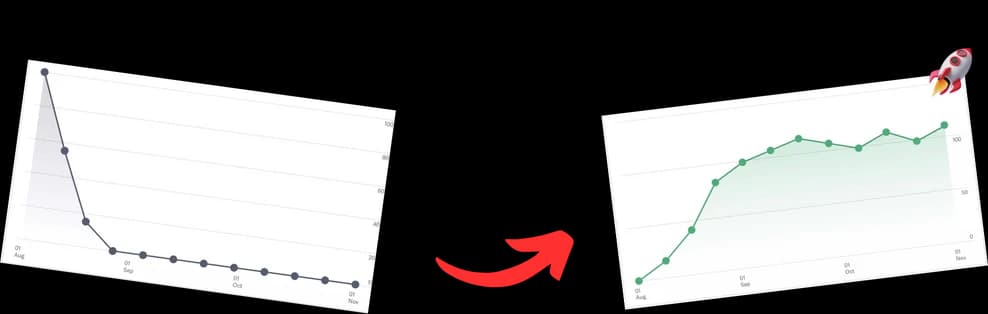
You upload a video you spent days making. The title sounds decent. The thumbnail looks clean. A few hours later, the dashboard is flat, and the only views are yours.
That usually isn't a content quality problem. It's a systems problem.
Most small creators don't fail because they lack effort. They fail because every video is treated like a separate project instead of part of a connected video content strategy. Topic choice happens in one tab, production happens in a rush, SEO gets added at the end, and promotion is an afterthought. Nothing compounds because nothing connects.
A strong channel grows more like an engine than a series of lucky uploads. Audience research shapes the topics. Topics shape the format. Format shapes retention. Retention strengthens discovery. Discovery gives you better data. Better data improves the next video. Once that loop starts working, growth becomes less random.
Why Your Videos Are Getting Zero Views
Zero views rarely mean "the algorithm hates me." More often, they mean your video entered the platform without a clear reason to be shown.
Creators usually start in one of three places. They make what they feel like making, they copy whatever trend is moving, or they publish inconsistently and hope one upload breaks through. All three approaches can produce the occasional spike. None of them build momentum.
Random uploads don't create compounding growth
A video can be well edited and still go nowhere if it misses audience intent. That's the hard truth. Viewers don't reward effort they can't immediately place in their own lives.
The usual failure pattern looks like this:
- The topic is too broad: "My thoughts on productivity" is harder to place than a focused problem-solving video.
- The packaging is vague: Titles and thumbnails don't signal who the video is for.
- The channel has no pattern: New viewers can't tell what they'll get if they subscribe.
- The creator stops too early: Weak early performance gets mistaken for proof that the idea was bad.
Practical rule: A video should answer one obvious question for one specific viewer. If it tries to serve everyone, it usually gets shown to no one.
This is why strategy matters. Not in the corporate sense. In the practical sense. A strategy tells you what to make, who it's for, how it gets found, and what role it plays inside the wider channel.
A channel needs a system, not motivation
If you're also posting clips on short-form platforms, the same logic applies there too. The creators who improve fastest usually study platform-specific packaging and distribution habits, which is why resources on strategies for gaining Instagram views can be useful. Not because Instagram and YouTube are identical, but because both reward clearer audience targeting and stronger content hooks.
Here's the shift that changes everything:
| Old approach | Strategic approach |
|---|---|
| Pick topics from instinct | Pick topics from audience demand |
| Film one video at a time | Build repeatable content formats |
| Upload and wait | Publish with search and promotion in mind |
| Judge success by views alone | Judge success by fit, retention, and discoverability |
Once you stop treating each upload as a standalone event, your videos start helping each other. That's when a channel begins to feel less fragile.
Define Your Audience and Core Mission
Most creators say they know their audience. Then they describe them in labels that don't help: beginners, founders, moms, students, gamers. That's not enough to build a sharp video content strategy.
Useful audience definition starts with behavior. What is this person trying to solve? What are they confused by? What are they embarrassed to ask? What would make them click right now?
A missed angle in video strategy is that discoverability depends less on generic posting advice and more on search-intent alignment, as noted in WSI World's discussion of video-first discoverability. That changes how you define your niche. Your niche isn't just a category. It's the overlap between what you know, what people search for, and what they care enough to watch through.

Build a target audience matrix
Instead of creating one vague avatar, build a simple matrix with four fields:
| Viewer segment | What they want | What blocks them | What your videos should do |
|---|---|---|---|
| Newcomer | Understand the basics | Overwhelm, jargon | Simplify and orient |
| Active learner | Improve a skill | Inconsistency, bad advice | Provide repeatable methods |
| Buyer or evaluator | Reduce risk | Unclear options, weak proof | Compare, explain, demonstrate |
| Loyal follower | Stay current | Fragmented updates | Give context and continuity |
This matrix keeps your channel from drifting into random topics. It also helps you spot content gaps. If every video targets beginners, your channel may attract clicks but struggle to build depth and trust.
Find audience language before you write scripts
Good audience research is rarely glamorous. It usually looks like reading comments, scanning Reddit threads, reviewing YouTube autocomplete, and noticing repeated phrases in competitor content.
Pay attention to the wording people use. If your audience says "I don't know where to start," that's a different video from "I tried this and it didn't work." The first needs orientation. The second needs diagnosis.
Use this quick research checklist:
- Comment mining: Look at questions under competitor videos with steady engagement.
- Forum review: Pull recurring pain points from Reddit, Discord, Facebook groups, or niche communities.
- Search patterns: Compare broad topics with narrower queries that reveal intent.
- Objections log: Save lines that reveal resistance, confusion, or mistrust.
The audience doesn't care how much you know until they can see that you understand their exact problem.
Tie audience needs to channel mission
A creator without a mission usually ends up chasing novelty. A mission acts like a filter. It tells you which opportunities to ignore.
Your mission should connect three things:
- Your expertise or perspective
- The audience problem you solve
- The outcome you want the channel to produce
A weak mission sounds like this: "I make videos about business and mindset."
A stronger mission sounds like this: "I help solo creators turn messy ideas into simple systems they can publish consistently."
That second version is narrower, but it's much more useful. It guides topic selection, naming, thumbnail style, series design, and even how you answer comments.
If you're building from scratch, write one sentence you can test against every idea: Does this video help the right person make the next decision more clearly? If the answer is no, it may still be interesting. It probably doesn't belong on the channel.
Develop Your Unbeatable Content Pillars
Channels stall when every upload tries to do the same job. Search content tries to entertain. Entertaining content tries to convert. Community content gets packaged like a tutorial. The result is confusion.
A healthier system uses content pillars with different roles. The most practical model for creators is Hero, Hub, Help. It works because it balances discovery, audience loyalty, and channel identity.
One reason this matters more now is that online video is normal behavior. A projection cited by Teleprompter says 94.6% of online adults had watched online video in the past 30 days by 2026, and 71% of respondents considered videos between 30 seconds and 2 minutes the most effective length, which supports a two-track strategy of quick discovery content plus deeper decision-support formats in the same ecosystem (Teleprompter's summary of Wyzowl video marketing statistics).

Help content brings in new viewers
Help videos answer specific questions. They solve a problem the viewer already knows they have. This is usually the best place to start a new channel because it gives platforms a clear signal about who should see your content.
Examples:
- How to set up a podcast recording space in a small room
- Why your YouTube retention drops in the first 30 seconds
- Best workflow for editing tutorial videos without burnout
These videos work when they're narrow, practical, and searchable. They don't need to be flashy. They need to be useful.
Hub content keeps people coming back
Hub videos are your recurring formats. They train the audience to expect a pattern from you.
That could be:
- A weekly breakdown series
- Monthly channel audits
- Behind-the-scenes build logs
- Reactions to changes in your niche
Hub content usually performs better after Help content has started bringing in the right people. It strengthens identity. It gives subscribers a reason to care beyond one search result.
Hero content expands reach and resets perception
Hero videos are larger bets. They often take more time, stronger storytelling, and sharper packaging. These aren't your everyday uploads. They're the videos designed to attract people who haven't heard of you yet.
For a creator channel, that might be a major experiment, a challenge, a documented transformation, or a thoroughly researched breakdown of a hot topic in your niche.
Hero content gets attention. Hub content builds habit. Help content earns trust. A strong channel uses all three.
Use a pillar template to generate ideas fast
If you struggle with ideation, don't ask "What should I post next?" Ask the same three questions every week.
-
What is my audience trying to solve right now?
That creates Help ideas. -
What format can I repeat without losing energy?
That creates Hub ideas. -
What bigger story would make a new viewer stop scrolling?
That creates Hero ideas.
A simple planning sheet can look like this:
| Pillar | Core purpose | Example angle |
|---|---|---|
| Help | Search and trust | Solve a common problem step by step |
| Hub | Consistency and loyalty | Repeatable series with a familiar structure |
| Hero | Reach and brand lift | Big narrative, experiment, or event-style video |
The mistake to avoid is overloading your schedule with Hero ideas. They feel exciting, but they aren't the foundation. Most channels grow because Help creates entry points and Hub creates familiarity. Hero works best when the other two already exist.
Create a Scalable Production Workflow
Two creators can have the same idea and get opposite results. One burns out after four uploads. The other posts consistently for a year. The difference usually isn't talent. It's workflow.
Creator A scripts every video from scratch, changes filming setups constantly, experiments with a new editing style every week, and treats each upload like a short film. Creator B uses repeatable templates, batches research, keeps the setup simple, and edits for clarity rather than novelty. Creator B usually wins.

Pre-production is where consistency is built
The easiest place to save time is before recording. Most creators try to solve structural problems in the edit. That gets expensive in hours and mental energy.
A lean pre-production system includes:
- A repeatable brief: topic, viewer, promise, hook, proof, call to action
- A script pattern: opening problem, key points, examples, close
- A shot plan: only for visuals that improve understanding
- A batch research habit: collect references for several videos at once
If your current process feels chaotic, reviewing practical breakdowns of a YouTube video production workflow can help you standardize the handoff from idea to upload.
Production should look good enough, not endlessly custom
A lot of creators hide behind gear decisions. They keep upgrading microphones, lights, and lenses when the actual issue is inconsistent publishing.
You don't need a cinematic setup for most educational, commentary, or creator-focused channels. You need clean audio, stable framing, decent light, and a recording process you can repeat without stress.
Use decision rules like these:
| Production choice | Good default |
|---|---|
| Camera | One reliable setup you can leave ready |
| Audio | Prioritize clarity over visual polish |
| Lighting | Keep a simple fixed lighting arrangement |
| Background | Remove distractions instead of decorating endlessly |
The goal isn't to lower standards. It's to remove friction from the parts that don't meaningfully change watch time or comprehension.
Post-production needs templates, not heroics
Editing turns into a bottleneck when every video demands custom motion design, custom sound work, and a fresh visual identity. That style can work for a while, but it usually collapses under its own weight.
A sustainable post-production process has guardrails:
- Intro rules: no long branded openings, get to the point fast
- B-roll rules: only add visuals that clarify, reset attention, or support a claim
- Text style presets: same fonts, sizes, caption treatments
- Thumbnail process: one concept, two variations, quick decision
If your process only works when you're highly motivated, you don't have a process yet.
The strongest creator workflows remove unnecessary choices. They decide framing, editing rhythm, graphic styles, and file organization in advance. That frees your attention for better topics and stronger storytelling. In the long run, that's what the audience notices.
Optimize for Discovery with Video SEO
A creator spends hours making a strong video, publishes it, and gets almost no traction after the first day. In many cases, the problem is not the video itself. The system around the video is weak. Discovery breaks when topic choice, packaging, viewer intent, and supporting text are treated as separate tasks instead of one connected engine.
SEO matters because recommendation traffic is inconsistent. Search and browse-driven relevance give your videos more chances to surface after the initial release window. A well-matched video can keep answering the same viewer need for months, sometimes longer.
SharpSpring explains in its guide to understanding video content marketing that the page around the video, the metadata, and the transcript all help search systems interpret relevance. That applies on YouTube and beyond. The spoken words, title, description, chapters, captions, and on-page copy should reinforce the same topic from different angles.

Search intent starts before recording
Good video SEO begins at the idea stage. If the topic has weak intent, metadata will not save it later.
The best search-driven topics usually have three qualities:
- Clear intent: the viewer wants an answer, process, comparison, or fix
- Specific phrasing: the topic matches the language people type and say
- Contained scope: one video can solve the problem without drifting into three other subjects
That last point matters more than many creators realize. Broad topics attract vague traffic. Specific topics attract qualified viewers who are easier to satisfy, and satisfaction is what helps the rest of the system work. If you want a practical breakdown of the mechanics, this guide on what video SEO is and how it works is a useful starting point.
Packaging has to match the promise
Discovery improves when the promise is consistent from impression to first minute. If the thumbnail sells a big outcome, the title frames a tutorial, and the opening wanders through backstory, the video sends mixed signals to both viewers and the platform.
Use this alignment check:
| Element | Job to do |
|---|---|
| Title | State the topic and angle in clear language |
| Thumbnail | Reinforce the payoff, problem, or tension |
| Opening | Confirm fast that the viewer clicked on the right video |
| Description | Add supporting terms and context naturally |
| Captions and transcript | Expand topical coverage with real language |
| On-page copy | Support the same intent as the video itself |
This is one of the core trade-offs in channel growth. Curiosity can raise clicks. Clarity usually improves viewer fit. Early-stage creators often benefit more from clarity because the wrong click hurts retention and weakens future distribution.
Chapters help viewers and strengthen topic clarity
Chapters are useful because they make the structure visible. They help a viewer scan the video, jump to the relevant section, and understand the scope before committing to the full watch.
Many creators give up at this stage. Writing timestamps and labels by hand is repetitive, and it often gets skipped when upload day gets busy. TimeSkip is one option that helps generate SEO-focused YouTube chapters through a Chrome extension, so creators can review and paste timestamps into the final upload faster.
There is a bigger strategic point here. Good chapter labels force clear thinking. If a section is hard to name, the underlying argument is often loose. That affects retention, comprehension, and search relevance at the same time.
The page around the video should carry part of the load
Embedded videos on empty pages waste search potential. Add a short summary, useful headings, and transcript sections when they improve the page. That supporting text gives search systems more context and gives viewers another way to confirm they are in the right place.
This broader connection between content quality and discoverability shows up in many effective video marketing strategies. SEO works best when it is built into the full publishing system, not added as a last-minute layer after editing.
The practical model is simple. Audience research shapes the topic. The topic shapes the script. The script shapes the title, chapters, and transcript. Those elements improve classification, clicking, and watch satisfaction. When those parts reinforce each other, discovery becomes more predictable and the channel has a stronger base to grow from.
Amplify Your Reach with Smart Promotion
Publishing is not promotion. A posting schedule gives you consistency. A promotion system gives each video multiple chances to find the right viewer.
Too many creators upload, share the link once, and move on. That approach wastes the asset you just made. Video takes time. The distribution should reflect that effort.
A broader market signal supports this thinking. By 2024, worldwide digital video ad spend had reached $176.63 billion across the 2007 to 2024 period, and in the same data set 77% of marketers said short-form video delivers the highest ROI while 22% favored long-form video, according to Siege Media's compilation of video marketing statistics. The practical takeaway isn't "abandon long-form." It's that short and long formats should support each other.
A publishing schedule is static. A promotion system is adaptive
A schedule answers, "When does the video go live?"
A promotion system answers tougher questions:
- Where will this idea travel next?
- Which parts can become clips, posts, emails, or threads?
- Which communities already care about this problem?
- What follow-up assets can keep interest alive after launch day?
That shift matters because discoverability is uneven. Some viewers find you through search. Others need a short clip, a newsletter mention, or a community recommendation before they ever click a full video.
Use a seven-day post-publish sprint
You don't need a huge team to promote properly. You need a repeatable routine.
Here is a practical seven-day sprint:
- Day one: Publish the full video and post one platform-native short clip.
- Day two: Send the video to your email list with a clear reason to watch.
- Day three: Pull one idea into a text post for LinkedIn, X, or a niche forum.
- Day four: Reply to comments and turn recurring questions into follow-up content.
- Day five: Post another short clip with a different hook.
- Day six: Share a quote card, screenshot, or lesson summary.
- Day seven: Review what angle earned the strongest response and reuse that framing.
For creators who need a broader framework, this roundup of effective video marketing strategies is useful because it reinforces the idea that distribution needs its own planning, not just leftover energy.
Repurposing works when each asset has a job
Repurposing fails when creators cut random moments and post them everywhere. Each asset should match the platform and the stage of viewer intent.
A simple breakdown:
| Asset type | Best use |
|---|---|
| Short clip | Spark curiosity and reach new people |
| Carousel or quote post | Distill one lesson for social engagement |
| Email summary | Bring warm viewers back to the full video |
| Blog recap | Support search and internal linking |
| Community post | Re-engage existing subscribers |
Promotion isn't noise when it's built around relevance. It's translation. You're taking one core idea and presenting it in forms that fit how people consume content across the week.
Measure and Iterate with YouTube Analytics
Creators often open analytics looking for reassurance. Strategists open analytics looking for decisions.
The most useful numbers aren't the ones that flatter you. They're the ones that explain viewer behavior. Retention, click-through rate, and traffic sources tell you where your system is breaking and where it's getting stronger.
For creators who want a better dashboard-level understanding, this walkthrough of YouTube analytics explained is a helpful companion to the platform's own reporting views.
Read retention like an editor
Retention graphs are blunt. That's what makes them valuable.
If viewers leave immediately, the problem is often one of these:
- Weak opening: you delayed the payoff
- Packaging mismatch: the title promised one thing and the intro delivered another
- Low clarity: the viewer couldn't tell what they'd get
If the graph falls after every transition, your pacing may be too choppy or your structure may feel fragmented. If viewers stay through the middle and leave near the end, your close may be overstretched or the core value may have already been delivered.
A useful benchmark from technical and educational content comes from Actual Tech Media's summary of video marketing data points, which found 72% of respondents considered 4 to 6 minutes ideal, while technical content with technical experts performs best in the 4 to 10 minute range. The lesson isn't to force every upload into one length. It's to match depth to the viewer's reason for watching.
Use comments and behavior together
Analytics tell you what happened. Comments often tell you why.
If viewers drop off at the same point where comments mention confusion, the fix is probably structural. If the graph holds but comments ask for more examples, the topic is strong but the execution needs more proof. Looking at both signals together is often more revealing than staring at one chart in isolation.
Tools that organize feedback can help here. For example, MicroPoster's YouTube growth guide is useful for spotting repeated audience themes inside comments instead of treating them like random noise.
Don't ask whether a video "did well." Ask what the audience rewarded, what they ignored, and what they wanted sooner.
Make one change at a time
A lot of creators overcorrect. One weak video leads to a new niche, new editing style, new thumbnail system, and new upload cadence. That muddies the data.
Instead, change one variable per batch:
- Topic angle
- Title structure
- Thumbnail concept
- Opening hook
- Length and chapter structure
That approach turns analytics into a feedback loop instead of an emotional roller coaster. Over time, you stop guessing. You start seeing patterns.
Your Essential Video Strategy Toolkit
A useful toolkit keeps the strategy engine running. Each tool should support one job in the system. Find demand, shape ideas, produce faster, package for discovery, distribute consistently, then review what the audience responded to.
That connection matters. If your research lives in one place, your scripts in another, and your post-publish notes nowhere, the channel gets harder to scale because each video starts from zero again.
Use tools to remove repeated manual work, not to outsource judgment.
| Stage | Tool Recommendation | Why We Recommend It |
|---|---|---|
| Audience research | YouTube Search, Reddit, AnswerThePublic | Surfaces real questions, repeated frustrations, and the language viewers already use |
| Content planning | Notion, Airtable, Google Sheets | Helps track pillars, series, publishing cadence, and topic backlog without losing context |
| Scripting and outlining | Google Docs, Notion AI, plain text templates | Keeps structure repeatable so good ideas are easier to turn into finished videos |
| Production | Sony ZV-E10, iPhone, Rode USB mic, simple softbox setup | Delivers enough quality for most channels without turning setup into a barrier |
| Editing | Descript, Final Cut Pro, Adobe Premiere Pro | Supports fast cuts, transcript-based editing, and more advanced workflows depending on your needs |
| Thumbnails and graphics | Canva, Figma, Photoshop | Fits different skill levels and gives you room to improve packaging over time |
| SEO optimization | TubeBuddy, vidIQ, TimeSkip | Supports topic framing, metadata decisions, and chapter creation |
| Promotion | Buffer, ConvertKit, native platform schedulers | Makes repurposing and multi-channel distribution easier to maintain |
| Analytics and review | YouTube Studio, Google Search Console, comments analysis tools | Helps connect discovery, retention, and audience feedback into the next planning cycle |
Start lighter than you want to. A small creator with a clear process usually outperforms a creator with eight subscriptions and no system for using them.
I usually recommend building the stack in the order your bottlenecks appear. If ideas are weak, fix research first. If production stalls, tighten templates and editing. If strong videos die after publish, improve packaging and distribution.
If chaptering keeps slipping to the bottom of your workflow, TimeSkip is worth considering. It adds SEO-focused YouTube chapters through a Chrome extension, which can reduce manual cleanup on longer videos and make those uploads easier to scan, rank, and watch.