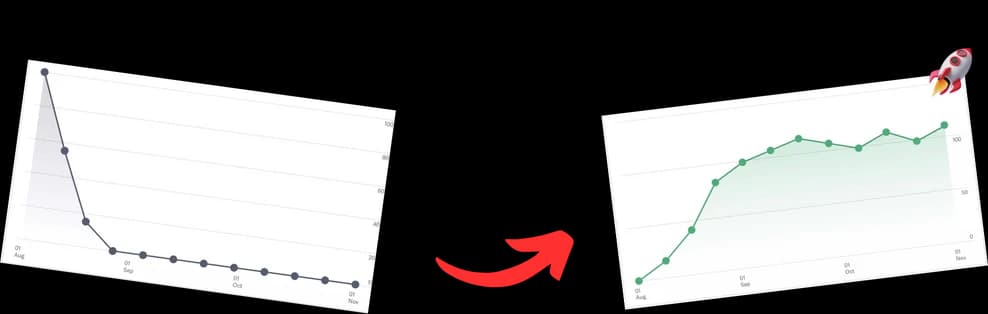
If you're looking for that one "secret hack" to make your YouTube channel blow up overnight, you're in the wrong place. Chasing viral trends is a losing game.
Real, sustainable channel growth comes from building a system—a reliable engine that brings in the right viewers, turns them into subscribers, and keeps them coming back for more. It's not about a single viral video; it's about a consistent strategy that delivers results month after month.
This guide is your playbook for building that engine. We're going to break down the three core pillars that every single successful creator has mastered. Forget quick fixes; we're focused on the foundational work that creates lasting success.
Your Blueprint for Authentic Channel Growth
At its heart, a powerful promotion strategy is built on three interconnected pillars: SEO, Content, and Community. Each one feeds into the others, creating a powerful growth loop that feels natural, not forced.
Think of it this way:
- Smart SEO helps new viewers discover your videos through search and recommendations.
- Great content hooks them, turning casual viewers into loyal subscribers.
- A strong community transforms those subscribers into die-hard fans who champion your work and help you grow.
When these three elements work together, you create a self-sustaining cycle that continuously fuels your channel's growth.
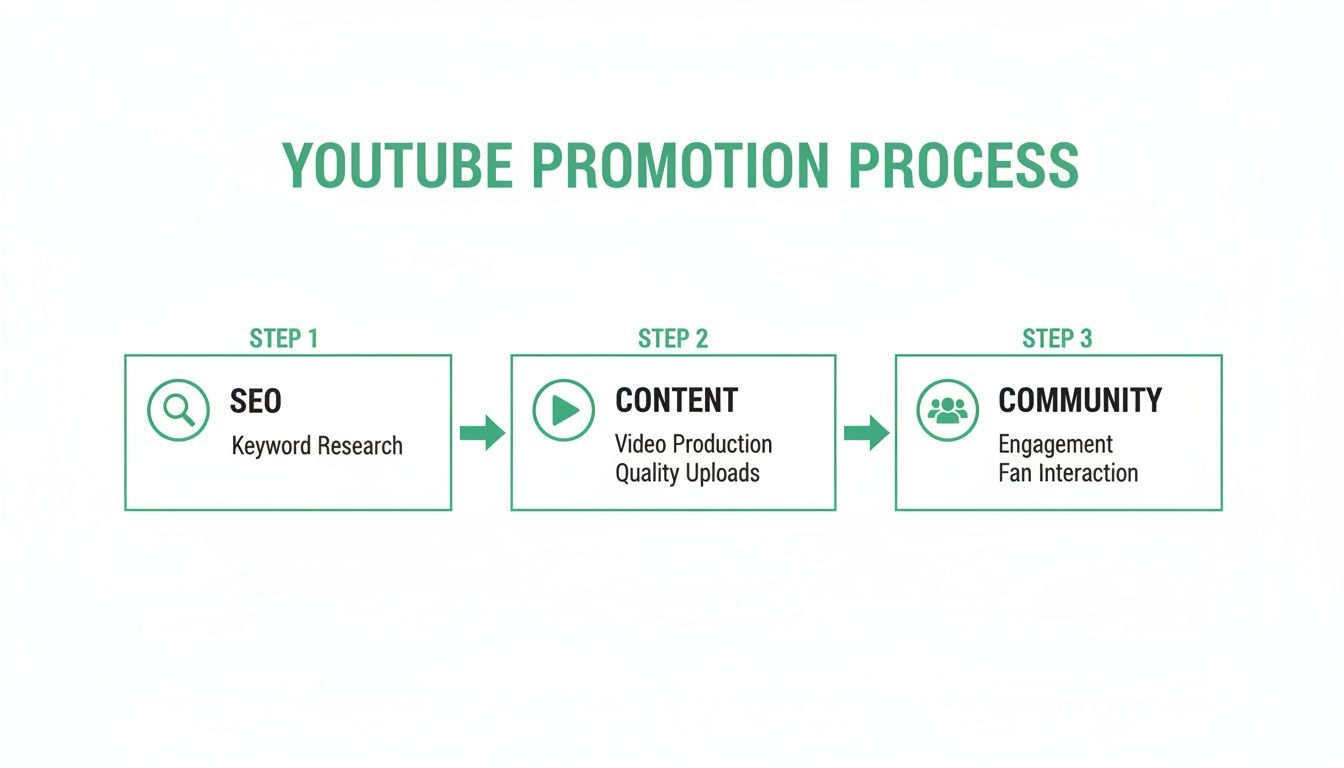
This isn't a linear checklist you complete once. It's a continuous process where you're always learning, refining, and engaging.
To give you a clearer picture, here's a high-level look at how these pillars function and the actions they involve.
Core YouTube Promotion Pillars at a Glance
| Strategy Pillar | Primary Goal | Key Actions |
|---|---|---|
| Algorithmic Discovery (SEO) | Get your videos found by new, relevant audiences. | Keyword research, title optimization, compelling thumbnails, SEO-rich descriptions. |
| Compelling Content | Turn viewers into subscribers and encourage binge-watching. | Creating high-value videos, consistent publishing schedule, analyzing watch time. |
| Community Building | Convert subscribers into a loyal, engaged fanbase. | Replying to comments, cross-platform promotion, collaborations, live streams. |
Each of these pillars deserves its own deep dive, and that's exactly what we'll be doing.
Before we jump into the specific tactics, let's get our mindset right. Promoting a channel effectively requires patience and a willingness to analyze your data. The YouTube algorithm isn't a mystery box; it's a system that rewards channels that consistently provide value and keep people on the platform.
Success on YouTube isn't accidental. It's the result of a deliberate strategy focused on serving a specific audience better than anyone else. Your promotion efforts should be an extension of that core mission.
This guide is designed to take the guesswork out of growth. We’ll walk through each pillar, giving you practical instructions, real-world examples, and templates to put this strategy into action. Let's get to it.
Get Found: Mastering YouTube SEO for Algorithmic Discovery
Thinking of YouTube as just a video-sharing site is your first mistake. At its core, YouTube is the world's second-largest search engine, and its algorithm is the gatekeeper standing between you and a massive audience. If you want to promote your channel, you have to learn to speak its language—and that language is Search Engine Optimization (SEO).
This isn't just about stuffing keywords into a description box. It's about sending clear, systematic signals to YouTube that your content is valuable, engaging, and exactly what someone is looking for. This whole process starts with figuring out what your audience actually wants to watch. Get this right, and you create videos that get seen. Get it wrong, and they just collect digital dust.
Uncovering What Your Audience Wants
Good keyword research isn't some dark art; it's just a listening exercise. You're trying to find the exact phrases and questions your ideal viewers are typing into that search bar. Start by brainstorming the big, broad topics in your niche.
Let's say you run a channel about home coffee brewing. Your big topics might be "espresso," "pour-over," or "cold brew." From there, you dig deeper to find the more specific, long-tail keywords that show someone is ready to watch.
- YouTube's Search Bar: The simplest tool is the best. Start typing a topic and see what auto-suggestions pop up. Those aren't guesses; they're real, popular searches people are making right now.
- Free Keyword Tools: A tool like Google Trends can show you how popular a search term is over time. This is perfect for spotting trends before they peak.
- Spy on Your Competition: Check out the top-ranking videos for your target keywords. What phrases are they using in their titles? Their descriptions? Their tags? Don't copy, but definitely take notes.
The goal is to find that sweet spot: keywords with decent search volume but competition you can actually beat. A keyword like "coffee" is way too broad. But "how to make dalgona coffee without a mixer"? That's specific, and it targets a viewer who has a real problem they need solved.
Crafting Titles and Descriptions That Work
Once you've got your primary keyword, it's time to build your video's metadata. Your title is everything. It’s the headline that has to earn the click, and it needs to feature your main keyword, preferably right at the beginning.
A great title finds the balance between being searchable and being intriguing. "Making Espresso" is boring. A much better title? "The Ultimate Espresso Guide for Beginners (No Fancy Machine Needed)." It hits a clear keyword, calls out the audience, and solves a common pain point.
Your description is where you give both viewers and the algorithm the full story. Don't just toss in a sentence or two. A properly optimized description should be a mini-blog post that expands on your video, naturally weaving in your primary and secondary keywords. For a full breakdown, our complete YouTube SEO checklist walks you through every step.
A great YouTube description does more than just describe. It anticipates viewer questions, provides additional resources, and uses semantic keywords to help the algorithm fully understand your video's topic and context.
Structuring Your Video for Maximum Engagement
YouTube's algorithm doesn't just care about clicks; it's obsessed with what happens after the click. Metrics like watch time and audience retention are massive ranking signals. This is where your in-video structure becomes a core part of your SEO and promotion strategy.
A huge, unstructured video is just intimidating. This is why video chapters (or timestamps) are such a game-changer. Chapters break your video into easy-to-navigate sections, letting viewers jump right to the part they need. This simple change dramatically improves the user experience, which in turn tells YouTube people are loving your content.
This screenshot shows how a tool like the TimeSkip Chrome extension can analyze a video and instantly generate optimized chapters. By using AI, these tools can pinpoint the key topics in your video and create descriptive, keyword-rich chapter titles. It saves you hours of manual work and beefs up your SEO at the same time.
This is more important than you might think. Did you know that by 2026, 70% of all YouTube watch time is projected to come from recommended videos, not direct searches? This statistic highlights a fundamental shift in how to promote a YouTube channel; success now hinges on pleasing the recommendation algorithm.
That engine rewards videos with high watch time. For creators making longer content, tools like TimeSkip that automate SEO-optimized chapters can increase visibility by up to 220% simply by keeping viewers on the page and engaged.
Developing a Smart Content and Publishing Strategy
Great SEO can get your videos discovered, but it's your content that makes people stay, subscribe, and smash that notification bell. You can't promote a channel effectively without a smart content strategy that consistently delivers value. This means moving past random video ideas and building a cohesive ecosystem that turns casual viewers into a loyal community.
The foundation of any solid strategy is defining your content pillars. These are the 2-4 core topics or themes your channel is built around. Think of them as your channel's promise, telling viewers exactly what they can expect from you.
For instance, a channel dedicated to home coffee brewing might build its content around these pillars:
- Espresso Techniques: Covering everything from machine tutorials to latte art.
- Alternative Brewing Methods: Diving into guides for pour-over, AeroPress, and French press.
- Coffee Bean Deep Dives: Exploring different roasts, origins, and flavor profiles.
Every single video you create should tie back to one of these pillars. This focus is what helps you attract a specific, dedicated audience instead of just a scattered group of one-time viewers.
Mixing Video Formats for Broader Appeal
Once you've got your pillars locked in, it's time to vary your video formats. Relying on just one type of video is a surefire way to limit your reach. The most successful channels mix up their formats to attract different types of viewers and serve different needs—a critical tactic for promoting your YouTube channel.
Try working with a blend of these formats:
- Hero Content: These are your big, deep-dive videos designed to pull in new audiences. Think "The Ultimate Guide to Pour-Over Coffee" or a detailed product review. They are usually heavily SEO-driven and have a long shelf life.
- Hub Content: This is your regularly scheduled programming that keeps your subscribers coming back for more. It could be a weekly "Brew Tip Tuesday" series or a monthly Q&A session.
- Help Content: Sometimes called "Hygiene" content, these are quick, problem-solving videos answering specific questions. Think "How to Clean Your Espresso Machine" or "Fixing a Clogged Grinder."
- YouTube Shorts: With over 70 billion daily views, Shorts are an absolute powerhouse for rapid discovery. Use them for quick tips, behind-the-scenes clips, or repurposed highlights from your longer videos to funnel fresh eyes to your channel.
This multi-format approach creates a rich content library where every video has a job to do, whether that's attracting new people or delighting your existing subscribers.
Your content strategy should be a feedback loop. Pay close attention to which formats get the most watch time and comments. Your audience's behavior is the best guide for what to create next.
Building a Sustainable Publishing Calendar
Consistency is arguably the most important signal you can send to both your audience and the YouTube algorithm. Sporadic uploads kill momentum. The secret to staying consistent without burning out is simple: plan your content with a publishing calendar.
This doesn't have to be some overly complicated system. A simple spreadsheet can completely transform your workflow from reactive to proactive. When you plan videos weeks or even a month ahead, you give yourself the breathing room to script, film, and edit without rushing.
Here is a simple template to help you map out your weekly publishing schedule and keep your growth on track.
Sample Weekly YouTube Content Calendar
| Day | Content Type | Promotional Focus |
|---|---|---|
| Tuesday | Hub Video: "Brew Tip Tuesday" | Engage existing subscribers, build community with a consistent series. |
| Thursday | YouTube Short: Highlight from a past Hero video | Attract new viewers through the Shorts feed, drive traffic to long-form content. |
| Saturday | Hero Video: "Comparing 3 Popular Grinders" | Target new audiences with SEO-driven, high-value content. |
A schedule like this balances different content types to hit multiple goals at once. More importantly, it establishes a reliable publishing cadence that tells viewers when to expect new content, giving them a reason to keep coming back.
Ultimately, a smart content strategy is your channel's engine. It provides the structure for consistent output and ensures every video you publish works together to build a strong, recognizable brand. Combine this with solid SEO practices, and you've got a powerful system for sustainable growth.
Expanding Your Reach with Cross-Platform Promotion
Making great, SEO-friendly videos is a huge win, but it's only half the battle. If you want to really grow, you've got to break out of the YouTube bubble. The real trick is to meet your audience where they already are. Think of your channel as the central hub, with every other social platform acting as a spoke in your distribution wheel.
Don't just see your YouTube videos as a one-and-done deal. Your long-form content is a goldmine that can be chopped up and repurposed for TikTok, Instagram, Twitter, and even LinkedIn. The goal isn't to spam links everywhere. It's about creating short, native content that hooks people and gives them a reason to click over to your channel for the full story.

This strategy builds a cohesive brand and massively increases your chances of being discovered. Someone scrolling TikTok is in a completely different headspace than someone actively searching on YouTube. Your promotional clips need to respect that context to have any real impact.
Tailoring Teasers for Each Platform
A one-size-fits-all approach is a recipe for failure in cross-platform promotion. Every social network has its own vibe, format, and audience. A smart strategy means creating custom teasers that feel right at home on each one.
-
For TikTok & Instagram Reels: Find the punchiest 15-30 second clip from your video. This could be a surprising stat, a powerful quote, a key takeaway, or a cliffhanger moment. Slap on some native text and maybe some trending audio to grab attention fast. The call to action is simple: "Full breakdown in the new video, link in bio!"
-
For Twitter (X): Twitter is perfect for text-based hooks and quick video clips. Pull out a compelling quote from your video and tweet it. You could also create a thread that breaks down 3-5 key points, with the last tweet linking to the full YouTube video.
-
For LinkedIn: If you’re in the business or career space, pull a professional insight from your video. Post a 60-second clip that highlights a key solution or framework. In the text, explain the problem it solves and how the full video offers a much deeper dive.
Using this method, a single YouTube video can fuel your social media calendar for a whole week. To really get this system firing on all cylinders, you need to think in terms of integrated cross-channel marketing campaigns that make your YouTube content the star of the show.
Your best promotional clips are often the "aha!" moments from your longer videos. Isolate the single most valuable piece of advice or the most surprising moment, and build your teaser around that.
Building a Community Beyond YouTube
Promotion isn't just about shouting into the void; it's about starting conversations. Getting active in existing online communities on places like Reddit, Facebook Groups, or Discord is an insanely effective way to establish yourself as an expert and gently guide people toward your content.
Here's the golden rule: provide value first. Don't be that person who just drops links and bails. Find relevant subreddits or groups in your niche, answer questions, and share what you know. When it’s a natural fit, you can say, "I actually made a detailed video explaining this exact process, you can check it out here." This positions you as a helpful resource, not a spammer. You can dig into more advanced ideas in our guide to content distribution strategies.
Leveraging Your Most Engaged Audience
Finally, don't forget your most powerful promotional asset: your email list. These are your true fans—the people who have literally asked to hear from you. An email newsletter is the absolute best way to drive that critical initial traffic to a new video.
The moment you publish, send a dedicated email to your subscribers. But don't just dump the link. Tell a story. Explain why you made the video, what problem it solves, and what they'll learn. That personal touch drives clicks and sends a flood of positive signals to the YouTube algorithm in that crucial first 24-48 hours. This early momentum can be the difference-maker that gets your video recommended to a much wider audience.
Accelerating Growth Through Collaborations and Community
If you want to pour gasoline on your channel's growth, collaborations are the way to do it. Instead of grinding it out one subscriber at a time, you get to tap into an audience that another creator has already spent months or years building. It’s a strategic move that introduces your content to a warm, highly relevant audience that’s already primed to like what you do.
The trick is finding the right partner. Forget chasing channels with massive subscriber counts for a moment. You need to find creators in your niche whose audience and content vibe are a perfect match for yours. A cozy gaming channel teaming up with another cozy gamer? That’s a no-brainer. But partnering with a high-octane FPS channel would just leave both audiences confused.

Crafting the Perfect Collaboration Pitch
Once you have a shortlist of potential partners, your outreach needs to be on point. A lazy, generic "wanna collab?" message is a one-way ticket to the trash folder. Your pitch has to be personal, thoughtful, and show you've actually done your homework.
- Be a Fan First: Don't just slide into their DMs cold. Genuinely engage with their content for a while. Leave insightful comments that show you actually watch and appreciate what they're doing.
- Bring a Concrete Idea: Don't put the mental load on them. Come prepared with 2-3 specific video ideas that would be a win for both of you. For example: "I saw your viewers went nuts for your espresso machine review. I specialize in latte art—how about we do a joint video on '5 Latte Art Designs Anyone Can Master'?"
- Show Them What’s In It for Them: Clearly spell out the mutual benefit. Explain why your audience would love their content and how the collaboration could expose them to a new, engaged group of potential subscribers.
This isn't just a friendly handshake; it's a proven growth strategy. The influencer marketing market is set to explode to $32 billion by 2026, a massive leap from just $1.7 billion in 2016. This growth is built on trust—a staggering 87% of viewers trust recommendations from creators far more than they trust traditional ads. You can dig into more of these YouTube statistics and trends on Recurpost.com.
Building a Thriving Community Around Your Channel
Collaborations give you those awesome growth spurts, but a strong community is what creates long-term, sustainable success. Your mission is to turn passive viewers into active members who feel like they're part of something special. This loyal crew will become your most powerful promotion team.
The easiest place to start is your own comment section. Don't just "heart" comments—reply with genuine questions. If someone asks a fantastic question, pin their comment to the top and give them a shout-out. These simple acts of recognition make people feel valued and spark even more interaction, which the YouTube algorithm absolutely loves.
Think of your channel not as a broadcast station but as a clubhouse. The more you can make your audience feel like valued members, the more they will advocate for you and your content.
Hosting interactive live streams is another fantastic tool for community building. Think Q&As, behind-the-scenes peeks, or even just casual co-working streams. It creates a direct, unfiltered connection. Use YouTube’s built-in tools like polls and the Community Tab to ask for their opinions on your next video. When your viewers see their ideas come to life, their connection to your channel deepens, transforming them from subscribers into true fans.
Using Paid Ads to Kickstart Your Channel's Growth
Look, organic growth is the bedrock of any successful YouTube channel. It's the long game. But sometimes, you need a little nudge—a strategic boost to get the ball rolling and show the algorithm your content is worth watching.
This is where paid advertising comes in. Done right, it isn't about buying vanity metrics. It's a calculated investment to get your best videos in front of your ideal audience, faster. This feeds the algorithm those juicy, positive engagement signals, which can spark a wave of organic recommendations down the line.
The trick is to start small and be incredibly targeted. The best way to do this is with strategic Google Ads campaigns that place your videos right where your target viewers are already looking. We're not talking about broad, expensive campaigns here; we're talking about surgical precision.
Start With a Small Test Budget
You absolutely do not need a huge budget to see if this works. The entire point of your first campaign is to run a small, controlled test and buy some data. A budget of just $50 to $100 is plenty to get started. This lets you figure out your real-world cost per view (CPV) and cost per subscriber without any major financial risk.
Think of that first $50 as an investment in knowledge. Your initial campaign will tell you:
- Which of your thumbnails and titles actually make people click.
- What it costs to get a highly-targeted viewer to watch your video.
- How many of those paid views actually convert into new subscribers.
This information is pure gold. You can use it to fine-tune not just your paid strategy but your organic content strategy, too.
Don't think of paid ads as a shortcut to subscribers. See them as a tool to amplify what’s already working and dramatically speed up the feedback loop on your content.
Zero in on Interest-Based Targeting
The real power of YouTube Ads is how deep you can go with targeting. Instead of blasting your ad out to the masses, you can laser-focus on people who have already shown they're interested in your niche.
Let’s say you run a channel about brewing coffee at home. You could target viewers who:
- Recently searched for "espresso machine reviews" on Google.
- Already subscribe to big coffee channels like James Hoffmann or Morgan Eckroth.
- Regularly watch videos about pour-over techniques.
This level of detail ensures your ad budget is only spent on people who are highly likely to find your content genuinely valuable. The results can be stunning. We saw one creator get a 548% ROI on a $500 campaign just by using this kind of interest-based targeting. This approach dropped their cost per subscriber to a mere $1.21—a 65% decrease from what they were paying with broader methods.
Once your test campaign is done, dig into the results. If a video is turning viewers into subscribers at a cost you're happy with, you've struck oil. At that point, you can confidently scale up the budget or look into how professional YouTube marketing services can optimize your campaigns to squeeze out even better performance.
Your YouTube Growth Questions, Answered
Getting a handle on YouTube promotion means you're going to have questions. Let's tackle some of the most common ones I hear from creators who are serious about growing their channels.
How Long Does It Take to See Growth on YouTube?
There's no magic number, but if you stick to a solid strategy, most creators start seeing real traction within 3 to 6 months. This isn't a hard-and-fast rule, of course. Your growth curve really depends on your niche, the quality of your content, and—most importantly—your consistency.
The YouTube algorithm tends to favor channels that publish regularly and keep viewers engaged over time. So, think of your first few months as building a foundation. You'll be refining your content, getting a feel for SEO, and actually listening to what your audience tells you. That early groundwork is what sets the stage for explosive growth later.
Should I Focus on Shorts or Long-Form Videos?
Honestly, the most effective strategy is a mix of both. Don't think of it as Shorts versus long-form; they're two different tools for two different jobs.
- YouTube Shorts: These are your discovery engine. Shorts are absolutely fantastic for grabbing the attention of new viewers and bringing in a quick burst of subscribers. Use them as bite-sized trailers for the value your channel offers.
- Long-Form Videos: This is where you build a real community. Your longer videos are essential for racking up watch time, cementing your authority in a niche, and eventually, making money. This is how you turn a casual viewer into a die-hard fan.
A simple way to think about it: Use Shorts to hook them, and use your long-form videos to make them stay.
Can I Promote My YouTube Channel for Free?
Absolutely. In fact, some of the most powerful and sustainable ways to grow your channel don't cost a dime. A killer strategy is built on smart, organic effort—not a huge ad budget.
Paid ads can definitely speed things up, but they're not a prerequisite for success. The real engine of long-term channel health comes from the free tactics we've already covered:
- Nailing your video optimization for search (YouTube SEO).
- Creating genuinely compelling, high-quality content.
- Engaging with your audience in the comments section.
- Cross-promoting your videos on your other social media accounts.
- Collaborating with other creators who serve a similar audience.
Ready to supercharge your video SEO and save hours of manual work? TimeSkip uses AI to generate perfect, SEO-optimized chapters for your YouTube videos in seconds. Get started for free and see how effortless chapter creation can be at https://timeskip.io.