The best YouTube automation tools in 2026 are TimeSkip for AI chapters, PostOnce for automatically crossposting your videos and Shorts to every other platform, TubeBuddy and vidIQ for SEO and ideation, a scheduler such as Buffer, Publer or SocialPilot for planned uploads, and Zapier or Make for custom workflows. Most creators only need two or three of them, one for each task that eats the most time.
As a YouTube creator, your most valuable asset is time: time to create, engage and plan. Yet hours still disappear into repetitive work like writing timestamps, rewriting descriptions, re-uploading the same video to TikTok, Instagram and Facebook, and checking what competitors are publishing. That's where YouTube automation tools come in.
This guide was refreshed for October 2026. It covers 13 tools, what each one actually automates, current pricing, who it suits, and its honest limitations. Prices change often, so treat the numbers below as a starting point and confirm on each vendor's pricing page before you buy. If you want a broader view of the production side, these real-world strategies to automate content creation are a useful companion.
Quick comparison: what each tool automates
| Tool | Best for | Starting price (2026) |
|---|---|---|
| TimeSkip | AI YouTube chapters, titles and descriptions | $19/mo |
| PostOnce | Auto-posting YouTube videos and Shorts to 8 other platforms | $29/mo (7-day free trial) |
| TubeBuddy | In-Studio SEO, A/B tests, bulk edits | Free plan; paid tiers |
| vidIQ | AI video ideas and keyword research | Free plan; paid tiers |
| Hootsuite | Enterprise social scheduling and approvals | Paid only |
| Buffer | Simple multi-platform scheduling | Free plan; per-channel pricing |
| Sprout Social | Team inbox, approvals and reporting | Per-seat pricing |
| SocialPilot | Agency scheduling and white-label reports | Paid only |
| Publer | Affordable scheduling with an AI assistant | Free plan; paid tiers |
| ContentStudio | Team content calendar and approvals | Paid only |
| Zapier | No-code workflows around new uploads | Free plan; paid tiers |
| Make | Visual, logic-heavy automations | Free plan; paid tiers |
| Elgato Stream Deck | Hardware macros for live streams and editing | One-time hardware cost |
1. TimeSkip: For Automated SEO-Optimized Chaptering
TimeSkip is built for creators of long-form content who want chapters without the manual work. It's a Chrome extension and web app that reads your video's transcript and generates SEO-friendly chapter titles and timestamps you can paste straight into your description. It solves a common pain point for podcasters, educators and tutorial makers who know chapters help viewers navigate but don't have 20 to 30 minutes per video to write them.
TimeSkip doesn't just split a video by time. It identifies topic changes and writes descriptive, keyword-aware chapter titles. Clear chapters make long videos easier to skim and give YouTube and Google Key Moments more context to show in search.
In-Depth Feature Analysis
Once the extension is installed, a button appears on the YouTube watch page and in YouTube Studio, so you can generate chapters in one click and then review them before publishing. Beyond chapters, the same workflow drafts titles, descriptions and tag suggestions, which turns a pile of post-upload chores into one review step.
Key Takeaway: TimeSkip removes the most tedious part of publishing long videos. You still review every chapter, but you start from a finished draft instead of a blank description box.
Ideal Use Cases & Implementation
- Podcasters & Interviewers: Automatically segment long conversations so listeners can jump to a topic or guest.
- Educators & Tutorial Creators: Break lessons and step-by-step guides into clearly labeled sections.
- Product Reviewers: Create chapters for each feature or test so viewers can jump to what they care about.
Install the Chrome extension, open your video on YouTube or in YouTube Studio, and click the TimeSkip button. You can also try the free YouTube chapter generator before signing up.
Pricing and Access
- Pro: $19/month, 15 videos per month, up to 90-minute videos.
- Studio: $39/month, 50 videos per month, up to 10-hour videos, priority support.
- Lifetime: $399 one-time for unlimited videos.
Yearly billing is discounted, and every plan can be cancelled anytime with a 7-day refund policy.
- Pros:
- Chapters, titles, descriptions and tags from one click.
- Keyword-aware chapter titles instead of generic "Part 1, Part 2" labels.
- Works directly on YouTube and in YouTube Studio.
- Handles very long content (up to 10 hours on Studio).
- Cons:
- The extension requires a Chromium-based browser.
- Focused on metadata; it doesn't schedule or distribute videos.
Website: https://timeskip.io
2. PostOnce: For Automatically Crossposting Your Videos Everywhere
PostOnce solves the other big time sink for YouTube creators: distribution. Instead of downloading every video and re-uploading it to TikTok, Instagram, Facebook and the rest, you keep posting the way you already do, and PostOnce publishes it to your other connected accounts automatically, usually within about 20 minutes. It works in every direction, so you can turn YouTube Shorts into Reels and TikToks, or turn your existing TikToks and Reels into YouTube Shorts.
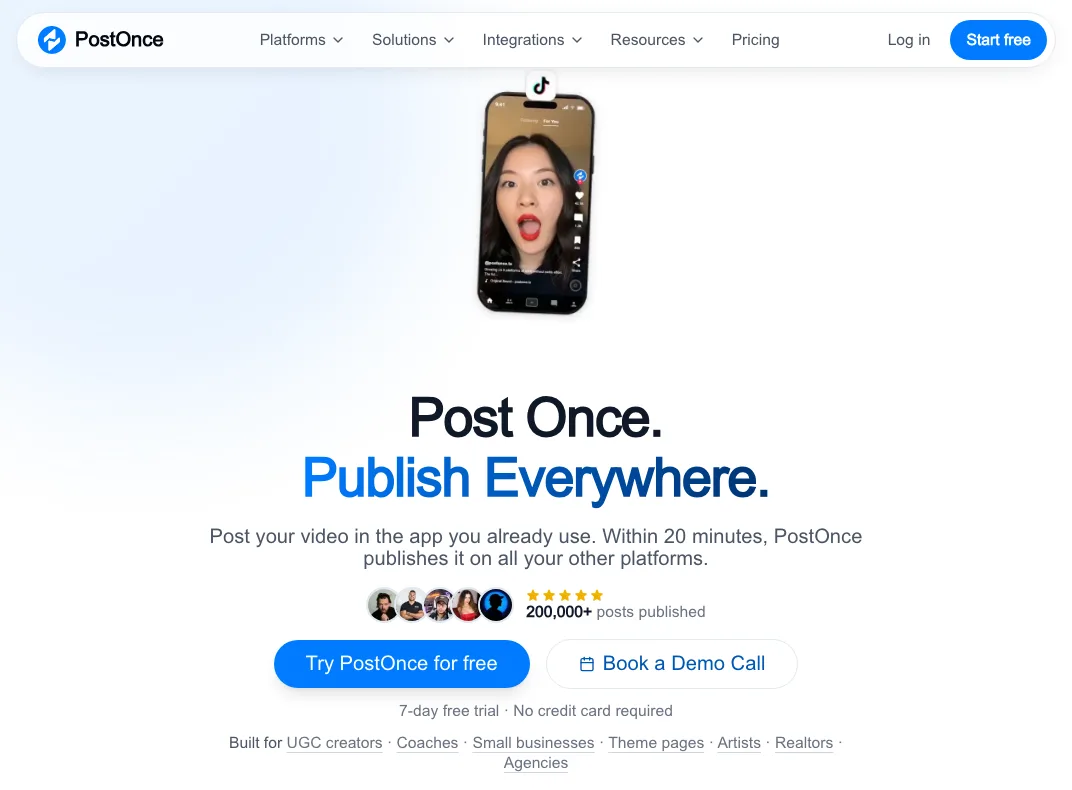
Unlike a traditional scheduler, PostOnce doesn't ask you to build a calendar or upload files into yet another dashboard. You set up a workflow once, for example "YouTube → TikTok, Instagram and Facebook", and every new post on the source account flows to the destinations through each platform's official posting API. That makes it one of the most hands-off YouTube automation tools for growing an audience on several platforms without extra work. PostOnce says more than 3,500 creators use it and it has published over 200,000 posts.
Watch this walkthrough to see how to auto post Instagram to YouTube and publish each Reel as a YouTube Short:
Key Features & Use Cases
- Automatic Crossposting Workflows: Connect a source account and choose destinations across YouTube, TikTok, Instagram, Facebook, LinkedIn, X (Twitter), Threads, Bluesky and Pinterest. New posts are republished automatically.
- Existing Content: Push your back catalog of past videos to new platforms, which is a fast way to seed a fresh YouTube Shorts channel from years of TikToks or Reels.
- Scheduling: Plan posts ahead when you want more control than "publish as soon as it goes live".
- Image Repurposing: Turn image posts and carousels into formats other platforms accept.
- Developer API & MCP: Trigger publishing from your own tools or AI assistants (such as Claude or ChatGPT) through a scoped API and a hosted MCP server.
| Feature | Ideal For | Impact on Automation |
|---|---|---|
| Auto Crosspost Workflows | Creators posting short-form video on one main platform. | High: Removes manual re-uploads entirely. |
| Existing Content | Creators launching on a new platform with a back catalog. | High: Fills a new channel in minutes. |
| Multi-Account Plans | Theme pages, UGC creators and agencies running many accounts. | High: One setup covers every account. |
| API + MCP | Technical teams and AI-agent workflows. | Medium: Lets other tools publish for you. |
Pricing & Platform Availability
Every paid plan includes all supported platforms, unlimited workflows and unlimited posts. Plans differ only by how many social accounts you connect, and yearly billing gives you 2 months free.
- Creator: $29/month ($24/month billed yearly) for up to 15 social accounts.
- Pro: $69/month ($58/month billed yearly) for up to 50 social accounts and priority support.
- Agency: $199/month ($166/month billed yearly) for up to 200 social accounts.
New customers get a 7-day free trial with no credit card required. PostOnce is a web app, so it works from any browser.
Pros & Cons
Pros:
- Truly hands-off: Keep posting where you already post; distribution happens in the background.
- 9 platforms on every plan: No per-platform add-ons or post limits.
- Uses official APIs: No browser bots or password sharing.
- Strong fit for Shorts: Turns one short-form video into posts on every major platform.
Cons:
- Not a YouTube SEO tool: It distributes videos; pair it with TimeSkip, TubeBuddy or vidIQ for metadata.
- No permanent free plan: You get a 7-day trial, then a paid plan.
Website: https://postonce.to
3. TubeBuddy
TubeBuddy is a quintessential browser extension and mobile app designed to be a creator's best friend, directly integrating into the YouTube interface. It excels at streamlining repetitive tasks and providing deep analytical insights, making it one of the most powerful YouTube automation tools for channel optimization. Its strength lies in automating the tedious "on-platform" work that consumes hours of a creator's time, from metadata updates to community management.

Unlike standalone platforms, TubeBuddy overlays its features onto your existing YouTube Studio dashboard. This native integration is its killer feature, allowing for a seamless workflow. You can perform bulk updates to video end screens, cards, and descriptions across your entire library with just a few clicks, a task that would otherwise require manual editing of each video. Its AI-powered features, like the title generator and thumbnail A/B testing, provide data-driven suggestions to improve click-through rates.
Key Features & Use Cases
- Bulk Processing Tools: Automate the addition or removal of text in all video descriptions. This is invaluable for updating affiliate links, changing social media handles, or adding a limited-time promotion across your channel instantly.
- A/B Testing: Systematically test different titles, thumbnails, tags, and descriptions to identify which variations perform best with your audience, taking the guesswork out of optimization.
- SEO Studio & Keyword Explorer: Get a step-by-step guide to optimizing your video's metadata for target keywords, complete with competitor analysis and rank tracking.
- Canned Responses: Speed up comment moderation by creating and using pre-written replies for frequently asked questions, saving significant time in community engagement.
| Feature | Ideal For | Impact on Automation |
|---|---|---|
| Bulk Find & Replace | Creators updating old branding or affiliate links. | High: Saves hours of manual editing. |
| Thumbnail A/B Test | Marketers maximizing click-through rates. | Medium: Automates performance testing. |
| Canned Responses | Channels with high comment volume. | High: Streamlines community management. |
| Best Time to Publish | Anyone wanting to maximize initial video velocity. | Medium: Provides automated insights. |
Pricing & Platform Availability
TubeBuddy operates on a freemium model with a robust free version offering basic tools. The real automation power, however, is unlocked in the paid tiers.
- Free: Basic tools, and the plan you fall back to if you cancel.
- Pro: Unlocks most keyword and productivity tools.
- Legend: Unlocks A/B testing, competitor tracking, and the full bulk processing suite.
- Enterprise: Custom pricing for MCNs and agencies.
Each license covers one channel, annual billing is discounted, and TubeBuddy offers a 30-day refund policy. It doesn't publish fixed prices in an easily comparable form, so check the TubeBuddy pricing page for your currency. New in 2026 are AI features like Next Video Ideas and Topical Analysis.
The primary tool is a Chrome extension, with companion iOS and Android apps. Many creators also find its suite of AI tools to be a great starting point for content ideation; for more information on similar platforms, you can find a list of the best AI tools for content creators.
Pros & Cons
Pros:
- Deep Native Integration: Feels like a natural extension of YouTube itself.
- Mature & Trusted: A long-standing, reliable tool with a massive user base.
- Comprehensive Toolset: Over 50 tools covering SEO, productivity, and data analysis.
Cons:
- Paywalled Power Features: The most impactful automation tools require a Legend subscription.
- Per-Channel Licensing: Managing several channels means paying for several licenses.
Website: https://www.tubebuddy.com/pricing
4. vidIQ
vidIQ is a powerful YouTube growth suite that functions as both a browser extension and a web application, focused on data-driven decision-making. It serves as an essential YouTube automation tool by providing AI-powered insights for content ideation, keyword research, and competitive analysis. Its core strength is helping creators discover high-demand, low-competition topics and then systematically optimizing their content to rank for them, automating the strategic planning phase of video production.

Similar to its competitors, vidIQ integrates directly into the YouTube interface, but it places a heavier emphasis on proactive content strategy. Features like "Daily Ideas" use AI to predict viral trends and suggest personalized video topics with high growth potential. Beyond optimizing existing content, AI also offers solutions to automate the creation process itself, such as quickly creating AI voice-overs for videos for faceless channels. This forward-looking approach makes vidIQ ideal for creators stuck in a content rut or looking to pivot into a new niche.
Key Features & Use Cases
- AI Daily Video Ideas: Delivers personalized, AI-generated video ideas with predictive view counts, helping automate content planning and brainstorming.
- Bulk SEO Tools: Apply SEO metadata updates, like adding tags or description text, to multiple videos at once, saving significant time on channel-wide optimizations.
- Competitor Tracking & Alerts: Monitor competitor channels to analyze their top-performing videos and receive alerts on trending topics within your niche.
- Keyword Research Engine: Provides in-depth data on search volume, competition, and related keywords, with a clear scoring system to identify optimization opportunities.
| Feature | Ideal For | Impact on Automation |
|---|---|---|
| Daily Ideas | Creators struggling with content ideation. | High: Automates the brainstorming process. |
| Bulk SEO | Managers standardizing metadata across a channel. | High: Eliminates repetitive manual editing. |
| Trend Alerts | News or trend-focused channels needing to act fast. | Medium: Automates market research. |
| Competitor Tracking | Growth-focused creators in competitive niches. | Medium: Provides automated intel. |
Pricing & Platform Availability
vidIQ moved to credit-based plans: each AI action (ideas, titles, research) spends credits from your monthly allowance.
- Free: 150 AI credits per month, which is enough to test the core tools.
- Boost: 2,000 AI credits per month, plus Daily Ideas, bulk SEO and deeper competitor tracking.
- MAX: 6,000 AI credits per month for heavier research.
- Boost + Coaching / Enterprise: Custom pricing for 1:1 guidance or larger teams.
vidIQ also now offers an MCP server on every plan, so you can use its data from AI assistants. Check the vidIQ pricing page for current local prices.
The tool is available as a browser extension for Chrome and Firefox, as well as on mobile for iOS and Android, offering broader accessibility than some competitors.
Pros & Cons
Pros:
- Strong Ideation & Trend Analysis: Excellent AI tools for discovering content opportunities.
- Comprehensive Free Version: The free plan offers significant value for new creators.
- Scalable with Coaching: Unique option to add personalized coaching for serious growth.
Cons:
- Confusing Pricing Tiers: Key features are spread across different plans, which can be unclear.
- Core Automation is Paywalled: Most significant time-saving features require a Boost plan or higher.
Website: https://vidiq.com/vi/plans/
5. Hootsuite
Hootsuite is an enterprise-grade social media management platform that brings professional-level scheduling and team collaboration to YouTube. While known for managing multiple social networks, it serves as one of the most powerful YouTube automation tools for teams and agencies that need to coordinate content publication across several channels. Its core strength is centralizing the entire publishing workflow, from drafting and scheduling to approval and performance analysis, all within a single dashboard.

Unlike creator-focused tools that operate within the YouTube interface, Hootsuite provides a high-level command center. It allows marketing teams to plan their entire YouTube content calendar, including both long-form videos and Shorts, far in advance. Features like bulk scheduling and automated posting at optimal times are designed to maximize efficiency. This makes it ideal for businesses that treat YouTube as a key part of a broader social media strategy, rather than a standalone platform.
Key Features & Use Cases
- Advanced Scheduling & Publishing: Plan and schedule YouTube videos and Shorts in a cross-platform content calendar. Use the bulk scheduler to upload up to 350 videos at once.
- Team Collaboration & Approvals: Create custom approval workflows to ensure all content is reviewed and on-brand before going live, perfect for agencies or corporate marketing teams.
- Centralized Analytics Dashboard: Track key YouTube metrics alongside data from other social platforms like Instagram and Facebook to get a holistic view of your video marketing performance.
- Unified Inbox: Manage YouTube comments directly from the Hootsuite inbox, allowing support teams to respond efficiently without needing direct YouTube access.
| Feature | Ideal For | Impact on Automation |
|---|---|---|
| Bulk Composer | Teams publishing a high volume of scheduled content. | High: Automates the entire upload process. |
| Approval Workflows | Agencies and brands requiring strict content oversight. | Medium: Automates the review cycle. |
| Centralized Analytics | Marketers measuring cross-platform campaign ROI. | Medium: Automates performance reporting. |
| Best Time to Publish | Anyone looking to maximize video reach and engagement. | Medium: Provides data-driven insights. |
Pricing & Platform Availability
Hootsuite is a premium SaaS product with per-user pricing geared towards businesses and teams. There is no free plan, but it offers a 14-day free trial with no card required.
- Standard: From about $99 per user per month.
- Advanced: From about $199 per user per month, with more automation and reporting.
- Higher tiers: Up to about $399 per user per month.
- Enterprise: Custom pricing for large organizations.
Annual billing is cheaper than the monthly rates above.
Hootsuite is a web-based platform accessible on all modern browsers and also offers comprehensive mobile apps for iOS and Android, allowing for on-the-go management.
Pros & Cons
Pros:
- All-in-One Platform: Manages YouTube alongside all other major social networks.
- Robust Team Workflows: Excellent for collaboration with features like assignments and approvals.
- Detailed & Unified Reporting: Consolidates analytics from multiple platforms into one view.
Cons:
- Expensive for Solo Creators: Pricing is significantly higher than YouTube-specific tools.
- Lacks Deep SEO Features: Not designed for keyword research or on-page video optimization like TubeBuddy.
Website: https://www.hootsuite.com/plans
6. Buffer
Buffer is a well-known social media scheduler that has carved out a specific niche as a powerful YouTube automation tool, primarily for creators focusing on short-form content. While it doesn't manage long-form videos, it excels at streamlining the entire lifecycle of YouTube Shorts, from ideation to publication and analysis. Its strength lies in its simplicity and multi-platform approach, making it ideal for creators who repurpose content across TikTok, Instagram Reels, and YouTube Shorts.
Unlike comprehensive YouTube management platforms, Buffer centers its automation on scheduling efficiency and content planning. Its AI Assistant can generate post ideas, rewrite descriptions, and help overcome creative blocks specifically for the Shorts format. This allows creators to batch-produce and schedule weeks of content in a single session, ensuring a consistent posting cadence which is critical for Shorts visibility.
Key Features & Use Cases
- Shorts Scheduling: Plan, schedule, and publish YouTube Shorts directly from the Buffer dashboard, maintaining a consistent content calendar.
- AI Assistant: Automate content ideation and copywriting. Use it to generate unique video ideas, write engaging captions, and repurpose existing content for the Shorts format.
- Tag Management & Collaboration: Organize content with tags and collaborate with team members using draft and approval workflows before anything goes live.
- Shorts Analytics: Track key performance metrics like views, likes, and comments to understand what resonates with your audience and refine your content strategy.
| Feature | Ideal For | Impact on Automation |
|---|---|---|
| Shorts Planner | Creators focused heavily on short-form content. | High: Automates consistent publishing. |
| AI Assistant | Solo creators needing content ideas or captions. | Medium: Speeds up the creative process. |
| Analytics | Marketers tracking Shorts performance. | Medium: Automates performance reporting. |
| Team Tools | Small agencies managing multiple client channels. | High: Streamlines approval workflows. |
Pricing & Platform Availability
Buffer offers a free plan suitable for individuals just starting out. The core automation and AI features are part of its paid plans.
- Free: Up to 3 channels and 10 scheduled posts per channel.
- Essentials: $5/month per channel - Includes planning, publishing, and analytics tools.
- Team: $10/month per channel - Adds unlimited users, collaboration tools and draft approvals.
Paid plans come with a 14-day free trial.
Buffer is a web-based platform with accompanying mobile apps for iOS and Android, making it easy to manage your content schedule from anywhere.
Pros & Cons
Pros:
- Simple & Intuitive Interface: Extremely easy to learn and use, perfect for beginners.
- Excellent for Multi-Platform: Seamlessly schedule Shorts alongside content for other social networks.
- Affordable Starting Price: The Essentials plan is very accessible for solo creators.
Cons:
- No Long-Form Video Support: Cannot be used to schedule traditional YouTube videos.
- Limited YouTube-Specific Features: Lacks advanced tools like thumbnail A/B testing or end screen editing.
Website: https://buffer.com/youtube
7. Sprout Social
Sprout Social is an enterprise-grade social media management suite that treats YouTube as a first-class citizen alongside other major networks. It’s designed for brands and agencies that require a centralized command center for all social media activities, including YouTube. While not a dedicated YouTube growth tool, its strength lies in bringing sophisticated scheduling, collaboration, and approval workflows to your video publishing process, making it one of the best YouTube automation tools for team-based content management.

Unlike creator-focused tools, Sprout Social excels at integrating YouTube into a broader marketing strategy. You can schedule and publish videos directly from the platform, complete with thumbnails, descriptions, tags, and playlist assignments. Its unified Smart Inbox also pulls in YouTube comments, allowing your team to respond and moderate alongside interactions from platforms like Instagram and Twitter, creating a seamless community management experience. This cross-platform approach is its key differentiator.
Key Features & Use Cases
- Publishing & Scheduling: Draft, schedule, and queue YouTube videos and Shorts from a shared content calendar. This is ideal for marketing teams aligning video launches with other campaign assets.
- Smart Inbox: Consolidate YouTube comments into a single stream with comments from other social networks. Assign comments as tasks to team members for follow-up.
- Approval Workflows: Implement multi-step approval processes for video uploads, ensuring brand compliance and quality control before anything goes live.
- Cross-Network Reporting: Analyze YouTube performance metrics alongside data from your other social channels to understand the holistic impact of your video content strategy.
| Feature | Ideal For | Impact on Automation |
|---|---|---|
| Unified Smart Inbox | Social media teams managing multiple brand channels. | High: Streamlines comment moderation. |
| Approval Workflows | Agencies and corporate marketing departments. | High: Automates compliance and review. |
| Content Calendar | Teams coordinating multi-platform campaigns. | Medium: Automates publishing schedule. |
| Performance Reporting | Marketers needing to prove ROI from video content. | Medium: Automates data consolidation. |
Pricing & Platform Availability
Sprout Social is a premium SaaS product priced per seat, making it a significant investment. It offers a 30-day free trial with no card required.
- Essentials: $79/seat/month (billed annually) - A new entry tier for up to 5 profiles.
- Standard: $199/seat/month - Core publishing and engagement tools.
- Professional: $299/seat/month - Adds advanced reporting and saved replies.
- Advanced: $399/seat/month - Unlocks the full feature set, including more automation.
- Enterprise: Custom pricing.
Every plan now includes AI agent credits for drafting and analysis.
The platform is web-based, accessible from any modern browser, and is complemented by robust iOS and Android mobile apps for on-the-go management.
Pros & Cons
Pros:
- All-in-One Platform: Manages YouTube alongside all other major social networks.
- Excellent for Teams: Top-tier collaboration, roles, and approval features.
- Unified Comment Management: The Smart Inbox is a powerful tool for community engagement.
Cons:
- Very Expensive: The per-user pricing model is costly for small teams or solo creators.
- Lacks Deep YouTube SEO: Missing specialized features like keyword research or A/B testing found in other tools.
Website: https://sproutsocial.com/pricing/
8. SocialPilot
SocialPilot is a social media management platform that offers powerful YouTube scheduling capabilities, positioning itself as a cost-effective alternative for agencies and small businesses. While not a dedicated YouTube-only tool, its strength lies in consolidating your entire social media calendar, including YouTube, into a single dashboard. This makes it one of the most efficient YouTube automation tools for those who need to manage content distribution across multiple platforms without juggling separate applications.

Unlike tools focused solely on on-platform optimization, SocialPilot excels at the pre-publication phase. It allows users to schedule both full-length videos and YouTube Shorts far in advance, complete with titles, descriptions, tags, and even custom thumbnails. For teams, its collaboration and approval workflow features are standout differentiators, ensuring content is vetted before it goes live. This streamlines the content pipeline, especially for agencies managing multiple client channels.
Key Features & Use Cases
- Direct Video & Shorts Scheduling: Automate your entire YouTube content calendar by scheduling videos to publish at optimal times, ensuring a consistent presence without manual intervention.
- Bulk Scheduling: Upload and schedule up to 500 videos at once using a CSV file. This is ideal for content batching, such as uploading an entire series of tutorials or a backlog of repurposed content.
- Team & Client Management: Provide dashboard access to team members or clients with specific permissions, creating a seamless review and approval process before videos are published.
- White-Label Analytics & Reporting: Generate and share customized, branded performance reports with clients, automating the process of demonstrating content ROI and channel growth.
| Feature | Ideal For | Impact on Automation |
|---|---|---|
| Bulk Scheduling | Creators with a large backlog of content. | High: Automates the entire upload pipeline. |
| Approval Workflows | Agencies and marketing teams managing client channels. | High: Streamlines pre-publication tasks. |
| Cross-Platform Post | Social media managers handling multiple channels. | Medium: Reduces time spent on each platform. |
| Analytics Reporting | Marketers needing to prove content value. | Medium: Automates client reporting. |
Pricing & Platform Availability
SocialPilot offers tiers based on the number of social accounts, with a 14-day free trial and no free plan. Annual billing saves 15%.
- Essentials: $20/month ($17 billed annually) - 5 social accounts.
- Standard: $40/month ($34 billed annually) - 10 social accounts.
- Premium: $100/month ($85 billed annually) - 20 social accounts, with team and client features.
- Ultimate: $200/month ($170 billed annually) - 40 social accounts.
- Enterprise: Custom pricing. Extra accounts cost about $4/month each.
SocialPilot is a web-based platform accessible through any modern browser. It also offers mobile apps for iOS and Android for on-the-go management.
Pros & Cons
Pros:
- Cost-Effective: Competitive pricing, especially for agencies needing multi-account features.
- All-in-One Dashboard: Manages YouTube alongside other major social media platforms.
- Strong Agency Features: Client management, approval workflows, and white-labeling are built-in.
Cons:
- Lacks On-Page SEO Tools: Does not offer features like keyword research or A/B testing found in dedicated YouTube tools.
- UI Can Feel Less Polished: The user interface is functional but less refined than some premium competitors.
Website: https://www.socialpilot.co/plans
9. Publer
Publer is a versatile and user-friendly social media scheduling tool that extends its powerful automation capabilities to YouTube. It is particularly effective for creators and businesses focused on maintaining a consistent content pipeline for both long-form videos and Shorts. Publer stands out by treating YouTube as a first-class citizen in its multi-platform scheduling ecosystem, offering dedicated features that go beyond simple "set it and forget it" posting.

Unlike many general schedulers, Publer provides deep, YouTube-specific options like setting video privacy, managing categories, and even a partially automated workflow for adding trending sounds to Shorts via its mobile app. Its built-in AI assistant helps automate the creative process by generating optimized titles, descriptions, and hashtags, turning it into a comprehensive content management hub rather than just a simple scheduler. This makes it one of the most practical YouTube automation tools for time-strapped creators.
Key Features & Use Cases
- Dedicated YouTube Scheduling: Plan and automate the release of both standard videos and Shorts with a visual calendar, content queues, or specific time slots.
- AI Assistant: Automatically generate compelling titles, SEO-friendly descriptions, and relevant hashtags directly within the scheduling interface to save time on content optimization.
- Multi-Platform Auto-Sharing: Seamlessly schedule a video for YouTube and automatically repurpose and post it to other social networks like Facebook, Instagram, and LinkedIn.
- Shorts Sound Workflow: A unique semi-automated process using the mobile app helps creators add trending audio to their Shorts after scheduling, overcoming API limitations.
| Feature | Ideal For | Impact on Automation |
|---|---|---|
| Video & Shorts Queue | Creators with a backlog of content needing a consistent schedule. | High: Automates publishing consistency. |
| AI Content Assistant | Marketers looking to speed up metadata creation. | Medium: Automates creative copywriting. |
| Mobile App Scheduling | Creators who manage their content on the go. | High: Enables remote workflow automation. |
| Cross-Platform Sync | Social media managers handling multiple channels. | High: Automates content distribution. |
Pricing & Platform Availability
Publer offers a free plan for getting started, and its paid plans are priced per social account, which keeps them affordable for small businesses.
- Free: 3 social accounts with limited scheduled posts.
- Professional: Per-account pricing with unlimited scheduling and the AI assistant.
- Business: Per-account pricing that adds analytics and team collaboration.
Extra accounts and team members are billed on top, so check the Publer pricing page to price your exact setup.
Publer is available as a web platform and has companion mobile apps for iOS and Android, which are essential for its unique Shorts workflow.
Pros & Cons
Pros:
- Affordable & Scalable: Excellent value compared to many enterprise-level social media tools.
- User-Friendly Interface: Clean, intuitive, and easy to set up, with helpful tutorials.
- Strong YouTube-Specific Features: More than just a generic scheduler; it understands YouTube's nuances.
Cons:
- Semi-Automated Shorts Audio: The workflow for adding trending sounds is not fully automated due to API restrictions and requires mobile intervention.
Website: https://publer.com/youtube-scheduler
10. ContentStudio
ContentStudio is an all-in-one social media management platform that extends its powerful scheduling and collaboration features to YouTube. While not exclusively a YouTube tool, its strength lies in integrating your YouTube channel into a broader content marketing strategy. It is one of the best YouTube automation tools for teams and agencies that need to manage multiple social channels, including YouTube, from a single unified dashboard.

Unlike channel-specific tools, ContentStudio excels at workflow automation. It allows you to schedule both long-form videos and YouTube Shorts far in advance, complete with titles, descriptions, and hashtags. Its key differentiator is the team-based approval process, where content can be drafted by one team member and sent to a manager for review before it goes live. This collaborative environment prevents errors and ensures brand consistency.
Key Features & Use Cases
- Multi-Channel Scheduling: Plan and schedule YouTube videos and Shorts alongside posts for Instagram, Facebook, TikTok, and more, all from a single content calendar.
- Team Collaboration & Approval Workflows: Assign tasks, leave comments, and require content to be approved by a manager before it is published, streamlining team management.
- AI Assistant: Generate compelling titles, descriptions, and hashtags directly within the composer, speeding up the metadata creation process.
- Content Queues & Evergreen Recycling: Create content categories and queues that automatically publish posts at set times, ensuring a consistent flow of content.
| Feature | Ideal For | Impact on Automation |
|---|---|---|
| Approval Workflows | Marketing agencies and content teams. | High: Automates the content review process. |
| Multi-Channel Calendar | Social media managers handling multiple platforms. | High: Centralizes all scheduling tasks. |
| AI Assistant | Creators struggling with writer's block. | Medium: Speeds up metadata writing. |
| Content Queues | Brands wanting to maintain a consistent posting schedule. | High: Automates publishing schedules. |
Pricing & Platform Availability
ContentStudio offers a 7-day free trial with no card required and no free plan. Pricing is tiered by users and social accounts.
- Standard: $19/month (billed annually; about $29 month-to-month) - Now includes API access and MCP integration.
- Advanced: $49/month (billed annually; about $69 month-to-month) - Adds approval workflows and more accounts.
- Agency Unlimited: $99/month (billed annually; about $139 month-to-month) - For agencies managing many clients.
- Enterprise: Custom pricing.
ContentStudio is a web-based platform, making it accessible from any modern browser. It also offers mobile apps for iOS and Android for on-the-go management.
Pros & Cons
Pros:
- Excellent for Team Collaboration: Approval workflows are a major asset for agencies and brands.
- True All-in-One Platform: Manages YouTube alongside all other major social networks.
- Robust Content Calendar: Provides a clear visual overview of your entire content strategy.
Cons:
- Not a Dedicated YouTube SEO Tool: Lacks deep keyword research or A/B testing features.
- Key Features Locked in Higher Tiers: Approval workflows and advanced analytics require a Pro plan or higher.
Website: https://contentstudio.io/youtube-scheduler
11. Zapier
Zapier is a powerful no-code automation platform that acts as a central hub, connecting YouTube to thousands of other web applications. It excels at creating custom, multi-step workflows (called "Zaps") that automate tasks off-platform. Instead of optimizing content on YouTube, Zapier automates the ecosystem around your channel, from content distribution and notifications to data logging, making it one of the most versatile YouTube automation tools available.

Unlike channel-specific tools, Zapier's strength is its unparalleled connectivity. You can build a workflow that triggers when you upload a new YouTube video, which then automatically creates a post on your WordPress blog, shares a link to your Discord community, adds a new row to a Google Sheet for tracking, and sends an email to your subscriber list. This level of cross-app integration allows you to build a completely bespoke content promotion and management engine without writing a single line of code. For those interested in deeper integration, it's worth exploring the possibilities of how to automate content creation across multiple platforms.
Key Features & Use Cases
- Cross-Platform Promotion: Automatically share new videos to Twitter, Facebook Pages, LinkedIn, and Discord servers the moment they go live on YouTube.
- Content Archiving: Create a Zap that saves new video details, including title, description, and URL, to a spreadsheet in Google Sheets or an Airtable base for easy tracking.
- Team Notifications: Set up a workflow to instantly notify your team in Slack or Microsoft Teams whenever a new comment is posted on a specific video, enabling rapid community response.
- Automated Social Graphics: Connect YouTube to an app like Bannerbear to automatically generate and share a custom promotional image for each new video.
| Feature | Ideal For | Impact on Automation |
|---|---|---|
| New Video Triggers | Creators wanting to automate social media promotion. | High: Eliminates manual cross-posting. |
| Multi-Step Zaps | Marketers building a complete content distribution system. | High: Creates complex, hands-off workflows. |
| Google Sheets Integration | Data-driven creators tracking video performance. | Medium: Automates data collection. |
| New Comment Trigger | Community managers needing real-time interaction alerts. | Medium: Streamlines team communication. |
Pricing & Platform Availability
Zapier offers a freemium model where the primary limitations are the number of tasks and the complexity of your Zaps.
- Free: 100 tasks/month (two-step Zaps only).
- Professional: $19.99/month billed annually ($29.99 monthly) - Multi-step Zaps, starting at 750 tasks/month.
- Team: $69/month billed annually ($103.50 monthly) - Shared workspaces, starting at 2,000 tasks/month.
- Enterprise: Custom pricing for higher volume and advanced controls.
You can try Professional free for 14 days.
Zapier is a web-based platform, making it accessible from any browser. For those seeking open-source alternatives or deeper customization, a guide to the n8n automation tool offers another powerful option for complex workflows.
Pros & Cons
Pros:
- Extreme Flexibility: Connects to over 9,000 apps, offering nearly limitless automation possibilities.
- No-Code Simplicity: The user-friendly interface makes it easy to build powerful workflows without technical skills.
- Robust Ecosystem: Extensive documentation and a vast library of pre-built templates.
Cons:
- Cost Can Escalate: Pricing is based on task volume, which can become expensive for high-activity channels.
- Reliant on API Limits: Heavy automation can be throttled by YouTube's own API quotas.
Website: https://zapier.com/apps/youtube/integrations
12. Make (formerly Integromat)
Make is a powerful visual automation platform that allows users to connect apps and automate workflows using a drag-and-drop interface. For YouTube creators with a technical inclination, it offers unparalleled control for building custom, multi-step automations. It excels at creating complex, off-platform workflows, such as automatically uploading finished videos from a cloud storage service like Google Drive or Dropbox directly to YouTube with pre-filled metadata.

Unlike simpler, single-purpose YouTube automation tools, Make’s strength is its flexibility. You can design intricate "scenarios" with conditional logic, routers, and error handling. For instance, you could create a workflow that, upon a new YouTube video upload, automatically creates a blog post on WordPress, shares a custom link to Twitter, and adds a new task to your project management tool like Trello. This level of granular control makes it a favorite for power users and agencies managing complex content pipelines.
Key Features & Use Cases
- Drag-and-Drop Scenario Builder: Visually map out complex automations by connecting modules from different apps. Add routers to create multiple paths based on specific conditions.
- Extensive App Integration: Connect YouTube with thousands of other applications to automate cross-platform content distribution, notifications, and data logging.
- Advanced Error Handling: Build robust scenarios that can manage unexpected errors, ensuring your automations don't fail silently.
- Precise Scheduling: Trigger workflows on a specific schedule, down to the minute on paid plans, or in response to real-time events (webhooks).
| Feature | Ideal For | Impact on Automation |
|---|---|---|
| Visual Workflow Builder | Technical creators building custom multi-app processes. | High: Enables deeply customized automation. |
| Cloud Storage Integration | Teams using services like Dropbox for video collaboration. | High: Automates the entire upload process. |
| Conditional Logic | Users wanting to cross-post content differently based on video tags. | Medium: Adds intelligence to distribution. |
| API Connectivity | Developers connecting YouTube to proprietary systems. | High: Offers limitless integration potential. |
Pricing & Platform Availability
Make now uses credit-based pricing, where each module action uses one credit. Its free tier includes 1,000 credits per month, which is enough for simple automations.
- Core: Entry paid tier with more credits and active scenarios.
- Pro: Higher credit limits and advanced features.
- Teams: Adds team roles and permissions.
- Enterprise: Custom pricing for enterprise-grade security and support.
Paid plans scale with your monthly credit volume and are cheaper billed annually, so check Make's pricing page for your volume.
Make is a web-based platform, accessible from any modern browser, with no extensions or local software required.
Pros & Cons
Pros:
- High Precision Control: Offers incredible flexibility to build automation logic exactly as needed.
- Cost-Effective at Scale: The pricing model based on "operations" is often more affordable than task-based competitors for complex workflows.
- Advanced Developer-Friendly Capabilities: Includes tools for working directly with APIs and handling data structures.
Cons:
- Steeper Learning Curve: Can be intimidating for non-technical users compared to simpler tools.
- Potential for Overage Charges: Unmonitored, high-volume workflows can lead to unexpected costs if usage spikes beyond your plan's limits.
Website: https://www.make.com/en/pricing
13. Elgato Stream Deck (Hardware Automation)
While most automation tools are software-based, the Elgato Stream Deck introduces a powerful hardware component to the mix. It's a customizable control pad with LCD keys, allowing creators to map complex actions to a single button press. This physical interface excels at automating in-the-moment tasks during live streams and post-production, making it one of the most tactile and responsive YouTube automation tools for hands-on creators who need instant control.

The Stream Deck's power lies in its deep integration with broadcast software like OBS and editing suites like DaVinci Resolve or Adobe Premiere Pro. Instead of navigating complex menus or remembering keyboard shortcuts, you can trigger multi-step macros with one touch. This includes switching camera scenes, playing sound effects, launching applications, or pasting pre-written text into a live chat, all with visual feedback directly on the LCD key.
Key Features & Use Cases
- One-Touch Actions: Program keys to start and stop recordings, switch scenes in OBS, mute your microphone, or trigger on-screen graphics instantly. This is crucial for maintaining a professional flow during live streams.
- Multi-Action Macros: Chain multiple commands onto a single key. For example, a "Go Live" button could open OBS, launch your chat window, tweet your stream link, and start the broadcast simultaneously.
- Software Integration: A vast library of plugins connects the Stream Deck to YouTube, Twitter, OBS, Twitch, Adobe Creative Suite, and more, creating a centralized command hub.
- Video Editing Shortcuts: Map complex editing functions, like color grading presets or multi-cam switching, to dedicated keys. This can dramatically speed up post-production workflows, and you can explore more ways to streamline your process with other video editing automation tools.
| Feature | Ideal For | Impact on Automation |
|---|---|---|
| Multi-Action Macros | Live streamers automating their "go-live" sequence. | High: Condenses multiple steps into one. |
| OBS Integration | Creators needing real-time control of scenes/sources. | High: Eliminates on-screen fumbling. |
| Editing Shortcuts | Editors performing repetitive post-production tasks. | Medium: Speeds up the manual editing process. |
| Custom Icons | Anyone wanting a fully personalized command center. | Low: Visual aid, not a functional automation. |
Pricing & Platform Availability
The Elgato Stream Deck is a physical product, most commonly purchased through retailers like Amazon. Pricing varies based on the model and key count.
- Stream Deck Mini (6 keys): The cheapest entry point.
- Stream Deck Neo (8 keys): A budget option with touch-sensitive page buttons.
- Stream Deck MK.2 / Classic (15 keys): The most popular all-rounder.
- Stream Deck XL (32 keys): For complex setups with many scenes and macros.
- Stream Deck + and + XL: Add dials and a touch strip for audio and editing control.
Elgato also sells the Stream Deck Pedal, Studio and Module. Retail prices vary widely by region and sale, so compare on Elgato's site.
The device connects via USB and is compatible with both Windows and macOS. The required software for programming the keys is a free download from Elgato's website.
Pros & Cons
Pros:
- Tactile & Instantaneous: Physical buttons provide immediate, reliable feedback.
- Highly Customizable: Map any action, shortcut, or macro with custom icons.
- Vast Plugin Support: Integrates with a huge ecosystem of creator software.
Cons:
- Requires Physical Hardware: Involves an upfront cost unlike subscription-based software.
- Steep Learning Curve: Initial setup and macro programming can be time-intensive.
Website: https://www.amazon.com/dp/B09738CV2G
YouTube Automation Tools Feature Comparison
| Product | Core Features & Automation ✨ | User Experience & Quality ★★★★☆ | Value & Pricing 💰 | Target Audience 👥 | Unique Selling Points 🏆✨ |
|---|---|---|---|---|---|
| TimeSkip 🏆 | AI chapters, titles, descriptions and tags in one click | Quick setup; works on YouTube and in Studio | Pro $19/mo, Studio $39/mo, Lifetime $399 | Podcasters, educators, long-form creators | Keyword-aware chapters for long videos |
| PostOnce 🏆 | Auto-crossposts every new video to 9 platforms | Set up once, then fully hands-off | Creator $29/mo, Pro $69/mo, Agency $199/mo; 7-day free trial | Short-form creators, theme pages, agencies | Unlimited posts; official APIs; existing-content import |
| TubeBuddy | 50+ YouTube tools; A/B testing; analytics | Mature, deep YouTube integration | Free + paid plans; most features paid | YouTube creators seeking in-depth automation | Bulk edits; competitor insights; strong YouTube focus |
| vidIQ | AI video ideas; bulk SEO; alerts; coaching option | Flexible plans; strong SEO & ideation | Free to enterprise; some features paid | Creators scaling channels | AI-driven content planning; channel audits |
| Hootsuite | YouTube & Shorts schedule; analytics; team tools | Robust reporting; multi-channel support | Higher enterprise pricing | Teams managing multiple channels | Team workflows; cross-network management |
| Buffer | YouTube Shorts focus; AI for captions & ideas | Simple UI; low starting price | Affordable plans | Shorts-first creators; small teams | Shorts-centric; multi-platform cross-posting |
| Sprout Social | Full YouTube publishing; team roles; analytics | Premium platform; strong collaboration | Expensive per seat | Brands, agencies needing reports | Complete workflow; mobile publishing |
| SocialPilot | YouTube videos/Shorts scheduling; multi-account | Cost-effective; user-friendly support | Competitive pricing | Small businesses, agencies | Multi-account; white-label reports |
| Publer | YouTube video & Shorts; AI titles & thumbnails | Easy setup; mobile app | Affordable | SMBs, content creators | AI-assisted content; mobile scheduling |
| ContentStudio | Multi-platform scheduling; AI assistance | Good for teams; 7-day trial | Paid tiers with advanced features | Teams needing collaborative planning | Team approvals; broad platform support |
| Zapier | YouTube triggers/actions; 9,000+ app integrations | Highly customizable; good docs | Free + paid; cost grows with usage | Automators needing no-code workflows | Extensive app ecosystem; multi-step logic |
| Make (Integromat) | Visual drag-drop workflows; thousands of apps supported | Developer-friendly; steep learning curve | Paid plans; value at scale | Technical users; advanced automation needs | Fine-grained automation; error handling |
| Elgato Stream Deck (hardware) | 6 to 32 programmable keys; multi-action macros | Robust build; requires customization effort | One-time hardware purchase | Streamers, live video producers | Hardware workflow acceleration; quick scene switching |
Choosing the Right Automation Stack for Your Channel
We've covered the best YouTube automation tools for 2026, from specialized chaptering assistants like TimeSkip and hands-off crossposting with PostOnce to analytics platforms like TubeBuddy and vidIQ and team schedulers like Hootsuite and Sprout Social. The journey through these options reveals a core truth: there is no single "best" tool, only the best tool for your specific workflow, channel goals, and biggest challenges.
The goal of automation is not to remove the human element from your content. Instead, its true power lies in its ability to amplify your creativity by systematically eliminating the repetitive, low-impact tasks that drain your time and energy. By automating processes like timestamp generation, crossposting to other platforms, and performance tracking, you reclaim valuable hours that can be reinvested into what truly matters: ideation, filming, editing, and engaging directly with your community.
Key Takeaways: Building Your Automation Strategy
Before you commit to a subscription, it’s crucial to step back and audit your own process. The most effective automation stack is one that is built intentionally, piece by piece, to solve real problems.
- Identify Your Bottleneck First: What is the single most time-consuming task in your YouTube workflow? Is it manually creating timestamps for your long-form tutorials or podcasts? Is it re-uploading every video and Short to TikTok, Instagram and Facebook? Pinpoint this primary pain point before you even look at a tool's feature list.
- Start Small and Scale: You don't need a complex, multi-tool ecosystem from day one. If chaptering is your biggest time sink, start with a dedicated solution like TimeSkip. If distribution is, let PostOnce crosspost for you. If SEO optimization is your weak spot, begin with vidIQ or TubeBuddy. Master one tool and integrate it fully into your process before adding another layer of complexity.
- Consider Your Channel Type: A solo creator producing educational content has vastly different needs than a marketing agency managing multiple client channels.
- Educators & Podcasters: Your stack might prioritize TimeSkip for chapter automation, TubeBuddy for SEO, and PostOnce to turn clips and Shorts into posts on every other platform.
- Agencies & Social Media Managers: A more comprehensive platform like Sprout Social or ContentStudio, combined with an integration tool like Zapier, will offer the necessary collaboration and reporting features.
- Shorts & Short-Form Creators: Post where you're strongest and let PostOnce publish to YouTube Shorts, TikTok, Reels and the rest automatically, then use vidIQ to find your next ideas.
- Vloggers & Streamers: Your focus might be on analytics with vidIQ to track trends and a hardware tool like the Elgato Stream Deck to streamline your live-streaming and editing commands.
Implementing Your Tools for Maximum Impact
Choosing your tools is only the first step. Successful implementation is what separates a helpful asset from a costly, unused subscription.
Focus on Integration: The most powerful YouTube automation tools are those that work well together. Think about how your chosen platforms can connect. Can your scheduling tool pull data directly from your YouTube uploads? Can you use Zapier or Make to create a custom workflow that triggers a series of actions once a video goes live? A connected stack is always more efficient than a collection of isolated tools.
Don't "Set and Forget" Everything: While scheduling and publishing can be automated, engagement cannot. Use the time you save to reply to comments, participate in community discussions, and analyze the performance data your tools provide. Automation should free you up for more meaningful human interaction, not eliminate it.
Ultimately, the right YouTube automation tools act as a support system for your creativity. They provide the structure, consistency, and efficiency needed to scale your efforts without burning out. By making a strategic, informed choice based on your unique needs, you can build a workflow that not only saves time but also produces better, more discoverable content that resonates deeply with your audience.
Ready to eliminate your most tedious YouTube task? If you create podcasts, tutorials, or any long-form content, stop wasting hours manually creating timestamps. TimeSkip uses AI to generate accurate YouTube chapters in seconds, so you can focus on creating great content. Try it at TimeSkip, and if you also want every video published everywhere else automatically, pair it with PostOnce.