The best channel keywords for your YouTube channel aren't just a random list of popular search terms. They are the absolute core of your channel's identity. Think of them as the DNA that tells YouTube’s algorithm exactly what your content is about and, more importantly, who it’s for.
Getting this right isn't about chasing viral trends. It's about laying a strategic foundation that consistently attracts the right audience—the kind that subscribes, engages, and comes back for more. Honestly, this is the single most important thing you can do to build a loyal community from the ground up.
Defining Your Channel's Strategic Foundation

Before you even think about firing up a keyword tool, you need to step back. Finding your best channel keywords is a strategic exercise, not just a technical one. It’s about getting crystal clear on who you're making videos for and what problems you solve for them.
Jumping straight into keyword research without this clarity is like trying to build a house without a blueprint. Sure, you might end up with something, but it’ll be wobbly, unfocused, and probably won't serve its purpose.
The goal here is to get specific. Forget generic ideas like "people interested in fitness." Are they total beginners who need at-home workouts with no equipment? Or are they experienced lifters looking for advanced powerlifting techniques? Those two audiences are searching for completely different things, and your keywords need to reflect that.
Building Your Ideal Viewer Persona
A viewer persona is basically a detailed profile of your perfect subscriber. It’s a fictional character, but one that’s grounded in the real-world motivations and behaviors of the people you want to reach. This simple exercise helps you get inside their head and anticipate what they need from you.
When building out your persona, ask yourself:
- What's their core problem? What specific challenge are they trying to solve? For a personal finance channel, it might be "getting out of credit card debt" or "learning how to invest for the first time."
- What are their biggest questions? What are the exact phrases they're typing into the YouTube search bar? Instead of a broad term like "budgeting," they're probably searching for something like "how to make a budget for a variable income."
- What language do they use? Pay attention to the slang, jargon, and common phrases they use. Hang out in Reddit communities, Facebook groups, or the comment sections of competitor channels to see how they talk.
This persona becomes your filter. From now on, every keyword idea should be measured against one simple question: "Would my ideal viewer actually search for this?"
Key Takeaway: Your channel keywords are a promise to your audience. They set expectations about the value you provide. If your keywords are vague, your audience will be too. If they are specific and targeted, you'll attract viewers who are genuinely invested in your content.
Brainstorming Your Seed Keywords
With your persona locked in, it’s time to brainstorm a list of "seed keywords." These are the foundational, big-picture topics that act as the main pillars of your channel. Think of them as the starting point for all the deep-dive research you'll do later.
For example, if your channel is all about "vegan baking for beginners," your seed keywords might look something like this:
- Vegan baking recipes
- Easy plant-based desserts
- Dairy-free baking tips
- Egg substitutes for baking
As you nail down your channel's strategy, using a solid content marketing strategy template can be a huge help in keeping your content and keyword plans aligned. This foundational identity is also a massive part of your channel's metadata, which is crucial for getting discovered. You can learn more about how all these pieces fit together in our guide on the role of metadata in YouTube.
This initial list isn't final, of course. It's just the raw material you'll refine into a powerful set of channel keywords. With YouTube pulling in around 1.7 billion organic visits every month, getting this foundation right is non-negotiable if you want to stand out.
Mastering the Tools for Keyword Discovery
Once you've got a clear picture of your ideal viewer and a handful of seed keywords, it's time to start digging for gold. This is where we move from gut-feeling brainstorming to data-driven discovery. It’s all about getting comfortable with a few powerful tools that show you what your audience is actually searching for.
The good news? You don't need a massive budget. Some of the most valuable insights come straight from YouTube itself, giving you a pure, unfiltered look into viewer behavior. When you combine these free methods with more specialized tools, you get the full picture.
Tapping into YouTube's Built-in Search
Your first and most important stop is YouTube’s own search bar. That autocomplete feature, often called "YouTube Suggest," is a direct line into your audience's collective mind. It shows you the most popular queries related to your seed keywords in real-time.
Start typing a broad term like "home office setup" and just watch what YouTube suggests. You'll likely see longer, more specific phrases pop up:
- "home office setup for small space"
- "home office setup on a budget"
- "minimalist home office tour"
These aren't just random guesses; they're popular, high-intent searches. Every single one is a potential video idea and a valuable long-tail keyword that tells you exactly what problems viewers need solved. This simple, free technique is the bedrock of any solid keyword strategy.
Leveraging Specialized Keyword Tools
While YouTube's search bar is fantastic for generating ideas, dedicated tools give you the hard data needed for strategic decisions. Tools like vidIQ and TubeBuddy are browser extensions that overlay crucial analytics right onto the YouTube interface.
They arm you with metrics that help you size up a keyword's potential, such as:
- Search Volume: An estimate of how many times a keyword gets searched each month.
- Competition Score: An assessment of how tough it will be to rank for that keyword.
This data is what keeps you from targeting keywords that are either way too competitive for a newer channel or have so little search volume they aren't worth the effort. It’s all about finding that sweet spot.
This screenshot from vidIQ shows exactly the kind of detailed data you can get, including related queries and the top-ranking channels for a term.
Seeing the specific scores for both search volume and competition lets you prioritize keywords that give you the biggest bang for your buck.
Keyword research has come a long way. In the early days, it was just about stuffing metadata. Now, it's a sophisticated game of real-time analytics. You can find more historical insights on what people search for on Backlinko.
Going Deeper with Long-Tail Keywords
Your goal is to build a list of both broad and hyper-specific phrases. Broad "head" terms (like "financial advice") are incredibly competitive. But specific "long-tail" keywords (like "how to save for retirement in your 20s") attract a much more engaged, targeted viewer.
Long-tail keywords are your secret weapon. They usually have lower search volume, but they convert like crazy because they match a very specific viewer intent. Someone searching a long-tail phrase knows exactly what they want, and if your video delivers, you've probably just earned a loyal subscriber.
For creators who want to really drill down into this strategy, a specialized tool can uncover phrases you'd never stumble upon manually. For instance, our own YouTube AI Keywords Generator is built to find these hidden long-tail opportunities that can give your channel a serious competitive edge.
Another killer free resource is Google Trends. Just be sure to set the filter to "YouTube Search," and you can compare the relative popularity of different keywords over time. This is perfect for spotting seasonal trends (think "back to school organization") or catching rising topics before they get saturated. That kind of foresight allows you to create content that meets emerging demand, putting you way ahead of the curve.
Analyzing and Prioritizing Your Keyword List
So, you've done the work and now you’re staring at a massive list of potential keywords. Great start, but a long list by itself is just noise. The real skill is learning how to find the signal—the specific phrases that will actually grow your channel. This is where we shift from discovery to decision-making.
Without a system, it's easy to waste time chasing keywords that are way too competitive or have so little search volume they won't make a dent. The goal here is to be surgical. We want to turn that raw research into a strategic action plan.
This handy decision tree shows a simple starting point for your analysis, depending on whether you're using a dedicated tool like vidIQ or just sticking to YouTube's native features.
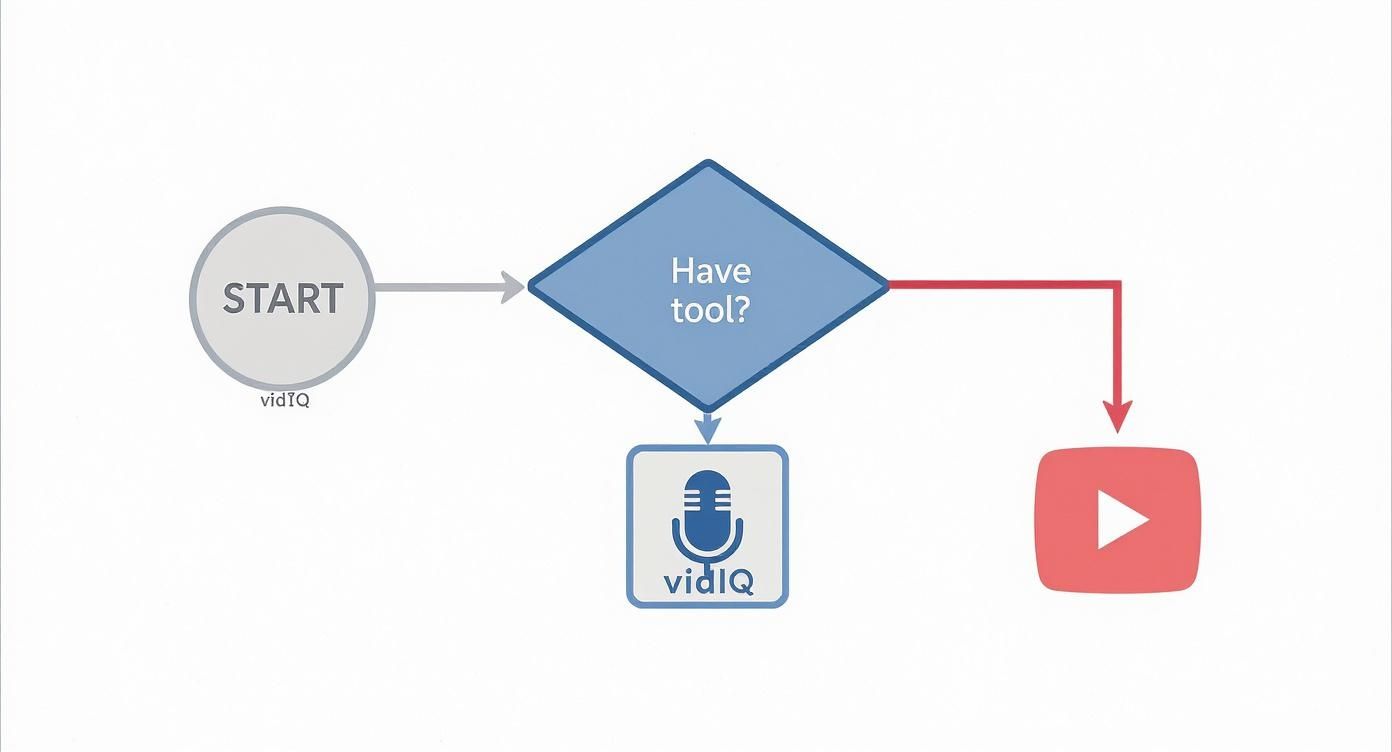
As you can see, even without fancy tools, YouTube’s own search bar is a surprisingly powerful path to keyword discovery.
Adopting a Scoring System
To cut through the clutter, I lean on a simple but incredibly effective scoring system. It balances three critical factors for every keyword on my list. Think of it like a three-legged stool—if one leg is weak, the whole thing tips over.
These are the three metrics I live by:
- Search Volume: How many people are actually looking for this term each month? Higher volume means more potential eyeballs on your content.
- Competition: How many other quality videos are already ranking for this term? Tools like vidIQ usually provide a score for this.
- Relevance: On a scale of 1-10, how perfectly does this keyword align with your channel's mission and what your ideal viewer needs?
That relevance score is your secret weapon. A keyword might have huge volume and low competition, but if it doesn't serve your audience, it’s a dead end. This is the human touch that pure data can't give you.
The Hunt for Golden Keywords
Your mission is to find what I call "golden keywords." These are the terms that hit the sweet spot: healthy search volume, manageable competition, and sky-high relevance to your niche.
For a brand new channel, a golden keyword might only have 500-1,000 searches per month, but crucially, it'll also have a "Very Low" competition score. Ranking for these helps you build that initial authority and get the ball rolling.
My Personal Tip: Don't get obsessed with massive search volume numbers, especially when you're starting out. It's far more effective to rank #1 for a keyword with 1,000 monthly searches than to be on page 10 for a keyword with 100,000 searches. The former brings you targeted viewers; the latter brings you crickets.
An established channel, on the other hand, can afford to target more competitive terms. They already have a subscriber base to give their videos that initial push, helping them go head-to-head with bigger players.
A Practical Prioritization Scenario
Let's walk through a real-world example to see how this works. Imagine you run a channel about "sustainable home gardening." After some research, you've got a list of potential keywords. Now it's time to score them.
Practical Keyword Prioritization Scorecard
To bring this to life, here’s how I would personally score and prioritize keywords for that gardening channel. This simple scorecard turns abstract data into a clear, actionable content plan.
| Keyword | Monthly Search Volume | Competition Score (1-100) | Relevance Score (1-10) | Final Priority Score |
|---|---|---|---|---|
| "gardening" | 500,000+ | 85 (Very High) | 7 | Low |
| "how to start a vegetable garden" | 75,000 | 70 (High) | 9 | Medium |
| "balcony vegetable garden for beginners" | 8,000 | 30 (Low) | 10 | High |
| "DIY drip irrigation system" | 3,500 | 18 (Very Low) | 10 | Very High |
In this scenario, "gardening" is a classic vanity keyword—it looks good, but it's too broad and competitive to be useful. "How to start a vegetable garden" is a solid medium-priority term, something to tackle once the channel has more authority.
The real winners here are the long-tail keywords. "Balcony vegetable garden for beginners" and "DIY drip irrigation system" have lower search volumes, but they are hyper-specific, face little competition, and are perfectly aligned with the channel's niche. These are your golden keywords. They attract a highly motivated audience that is way more likely to watch, engage, and subscribe because you solved their exact problem. This analytical approach ensures you’re making the best channel keywords for YouTube choices for sustainable growth.
Where to Place Your Channel Keywords for Maximum Impact

Discovering your golden keywords is a huge win, but it's only half the battle. Those carefully selected phrases don't do you any good sitting in a spreadsheet. To really put them to work, you have to place them strategically across your channel where YouTube’s algorithm is actively looking.
Think of your channel page as prime digital real estate. Certain spots are far more valuable than others for SEO, and knowing where to put the best channel keywords for YouTube is what turns your research into real growth. This isn't about stuffing keywords everywhere; it's about smart, natural placement.
Your Channel Description (The "About" Section)
If there's one place to get this right, it's your channel's "About" section. This description is indexed by both YouTube and Google, making it a critical piece of the puzzle for search and discovery. It's your first and best chance to tell the algorithm—and potential subscribers—exactly what you're all about.
The key is to write for humans first, algorithm second. Weave your main keywords into a compelling narrative that explains the value you provide.
- Front-Load Your Keywords: The first 100-150 characters are the most critical, as they often show up in YouTube search results. Nail your opening sentence by including your core keyword. For example, "Welcome to Sustainable Kitchen, your guide to delicious zero-waste recipes and practical eco-friendly living tips."
- Tell a Story: Use the rest of the description to elaborate on your channel’s mission, mixing in your secondary keywords naturally. Talk about who the channel is for and what problems you solve for them.
This section isn't just a list of terms; it’s a sales pitch for your channel. Make it both discoverable and persuasive.
The Official Channel Keywords Section
Beyond your "About" page, YouTube gives you a dedicated spot to list your channel keywords, sometimes called "channel tags." You'll find this in your YouTube Studio under Settings > Channel > Basic info. This is where you give YouTube direct, explicit signals about your overarching themes.
Expert Insight: You have a 500-character limit, but don't feel obligated to use it all. Aim for 5 to 15 highly relevant keywords. Studies suggest performance benefits drop off after about 200 characters, and overloading this section can just confuse the algorithm. Quality and precision beat quantity every time.
Your channel keywords should be a mix of broad and specific terms that define your niche.
Example for a "DIY Home Repair" Channel:
- DIY home repair
- home improvement tutorials
- beginner plumbing tips
- how to fix drywall
- electrical basics
- home maintenance
These keywords provide a clean, concise summary of your entire content library, helping YouTube recommend your channel to the right viewers.
Expanding Your Reach with Playlist Titles and Descriptions
Playlists are a massively underutilized SEO tool. When you group related videos, you create a brand-new asset that can rank in search on its own. By optimizing your playlist titles and descriptions with channel keywords, you give YouTube even more context about your content.
For instance, a channel about digital art could have playlists like:
- "Procreate Tutorials for Beginners"
- "Advanced Photoshop Painting Techniques"
- "Digital Art Character Design"
Each playlist title is a long-tail keyword in its own right. The playlist description then gives you another opportunity to naturally sprinkle in related keywords, which reinforces your topical authority and makes your content more binge-worthy.
And don't forget, you can also incorporate the best hashtags for YouTube alongside your keywords to add another layer of discoverability, especially within the mobile app.
Ultimately, placing your keywords is about creating a cohesive story for the algorithm. When your "About" section, channel tags, and playlist titles all align around a core set of topics, you send a powerful signal to YouTube that your channel is an authoritative voice in its niche.
Uncovering Hidden Keyword Opportunities
Your standard keyword tools and brainstorming sessions are a great start, but they often lead you down the same crowded highways everyone else is driving on. If you really want to get an edge, you have to venture off the beaten path. This means digging for the exact phrases and questions your audience is typing into search bars when the data-scraping tools aren't looking.
This is where you find keywords that are practically invisible to most creators. These are the golden nuggets that help you build a loyal, super-engaged community because you’re not just talking at them—you're speaking their exact language. It’s about getting into their heads, not just crunching numbers.
Reverse-Engineer Your Competitors
One of the quickest ways to find proven keywords is to peek over the shoulder of successful channels in your niche. I'm not talking about blindly copying them. This is about reverse-engineering their strategy to figure out what’s already resonating with the audience you both share.
First, pull up three to five channels that are killing it. Go to their channel page and start dissecting the language they use everywhere:
- Channel "About" Section: What are the very first things they say? These are their core themes.
- Video Titles: Look for patterns. Do they lean heavily on "how-to" videos, listicles, or reviews? Notice any recurring phrases.
- Playlist Names: Playlists are a goldmine. Channels build them around their core content pillars, basically handing you a list of their most important topics.
This whole process gives you a proven framework to start with. You can even use free online tools to pull a channel’s official keywords, giving you a direct look at how they're telling the YouTube algorithm what they're all about.
Mine Community Hubs for Raw Language
Keyword tools show you what people search for. Community forums show you how they talk about their problems and passions. This is where you find raw, authentic, high-intent keywords that most tools will never pick up on.
Hang out where your audience hangs out. Places like Reddit, Quora, and niche-specific forums are invaluable. Find subreddits or spaces related to your topic and just read. Pay close attention to the titles of threads where people are desperate for help or recommendations.
Pro Tip: Keep an eye out for phrases that start with "How do I…," "What's the best way to…," or "I'm looking for a…." These are pure, unfiltered long-tail keywords that signal a very specific need. You're essentially eavesdropping on your audience's biggest questions.
The comment section of popular videos in your niche is another goldmine. Scan through the comments and look for questions people are asking. If one person took the time to ask it, you can bet hundreds more are wondering the same thing. Every one of those questions is a potential video idea and a keyword to target.
Explore Shoulder Niches for Audience Expansion
Sometimes the best growth opportunities aren't right in front of you but in adjacent topics, or "shoulder niches." These are subjects your target audience is also into, even if it’s not the main focus of your channel.
For example:
- A channel about personal finance might discover their audience is also obsessed with minimalism or productivity hacks.
- A creator focused on landscape photography could easily branch into content about travel planning for photographers or drone videography basics.
Dipping your toes into these shoulder niches is a brilliant way to attract a broader audience without watering down your channel's core identity. You're introducing new viewers to your world who might then get hooked on your main content. It’s a clever strategy for finding the best channel keywords for YouTube that your direct competitors completely ignore.
This method is especially powerful for unearthing new long-tail keyword opportunities. To go even deeper on finding these specific, high-intent phrases, check out our complete guide on advanced long-tail keyword research. Exploring these related areas often uncovers keywords with less competition and highly engaged audiences, paving a sustainable path for real channel growth. When you combine smart competitor analysis with deep community listening, you build a keyword strategy that is both data-informed and genuinely connected to your audience.
Got Questions About Channel Keywords?
Even with a solid game plan, it's natural for questions to pop up, especially when you're tweaking your channel's SEO foundation. Nailing this stuff down builds the confidence you need to actually put these tactics to work. Let’s clear up some of the most common questions creators have about YouTube channel keywords.
What’s the Difference Between Channel Keywords and Video Tags?
Think of channel keywords as your channel's elevator pitch to the YouTube algorithm. They define your broad identity. These are the handful of core phrases (usually 5-15) you set in YouTube Studio that say, "Hey, this channel is all about 'beginner guitar lessons' and 'vegan meal prep.'" They paint a picture of your entire content world.
Video tags, on the other hand, are hyper-specific to one video. For a video called "Easy 3-Chord Songs on Acoustic Guitar," your tags would get granular: "3 chord guitar songs," "acoustic guitar for beginners," "easiest guitar songs," etc. While they might borrow from your channel keywords, video tags are all about the nitty-gritty details of that specific video.
How Often Should I Update My Channel Keywords?
Here's the short answer: almost never.
Once you have a clear vision and have locked in your keywords, let them sit for at least six to twelve months. This gives the YouTube algorithm plenty of time to really understand what your channel is about, categorize it, and start recommending your content to the right people.
If you're constantly swapping them out, you're basically hitting the reset button on the algorithm's learning process. This can seriously mess with your discoverability. The only time you should even think about an update is if you're making a massive, permanent pivot to a totally new niche. Otherwise, leave them alone and focus on creating great videos that align with them.
Can I Use a Competitor's Channel Name as a Keyword?
Technically, you can, but it's a terrible idea. Seriously, don't do it.
Using a competitor’s name as a keyword is a fast track to violating YouTube's misleading metadata policies. It’s a cheap tactic that might snag you a few clicks from people searching for that specific creator, but that traffic is junk.
Those viewers will realize they've been tricked, click away immediately, and tank your watch time. This sends a massive red flag to the algorithm that your content is a poor match, which will actively hurt your channel's reach in the long run. You're far better off building your own brand around keywords that describe what makes you unique.
Key Insight: Relevance is everything. A short, precise list of keywords that genuinely describes your content is infinitely more powerful than a bloated list of misleading or vaguely related terms. The goal isn't to attract any audience; it's to attract the right one.
How Many Channel Keywords Should I Actually Use?
YouTube gives you a 500-character limit, but don't feel like you need to cram it full. When it comes to channel keywords, quality beats quantity every single time. Overloading this section just dilutes your channel's focus.
Aim for a sweet spot of 5 to 15 highly relevant keywords. A good mix includes a few broad terms (like "home cooking") paired with more specific, niche-down phrases (like "30 minute meals for families"). This approach gives the algorithm both a high-level category and specific subtopics to work with, setting you up for discovery across a wider range of relevant searches.
Finding the best channel keywords is a great start, but the real growth happens when you implement them across your videos—especially in SEO-optimized chapters. With TimeSkip, you can automatically generate keyword-rich video chapters in seconds, boosting both your visibility and viewer retention. See the difference for yourself with two free video generations at TimeSkip.io.