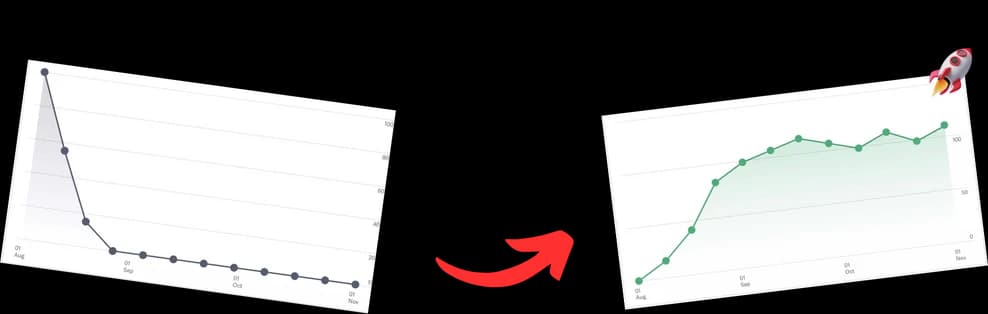
Beyond the first play, retention decides whether you have a business or a brief spike. That pressure is easy to see in mobile gaming benchmarks: one industry summary reports the median mobile game retains about 1% by Day 30, while even top-tier games often struggle to keep more than 4% by that point, and a related benchmark says many teams aim for about 30% Day 1 retention (mobile retention benchmark summary). Those numbers are brutal, but they're useful because they force clear thinking.
The best player retention strategies don't rely on one lucky feature. They combine onboarding, habit loops, relevance, support, and smart reactivation into a system that gives people reasons to come back after the novelty wears off. That applies to games, and it applies just as much to creator SaaS, workflow tools, and subscription products.
What works in practice is rarely mysterious. Users stay when they reach value fast, feel progress, get help without friction, and keep discovering useful reasons to return. What fails is also predictable: overpaying for acquisition while ignoring first-session friction, stuffing rewards on top of a weak core experience, or sending generic win-back emails to users who never activated in the first place.
Here's a practical playbook with ten retention tactics that hold up under real product pressure, with examples for game developers and SaaS creators.
1. Build a Habit with Gamification and Reward Systems

Daily loops work because they reduce the effort required to decide whether to return. In a major 2023 global survey, 67% of responding game studios said they used daily rewards and missions for retention, and achievements and challenges were the second-most common tactic, used by nearly six in ten studios (global survey on gamer retention tactics). That tells you this isn't a niche design trick anymore. It's standard operating practice.
For game teams, the obvious forms are login rewards, streaks, quest ladders, and achievement tracks. For SaaS creators, the equivalent is usage-based progress. TimeSkip, for example, could frame repeat chapter generation as streak-based publishing momentum, milestone achievements, or credit bonuses tied to consistent use.
What to build
A good reward system should make progress visible and tied to user intent.
- Visible progress: Use progress bars, streak counters, and milestone badges so users can see momentum.
- Meaningful rewards: Give something users already value, such as credits, access to templates, faster workflows, or advanced reporting.
- Mixed time horizons: Pair short loops like daily actions with longer goals like monthly challenges.
Duolingo does this well with streaks and XP. Canva uses tiered access and upgrade logic to keep users moving toward more capability. Figma can turn project completion and team collaboration into a sense of earned progress, even without overt game mechanics.
Practical rule: Reward the behavior that predicts retention, not the behavior that merely inflates activity.
The trade-off is simple. Overdo the mechanic and users feel manipulated. Underdo it and they don't notice it. The sweet spot is when the reward reinforces the product's native value. If a creator returns because they want better timestamps on the next upload, the reward system should support that workflow, not distract from it.
2. Create a For-You Feel with AI-Driven Personalization
A generic product experience makes users work too hard. Personalization reduces that work by curating the next best action, next piece of content, or next feature recommendation based on behavior.
Netflix and Spotify are the standard examples because they've trained users to expect relevance. But the same retention principle matters in non-media products. HubSpot can tailor dashboards by lifecycle stage. YouTube routes viewers toward watch paths that feel custom. A creator tool can suggest chapter structures, SEO prompts, or workflow shortcuts based on prior usage patterns.
Where personalization actually helps retention
Personalization matters most when the catalog is broad or the workflow has multiple branches.
- Feature discovery: Recommend the next feature based on what a user already does often.
- Content relevance: Surface templates, actions, or examples tied to a user's niche.
- Churn prevention: Flag behavior changes early, then tailor prompts before the user lapses.
For a tool like TimeSkip, that could mean showing podcasters one kind of chapter recommendation, tutorial channels another, and interview-based creators something else again. If users repeatedly edit generated timestamps in the same way, the product should learn from that and pre-shape the output.
What doesn't work is shallow personalization. Greeting someone by first name is not a retention strategy. Recommending the wrong workflow because two users look similar on paper can also backfire. Start with rules before fancy models. Segment by intent, use case, content type, and repeat behaviors. That's usually where useful personalization begins.
3. Foster Belonging Through Community and Social Features

People stay longer when the product becomes part of a social identity. That's why communities outperform newsletters and one-way product announcements over time. If users form relationships, share tactics, and compare results, leaving the product starts to feel like leaving a group, not just canceling a tool.
Figma, Notion, Slack, and Substack all benefit from this. Their retention doesn't come only from features. It also comes from shared templates, collaborative habits, peer learning, and public examples of success. For creators, that's especially powerful because they often learn by watching how other creators package and distribute work.
Community features that do more than look good
A Discord server with no conversation won't help retention. A forum full of unanswered posts can hurt it.
What does work:
- Weekly showcases: Highlight strong creator outputs, smart workflows, or unusual use cases.
- Live learning: Host office hours, webinars, or teardown sessions users can apply immediately.
- Peer contribution: Let users share templates, frameworks, or examples others can copy.
If you're building around creators, a structured community strategy beats casual posting. TimeSkip's own guide to community management strategy is the right kind of operational lens here. Community isn't just moderation. It's programming, recognition, and feedback loops.
Community works best when users get status from contributing, not just consuming.
The trade-off is operational overhead. Community is hard to fake and expensive to neglect. If your team can't sustain it, start smaller. A monthly creator spotlight series and a focused private group often retain users better than a sprawling “community” space with no energy.
4. Stay Relevant with Continuous Product Innovation
Retention usually drops when users feel they've seen everything your product can do. This is especially dangerous after the novelty window, when the initial excitement wears off and habits haven't fully formed.
Recent retention coverage has pushed this point hard: the core problem often appears when content variety slows, live-ops cadence slips, or teams rely too much on blanket promotions instead of operational rhythm and selective re-engagement (player retention after the novelty window). That's a useful warning for both games and SaaS. Big launch energy doesn't protect you from later boredom.
Innovation that users can feel
Users don't need constant reinvention. They need visible proof that the product is improving in ways that matter.
For game teams, that can mean event cadence, balance updates, fresh progression layers, and new reasons to re-enter old systems. For SaaS, it usually means a mix of headline features and small quality-of-life improvements. Figma's release rhythm works because major launches are paired with practical enhancements people notice in the week-to-week workflow.
A strong release cadence usually includes:
- Roadmap clarity: Show users what's coming and who it's for.
- Small wins: Improve speed, UI friction, defaults, and reliability every month.
- Targeted launches: Ship features for specific segments rather than chasing broad applause.

The common mistake is shipping novelty that doesn't deepen value. A flashy feature might attract clicks but still fail to improve retention if it doesn't fit the user's core job. Prioritize releases that remove recurring friction or expand utility for existing users.
5. Win at Day One with Flawless Onboarding and Activation
Most retention problems start as onboarding problems. If users don't experience value fast, they rarely give you a second chance.
That's why Day 1, Day 7, and Day 30 are treated as core retention windows in industry practice. They tell you whether onboarding worked, whether early engagement held, and whether the product built staying power. In products with steep drop-off, the first session carries more weight than is often acknowledged.
Activation before education
The best onboarding gets users to a meaningful outcome before it explains everything. Slack does this with fast workspace setup. Loom gets users recording quickly. Zapier leans on templates so people don't begin from a blank page.
For games, activation might mean completing a satisfying first match, earning an early upgrade, or reaching a social interaction quickly. For creator SaaS, activation is usually the first successful output.
With a tool like TimeSkip, a strong activation flow would focus on one thing first: generate useful chapters from a real video with as little setup friction as possible. Explanations about advanced options can wait until after that success moment.
What works:
- Reduce choices: Don't show five advanced options before the first win.
- Use progressive disclosure: Reveal more capability after the user succeeds once.
- Shorten time to value: The user should feel the product helping before they start comparing alternatives.
A lot of onboarding fails because teams confuse feature exposure with activation. Users don't retain a product because they saw the menu. They retain it because they got value they can picture using again.
6. Build Trust with Transparent and Flexible Pricing
Pricing affects retention more than many product teams admit. Confusing plans, sudden limits, and unclear upgrade logic create churn even when users like the product itself.
The best pricing systems help users understand what they get, when they should upgrade, and whether the cost scales sensibly with value. Canva, Notion, Buffer, and Figma all benefit from this kind of clarity. Even when users don't upgrade immediately, they can understand the path.
What pricing should communicate
Pricing should answer three questions quickly: what's included, who the plan is for, and what happens when usage grows.
For game products, this shows up in battle passes, subscriptions, premium currencies, and cosmetic bundles. For SaaS, it's usually tiered plans, usage allowances, and optional upgrades. TimeSkip already has a clear product shape to work with because it offers two free generations without a credit card and uses Creator, Pro, and Lifetime plans.
A practical pricing setup usually includes:
- Clear segmentation: Separate solo users from power users and teams.
- Low-friction trial: Let people reach value before asking for commitment.
- Simple upgrade cues: Trigger plan suggestions based on actual usage, not constant nags.
The trade-off is between simplicity and monetization precision. More plans can improve fit, but too many plans create hesitation. If users need a spreadsheet to understand your pricing, retention will suffer because trust erodes before the renewal question even arrives.
7. Prove Your Value with Data-Driven Performance Insights
If users can't see the result of using your product, many will assume the result isn't there. Analytics turn invisible value into visible proof.
That matters in every retention model. Social teams want to know which posts worked. Sales teams want to know which activities moved deals. Creators want to know whether formatting, packaging, and metadata improved discoverability or engagement.
Show cause and effect
The strongest dashboards tie product usage to outcomes users care about. Hootsuite, Buffer, HubSpot, and Mixpanel all do this in different ways. They don't just report activity. They connect actions to performance.
For a creator workflow, analytics should answer practical questions:
- What changed after I used this feature?
- Which outputs performed best?
- What should I do next based on the pattern?
TimeSkip users already think in terms of visibility, watch behavior, and navigability, so product reporting should follow that logic. The company's own discussion of YouTube video analytics fits here because retention improves when users can connect formatting choices to content performance.
Users rarely churn because they hate value. They churn because they can't see it clearly enough to justify another session or another bill.
What doesn't work is vanity analytics. If the dashboard is full of charts but light on decisions, users stop checking it. Show trend movement, comparisons, and next actions. Make the report useful enough that users would miss it if it disappeared.
8. Prevent Churn with Proactive Customer Success
Support is often treated as a service function when it should be treated as a retention system. That's a mistake. Users often churn at moments of friction, confusion, or interruption, not after a formal evaluation of your product roadmap.
Support-focused retention thinking makes this explicit. Players leave when they have to exit the experience to get help, repeat themselves across channels, or wait for help in the wrong language or time zone. The retention gain comes from reducing friction in the moment, with in-product help, preserved context, and proactive intervention before churn becomes obvious (support as a retention lever).
What proactive support looks like
Reactive support answers tickets. Proactive customer success notices risk early and intervenes before the user mentally checks out.
For games, that might mean surfacing help after repeated failed actions, payment friction, or live-event confusion. For SaaS, it often means usage monitoring, milestone nudges, onboarding outreach, and contextual guidance. Notion, Slack, Salesforce, and Intercom all lean on some version of this model.
Useful tactics include:
- In-app help first: Solve small issues without forcing users into email.
- Context preservation: If escalation happens, don't make users repeat the issue.
- Risk-based outreach: Contact users after usage drops, stalled setup, or repeated failure states.
For creator products, customer success should connect support to outcomes. TimeSkip's write-up on YouTube audience retention points in that direction. Help shouldn't stop at “feature works as intended.” It should move toward “here's how to use it better so your videos are easier to watch.”
The trade-off is cost. Human support doesn't scale infinitely. That's why the best teams automate triage and basic assistance, then reserve human judgment for moments that influence long-term retention.
9. Become Indispensable via a Rich Integration Ecosystem
A product becomes harder to leave when it's embedded in the user's existing workflow. That's the retention power of integrations.
Zapier, Slack, Figma, and IFTTT all benefit from this dynamic. Once your product sits between other tools, powers automation, or becomes the place where data flows through, switching gets expensive in time and mental load even before price enters the conversation.
Integrations that increase stickiness
Not all integrations help retention. Some are marketing checkboxes. The useful ones reduce repetitive work or connect your product to a high-frequency task.
For game teams, integrations may involve identity, community, payments, streaming, and messaging. For creator SaaS, it's usually publishing, storage, analytics, and automation.
High-retention integrations tend to do one of three things:
- Remove duplicate work: Pull data in automatically or push outputs out without copy-paste.
- Trigger workflows: Start actions based on uploads, events, or publishing milestones.
- Centralize context: Keep related assets and decisions connected.
For TimeSkip, obvious examples include tighter YouTube workflow integration, Google Drive storage connections, automation via Zapier, or webhook support for custom content pipelines. Those integrations don't just add convenience. They make chapter creation part of the publishing process itself.
The warning here is maintenance burden. Each integration increases support surface area. Build the ones that support your strongest retention motion first, then expand based on real usage rather than marketplace vanity.
10. Recover Lost Users with Smart Win-Back Campaigns
Not every user who leaves is gone for good. Many lost momentum, hit friction, or never saw enough value to build a habit. A good win-back campaign diagnoses which of those happened and responds accordingly.
Blanket “we miss you” emails don't do much. Segmenting by last meaningful action works better. Someone who activated and lapsed needs a different message from someone who signed up, clicked around, and vanished.
Win-back that respects why users left
The strongest reactivation flows combine timing, segmentation, and a clear reason to return.
Netflix and Spotify are common examples of re-engagement because they can point users back to fresh content. SaaS products have to be more deliberate. They need to highlight a new capability, remove old friction, or make the next action obvious.
A practical win-back sequence often includes:
- Behavior-based triggers: Reach out after inactivity that matters, not arbitrary silence.
- What changed: Show a new feature, simpler workflow, or better fit since the user left.
- Low-friction return path: Give them one clear action, not a tour of everything new.
For a creator product, that could mean reaching out to users who stopped generating chapters, then showing updated keyword support, simpler publishing steps, or a quick way to process the next video. If possible, ask why they stopped. Churn feedback often exposes onboarding gaps, pricing confusion, or missing integrations that product analytics alone won't reveal.
The trade-off is frequency. Too many win-back attempts feel desperate. Too few and you miss recoverable users. Tie outreach to meaningful product moments, and stop once the signal is clear.
10-Point Player Retention Strategies Comparison
| Item | 🔄 Implementation Complexity | ⚡ Resource Requirements | 📊 Expected Outcomes | 💡 Ideal Use Cases | ⭐ Key Advantages |
|---|---|---|---|---|---|
| 1. Build a Habit with Gamification and Reward Systems | Medium, design + tuning of reward loops | Low–Medium, UI, tracking, minor backend | 📊 Strong DAU/engagement uplift; habit formation | Creators needing repeat usage and retention | ⭐ Clear progression, high engagement ROI |
| 2. Create a "For-You" Feel with AI-Driven Personalization | High, ML models + data pipeline | High, data engineering, privacy, ML ops | 📊 Large satisfaction & LTV gains; better feature adoption | Platforms with diverse creator behaviors | ⭐ Deeply tailored UX; reduces onboarding friction |
| 3. Foster Belonging Through Community and Social Features | Medium–High, moderation & social design | Medium, community managers, platform features | 📊 Network effects, longer sessions, organic advocacy | Building creator networks and peer learning | ⭐ User-generated content and word-of-mouth growth |
| 4. Stay Relevant with Continuous Product Innovation | High, ongoing roadmap execution | High, R&D, QA, product management | 📊 Keeps product fresh; drives re-engagement and PR | Competitive markets requiring constant improvement | ⭐ Sustains retention and justifies premium pricing |
| 5. Win at Day One with Flawless Onboarding and Activation | Low–Medium, UX flows & content production | Low–Medium, tutorials, tooltips, small dev changes | 📊 Immediate lift in Day‑1/Day‑7 activation and conversion | New-user acquisition and free-trial optimization | ⭐ Fast time-to-value; lowers early churn |
| 6. Build Trust with Transparent and Flexible Pricing | Low, pricing strategy and UI clarity | Low–Medium, billing, marketing, legal | 📊 Higher conversion and reduced price friction | Monetization improvements and segmenting users | ⭐ Clear value signals; easier trial-to-paid conversion |
| 7. Prove Your Value with Data-Driven Performance Insights | Medium–High, analytics + integrations | Medium–High, API integration, storage, dashboards | 📊 Demonstrable ROI; better retention via feedback loops | Users who need measurable impact and ROI proofs | ⭐ Converts usage into measurable business outcomes |
| 8. Prevent Churn with Proactive Customer Success | Medium, processes + tooling | High, human success managers, support ops | 📊 Reduced churn and higher LTV for supported users | High-value or enterprise creators | ⭐ Personalized retention and deep customer insight |
| 9. Become Indispensable via a Rich Integration Ecosystem | High, multiple third‑party integrations | High, engineering, maintenance, partner ops | 📊 Increased daily usage; higher switching costs | Creators with established workflows needing automation | ⭐ Seamless workflows and automation that lock in users |
| 10. Recover Lost Users with Smart Win-Back Campaigns | Medium, data segmentation + campaigns | Medium, marketing automation, analytics | 📊 Cost-effective revenue recovery and insights on churn | Lapsed users and seasonal churn patterns | ⭐ Efficient reactivation with targeted offers and messaging |
Your Retention Playbook Starts Now
Retention isn't one feature, one dashboard, or one email sequence. It's the sum of the small decisions that make a product worth returning to. That's why the strongest player retention strategies are rarely isolated tactics. They work because they reinforce each other.
Onboarding gets users to first value. Gamification gives them a reason to come back soon. Personalization helps the product feel relevant instead of generic. Community makes the experience social, not solitary. Product innovation keeps boredom from setting in. Pricing preserves trust. Analytics prove the product is helping. Customer success catches friction before it turns into churn. Integrations weave the product into daily routines. Win-back campaigns recover people who slipped away but still have a reason to return.
In practice, not all ten strategies are needed simultaneously. The focus should be on the right next move. If activation is weak, start there. If users activate but vanish after the novelty window, focus on cadence, personalization, and support. If the product is sticky among power users but weak among everyone else, pricing clarity and performance visibility are often better bets than adding another feature.
The same principle applies whether you're running a game studio or a creator-focused SaaS product. Retention improves when you remove uncertainty. Users should know what to do next, why it matters, and how the product is helping them succeed. Every point of confusion increases the chance they drift away. Every point of clarity increases the odds they stay.
One more practical point. Don't try to “save retention” with incentives alone. Rewards help. Discounts help. Re-engagement campaigns help. But if the product doesn't create repeated value, those tactics only delay churn. Build the habit loop around real utility, then add mechanics that strengthen it.
If you work in creator tools, that can be very concrete. A product like TimeSkip fits into retention thinking when it helps users make long videos easier to browse, easier to discover, and easier to reuse as part of a repeat publishing workflow. That's the kind of utility users can build habits around.
Pick one weak point in your journey and fix it well. That's how retention improves in practice. Not through slogans, but through tighter loops, clearer value, and fewer reasons to leave.
If you want a simpler way to turn long YouTube videos into navigable chapters as part of a repeat publishing workflow, TimeSkip is one option to explore. It automates chapter and timestamp generation inside YouTube, offers two free generations without a credit card, and can help creators make long-form content easier to scan and return to.