A long-tail keyword strategy is all about targeting those super-specific, multi-word search phrases to pull in viewers who know exactly what they want. Instead of duking it out for broad, high-volume terms, you’re capturing qualified traffic from people who are way past the window-shopping phase. They’re ready to learn or buy, which often means much higher conversion rates for you.
Why Long-Tail Keywords Are Your Secret Weapon for YouTube Growth
If you're making videos for YouTube, you've probably felt that pull to rank for the big, popular, single-word keywords. Maybe you’re targeting something like "baking" or "video editing," only to see your hard work get completely buried under thousands of videos from channels with massive followings. It feels like shouting in a packed stadium and hoping someone, anyone, hears you.
Honestly, it’s a frustrating and exhausting uphill battle.
But what if you could just… step around all that competition? That’s where a long-tail keyword strategy comes in. It’s a simple but powerful shift: you stop chasing those broad "head" terms and start focusing on the longer, more conversational phrases that real people are typing into the search bar when they need specific answers.
The Evolution of Searcher Intent
Just think about how you actually use YouTube or Google. You almost never just type "baking." You’re usually looking for something specific, right?
- "how to get a sourdough starter to rise in cold weather"
- "beginner's guide to decorating sugar cookies without special tools"
- "what's the best vegan substitute for eggs in a cake recipe"
Every single one of these is a long-tail keyword. They don't just hint at what the user wants—they spell it out perfectly. The person searching isn't just casually browsing; they have a real problem and they're on a mission to find a solution. When your video is that exact solution, you don't just get a fleeting view. You earn a genuinely grateful and engaged subscriber.
This isn't just a hunch; it's a fundamental change in how people search. When you target these detailed questions, you're lining up your content with what the vast majority of modern searchers are actually doing.
Escaping the Competition Trap
The real beauty of a long-tail strategy is that anyone can do it. A term like "video editing" is a shark tank of competition. But a specific phrase like "how to color grade cinematic drone footage in DaVinci Resolve"? That’s a much smaller, more focused pond. The competition is way lower, giving your video a real shot at ranking right at the top.
You stop fighting for scraps of attention from a huge, indifferent audience. Instead, you become the go-to expert for a dedicated niche. Believe me, that’s how you build real authority and trust—way more effectively than just chasing vanity metrics.
To illustrate this, let's break down the practical differences.
Short-Tail vs Long-Tail Keywords: A Practical Comparison
This table really drives home the key differences in intent, competition, and conversion potential for a hypothetical YouTube channel.
| Attribute | Short-Tail Keyword (e.g., 'Video Editing') | Long-Tail Keyword (e.g., 'How to color grade cinematic drone footage') |
|---|---|---|
| Search Volume | Very High | Low to Moderate |
| Competition | Extremely High | Low |
| Searcher Intent | Broad, informational, often browsing | Highly specific, looking for a direct solution |
| Conversion Potential | Low | High |
| Content Focus | General overview, broad topic | Niche, step-by-step tutorial, specific solution |
| Audience | Wide, unfocused | Targeted, highly engaged |
As you can see, the value isn't just in the volume—it's in the quality and intent of the viewer you attract.
Connecting with High-Intent Viewers
This entire strategy is fueled by a simple, undeniable trend: people are getting more and more specific with their searches. We’re all using detailed, conversational queries now. The data is pretty staggering—an incredible 91.8% of all search queries are long-tail keywords.
These phrases drive around 70% of all web traffic. Even more telling? These specific searches convert at a rate 2.5 times higher than their short-tail counterparts. That means the user is ready to take action. If you want to dig deeper into the numbers, check out these secrets of keyword research.
What this data really confirms is that by ignoring a long-tail keyword strategy, creators are leaving the vast majority of their potential audience on the table.
When you create content that directly answers these detailed questions, you attract viewers who are already invested. They're far more likely to watch longer, engage with your comments, and see you as a credible expert they can trust. This is how small channels grow into authorities—not by being the loudest, but by giving the clearest, most helpful answers to the right questions.
How to Uncover High-Value Long Tail Keywords
Alright, so you get why long-tail keywords are a game-changer. But moving from theory to practice—actually finding the right ones—is where the real magic happens. The good news? You don't need a bunch of expensive tools to get started. In fact, the best ideas are usually hiding in plain sight, using the exact language your audience uses every single day.
To dig up these gems, you need to master a few proven methods for how to find YouTube keywords that actually connect with people. This isn’t about guessing; it's about strategic listening.
Think about how a search evolves. It starts vague, gets a little more specific, and then drills down into a high-intent question your video can answer perfectly.
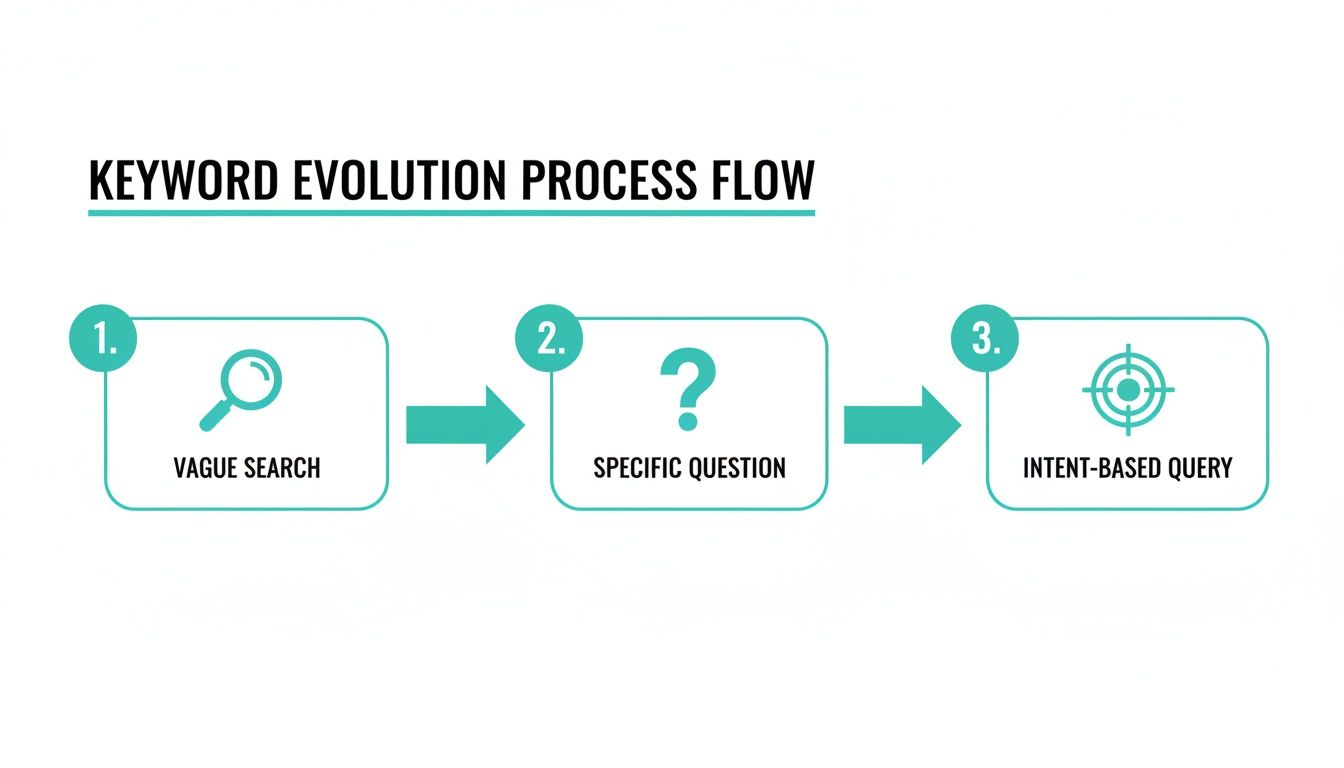
This is the natural path viewers take. They go from general curiosity to a very specific need, and that's exactly where a sharp long-tail keyword comes in.
Mine YouTube and Google Search Features
Your first stop should be the search bars themselves. They're a direct pipeline into what your potential viewers are thinking, showing you what they're looking for in real-time.
YouTube Search Autocomplete is your best friend here. Start typing a broad topic related to your channel—say, "home workout"—and just watch the suggestions that pop up.
- "home workout for beginners no equipment"
- "home workout plan to build muscle"
- "home workout for weight loss women"
These aren't just random phrases. They are the most common searches people are making around your seed keyword. Each one is a potential video topic with a built-in audience.
Don't forget Google's People Also Ask (PAA) box. Search for one of your core topics and scroll down. You'll find a goldmine of questions you can use for video titles, video chapters, or even an entire content series.
Listen to Your Own Community
Honestly, your most valuable source of keyword ideas might just be your existing audience. The people already watching your content are literally telling you what they want to see next. You just have to listen.
Dive into your video comment sections. Hunt for the questions, the pain points, and the specific words people use to describe their problems. If one person asks, "how do you get the audio to sound less echoey in a big room?" you can bet others are wondering the same thing. That question is a perfect, naturally phrased long-tail keyword.
This approach gives you ideas that are already validated by your target demographic. Plus, creating videos that directly answer audience questions is one of the fastest ways to build a fiercely loyal community.
By focusing on these specific, user-generated queries, you sidestep the intense competition of broader terms. This creates genuine ranking opportunities where smaller channels can thrive.
Use Free Tools to Find Question-Based Keywords
Beyond YouTube and Google, a few free tools can speed up your research and help you find keywords you might have otherwise missed. These platforms are built to organize search data around questions, making them perfect for a long-tail strategy.
-
AnswerThePublic: This is a fantastic tool for visualizing search questions. Pop in a broad keyword, and it spits out mind maps of queries broken down by questions (who, what, why), prepositions (for, with, to), and comparisons (vs, and, or).
-
Google Trends: While it's great for spotting broad trends, its "related queries" feature can unearth breakout long-tail keywords. This helps you jump on rising search interest before a topic gets totally saturated.
By combining these methods, you build a solid system for discovering high-value keywords. The goal is to create a targeted list of phrases that have realistic search volume and low competition, giving your videos the best possible shot at getting discovered. For a deeper dive into this discovery phase, check out our guide on https://timeskip.io/blog/long-tail-keyword-research.
Weaving Keywords Into Your Video Content
Alright, so you’ve got a solid list of high-potential long-tail keywords. That’s a great start, but it's just that—a start. The real magic in a long tail keyword strategy happens when you skillfully weave these phrases into the very fabric of your video. This is how a simple list transforms into a roadmap for content that both search algorithms and actual human viewers will love.
This isn’t about awkwardly stuffing keywords where they don’t fit. It's about strategically building your video’s narrative around them. This creates a natural, valuable viewing experience that sends all the right relevance signals to YouTube and Google. Once you’ve pinpointed your high-value keywords, using the right content optimization features is key to making sure everything flows naturally while maximizing your search visibility.
Build Your Script Around a Primary Keyword
First things first: pick one primary long-tail keyword to be the North Star for your video. This phrase should nail the core problem you're solving or the main question you're answering. Think of it like the title of a book—it sets the expectation and provides the central theme for everything that follows.
For example, if your primary keyword is "how to set up a home podcasting studio on a budget," every single part of your script should directly support that topic. You'd structure your video to walk the viewer through that exact process, mentioning the main phrase naturally in your intro, conclusion, and maybe a few times in between.
This laser-focused approach gives your video a clear purpose and delivers exactly what the viewer was searching for.
Use Secondary Keywords for Video Chapters
This is where you can seriously multiply your video's reach. All those other valuable, related long-tail keywords you found? They're perfect candidates for your video chapters. By mapping these secondary keywords to specific segments of your video, you create a structured, easy-to-navigate experience.
More importantly, you're telling the YouTube algorithm exactly what sub-topics you cover in detail. A single video can suddenly start ranking for dozens of different search queries.
Let's say your main video is about "common beginner gardening mistakes to avoid." You could structure your chapters using secondary long-tail keywords like this:
- 00:00 - Introduction to Common Gardening Mistakes
- 01:15 - Choosing the wrong soil for your container plants
- 03:45 - How much water is too much for tomato plants
- 06:20 - Best way to manage pests without chemicals
- 09:00 - Understanding sunlight needs for different vegetables
Each chapter title is a specific, searchable phrase that tackles a distinct part of your main topic. This strategy has a powerful two-part punch.
First, it massively improves the viewer experience. People can instantly jump to the information they need, which boosts watch time and session duration—two metrics YouTube's algorithm absolutely loves.
Second, it gives YouTube incredibly precise data. The algorithm now understands your video isn't just a generic piece on "gardening mistakes." It's also a highly relevant answer for someone specifically searching for "how much water is too much for tomato plants." This chapter-based optimization is a cornerstone of any killer long-tail keyword strategy.
Speak Your Keywords Naturally
As you're writing your script, remember to actually say these keywords conversationally. Don't try to cram them into sentences where they sound robotic or forced. Your on-camera delivery needs to sound authentic and genuinely helpful.
Think about how you'd explain the concept to a friend. You'd naturally use specific phrases to get your point across. For instance, when talking about soil, you might say, "Now, one of the biggest issues people run into is choosing the wrong soil for your container plants, because potted plants just have different needs…"
This natural integration makes your video feel authentic while still hitting all the SEO marks. By planning your script around one primary keyword and structuring it with secondary keywords as chapters, you create a deeply optimized video that serves both your audience and the algorithm, setting you up to drive targeted organic traffic for years to come.
Automating Your Video Chapters with TimeSkip
Mapping out your secondary keywords and crafting a detailed script is a huge part of a solid long tail keyword strategy. But let’s be honest, the manual work that comes next can be a real grind. Scrubbing through an hour-long video, trying to pinpoint the exact start and end times for each sub-topic, and then writing keyword-rich chapter titles? That can easily burn an entire afternoon.
For many creators, this manual slog is the biggest bottleneck preventing them from consistently optimizing their content for search.
This is where automation stops being a simple convenience and becomes a real strategic advantage. Instead of pouring your creative energy into the tedious job of timestamping, you can let a specialized tool handle the heavy lifting. This frees you up to focus on what actually grows your channel: creating fantastic content.
A Smarter Workflow for Chapter Creation
Imagine turning that entire, painstaking chapter creation process into a single click. That’s the whole idea behind tools built to automate this workflow. By analyzing your video’s transcript, AI can instantly identify the main topics you discussed, find their exact timing, and generate descriptive, SEO-friendly chapter titles based on the actual words you spoke.
This isn’t just about saving time, either. It’s about achieving a level of optimization that’s often tough to do by hand. AI can spot keyword patterns and subtle thematic shifts within your transcript that you might miss, making sure every potential long-tail ranking opportunity is captured.
The screenshot below shows just how simple the TimeSkip Chrome extension is, working right inside your YouTube Studio.
As you can see, it integrates seamlessly. You can generate chapters with one click without ever having to leave the page you’re already on.
How AI-Powered Chapter Generation Works
The process itself is surprisingly straightforward but incredibly powerful. Once you install a tool like the TimeSkip Chrome extension, it just adds a new button directly into your YouTube upload or editing screen.
When you're ready to add chapters, you just click the "Generate with TimeSkip" button. The tool’s AI then gets to work in the background, knocking out several key tasks in just a few seconds:
- Transcript Analysis: It grabs and analyzes your video's full transcript, breaking down the entire conversation.
- Topic Identification: The AI figures out the core thematic sections of your video, recognizing when you pivot from one sub-topic to the next.
- Keyword Extraction: From each of those sections, it pulls out the most relevant phrases and long-tail keywords.
- Chapter Generation: Finally, it uses all that information to create accurate timestamps and craft concise, keyword-optimized titles for each chapter.
What you get is a complete, ready-to-paste set of chapters that perfectly aligns with the content you created. This approach ensures your timestamps aren't just there for viewers, but are engineered from the ground up to maximize your search visibility.
By automating this part of your workflow, you guarantee that every single video is perfectly structured to rank for dozens of related long-tail queries. It turns chapter creation from a chore into a consistent, powerful SEO tactic.
From Manual Labor to Strategic Advantage
Let's walk through a real-world scenario. You just wrapped up a 45-minute podcast episode on "starting an e-commerce business." The old way of doing things would mean you have to re-watch the whole thing, jot down timestamps for segments like "choosing a niche," "setting up a Shopify store," and "marketing your first product," and then come up with titles. That could easily take an hour, maybe more.
With an automated tool, you just click a button. In about five seconds, you get a perfectly formatted list of chapters like this:
- 00:00 - Introduction to Your E-commerce Journey
- 04:32 - How to Find a Profitable Niche
- 11:18 - Shopify vs WooCommerce Which Platform is Best
- 22:45 - Essential Tips for Product Photography
- 35:10 - Your First Social Media Marketing Campaign
Notice how each chapter title is a valuable long-tail keyword on its own. This AI-driven efficiency lets you implement a sophisticated long tail keyword strategy across your entire library of content without the burnout. You can learn more about how TimeSkip boosts video visibility and see how it can fit into your own workflow. The impact is huge, turning a time-sucking task into a scalable advantage for your channel's growth.
Weaving Long-Tails Into Your Video Metadata
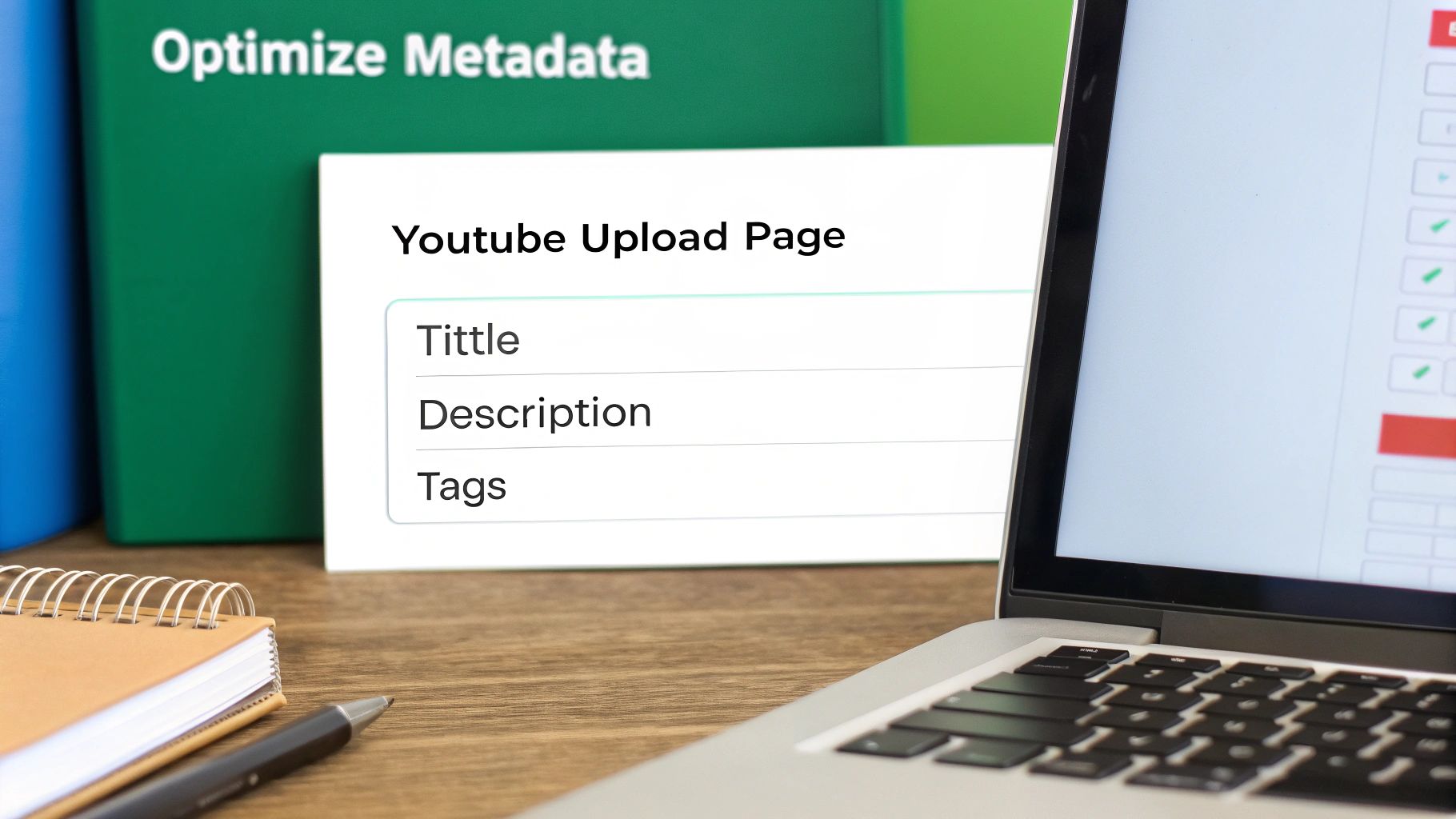
You could create the most helpful video in the world, but if its packaging—the title, description, and tags—is an afterthought, you're hiding your masterpiece in a locked room. This metadata is the first thing YouTube's algorithm looks at to figure out what your video is all about. A solid long-tail keyword strategy lives or dies by how well you handle this.
Think of your metadata as the language you use to talk directly to the search algorithm. Nail it, and your video gets served up to the exact people searching for the solutions you offer.
Crafting Click-Worthy Titles
Your video title is doing double duty. It has to include your main keyword for the algorithm, but it also needs to be interesting enough for a real person to actually click on it. The best approach is to lead with your primary long-tail keyword whenever you can. This gives searchers instant confirmation that your video is what they're looking for.
A generic title like "Gardening Tips" is just digital noise. But something like "How to Grow Tomatoes in a Small Balcony Garden - Complete Beginner's Guide"? That's specific, packed with keywords, and promises a clear outcome.
Front-Loading Your Video Description
Those first two sentences of your YouTube description are prime real estate. This is the snippet that shows up in search results and sits right above the "Show more" button. You absolutely have to get your most important primary long-tail keyword in there, along with a compelling hook.
This is called "front-loading," and it works on two levels. It immediately signals relevance to the YouTube algorithm while also confirming to the viewer that they’ve found the right video, which is a huge boost for your click-through rate.
Key Takeaway: Don't bury the lead. Assume both viewers and the algorithm will only read the first 25 words of your description. Make them count by stating exactly what the video is about, using your primary keyword.
Once you’ve nailed that crucial opening, you can flesh out the rest of the description. This is your chance to organically weave in your secondary long-tail keywords. I like to think of it as writing a mini-blog post that gives the algorithm all the context it needs. You can get a deeper dive into this process in our guide to optimizing metadata for YouTube.
- Provide a detailed summary: Briefly explain the main points covered in the video.
- Include timestamps: Drop in your keyword-optimized chapter list for easy navigation.
- Link to relevant resources: Share links to your website, social media, or related videos.
This turns your description from a simple summary into a powerful SEO asset that helps you rank for a much wider range of search terms.
Making Sense of Video Tags
Video tags aren't as critical as they once were, but they still help YouTube understand your content—especially if your title or description uses ambiguous terms. A strategic mix of broad and long-tail keywords is the way to go.
Start with your most specific, primary long-tail keyword as the very first tag. This just reinforces the video's main topic. From there, add your secondary keywords, which should line up nicely with your video chapters.
Finally, sprinkle in a few broader, single-word tags to provide that high-level context.
Example Tag Strategy:
- Primary Long-Tail: "how to grow tomatoes in a small balcony garden"
- Secondary Long-Tails: "best container size for tomatoes," "balcony gardening tips for beginners," "how often to water potted tomatoes"
- Broad Terms: "gardening," "tomatoes," "container gardening," "urban gardening"
This structured approach tells YouTube exactly what your video is about, who it’s for, and the specific problems it solves. By optimizing these three pieces of metadata together, you create a powerful, cohesive signal that dramatically increases your video's chances of getting discovered.
Answering Your Long-Tail Keyword Questions
Jumping into a long-tail keyword strategy can feel like a big shift. It's totally different from just chasing those massive, broad terms everyone else is fighting for. Instead, you're focusing on precise, intent-driven phrases.
Let's walk through some of the most common questions that pop up when creators start heading down this path. I'll give you straight answers to help you get this strategy rolling with confidence.
How Many Long-Tail Keywords Should I Actually Target in a Video?
It’s tempting to stuff a video with keywords, but a focused approach always wins. Think of it this way: pick one primary long-tail keyword to be the heart and soul of your video. This is the phrase that’s going to anchor your title and your intro, telling both viewers and the algorithm exactly what to expect.
From there, you can sprinkle in 5-10 secondary long-tail keywords. These are perfect for building out your video chapters and fleshing out your description. The goal isn't to just list them out; it's to naturally answer a cluster of related questions. For example, a video centered on "how to start a podcast for beginners" could easily have chapters like "best budget microphones for podcasting" and "free podcast editing software." You're creating a comprehensive resource, not a keyword salad.
Will Targeting Niche Keywords Limit My Video's Reach?
This is a huge fear, I get it. The idea that focusing on smaller keywords will shrink your audience seems logical, but in practice, the opposite is often true. Sure, a single long-tail keyword has less search volume than a monster term like "podcasting," but ranking at the top for it drives incredibly qualified traffic. These aren't just random viewers; they're people actively searching for the exact solution you're providing.
Plus, a well-optimized video never ranks for just one phrase. It will naturally start popping up for dozens of related variations. The combined traffic from all these super-specific searches often adds up to more than what you’d get being buried on page five for a hyper-competitive keyword. It’s all about winning in smaller, achievable arenas to build up your authority.
How Long Does This Stuff Actually Take to Work?
Let's be real: SEO is a marathon, not a sprint. But the great thing about a long-tail strategy is that the results tend to show up much faster because you’re not fighting an army for the top spot. You could see a brand-new video start to rank for specific, longer phrases within just a few days or a couple of weeks.
The real magic happens with consistency. When you apply this strategy to every single video, you create a compounding effect. It builds a steady stream of organic traffic that grows on itself, month after month. Keep a close eye on your YouTube Analytics—specifically, the Traffic source: YouTube search report—to see exactly which queries are bringing new people to your channel.
Can I Use This Strategy on My Old Videos?
Absolutely. In fact, you should. Auditing and updating your back catalog is one of the biggest untapped growth opportunities on any channel. Go comb through your library and find those videos that are already popular but could be doing so much better in search.
Do some fresh research to find relevant long-tail keywords you might have missed the first time. Then, go back and update the video’s title, description, and tags. This simple act can breathe new life into old content, telling the YouTube algorithm it's time to re-evaluate and re-surface your video in search results. You get more views without having to film a single new thing.
Updating old videos with keyword-rich chapters is one of the fastest ways to give your content a second wind. TimeSkip automates this entire process, analyzing your transcript to generate optimized timestamps in seconds. Get started for free and see just how easy it is to boost your channel’s visibility.