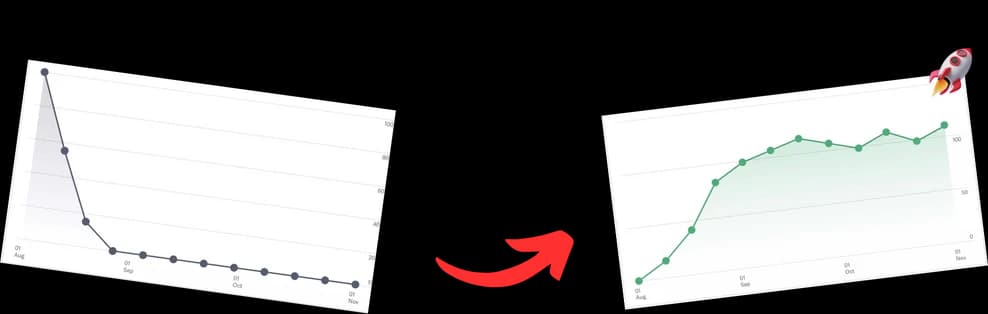
A great video description on YouTube is so much more than a quick summary. It's a powerhouse tool that tells the algorithm what your content is about and convinces real people to watch, engage, and subscribe. Think of it as your secret weapon for discoverability—part SEO magnet, part sales pitch.
Why Your YouTube Description Is Your Secret Weapon

Let’s be honest, for most creators, the description box is an afterthought. A quick copy-paste job and it's on to the next video. But treating it this way is a massive missed opportunity. A well-thought-out YouTube description plays a critical dual role that directly fuels your channel's growth, making it one of the most underrated assets you have.
First, it’s a direct line of communication to the YouTube algorithm. By packing it with relevant keywords and context, you’re essentially spoon-feeding both YouTube and Google everything they need to understand your video’s topic and value. This dramatically increases your chances of popping up in search results and suggested video feeds for the right audience.
Driving Clicks and Engagement
Second, the description is your persuasive pitch to turn a curious browser into an engaged viewer. Those first few lines are gold. They show up right under your video in search results and can make or break someone's decision to click, which has a huge impact on your click-through rate (CTR).
Ever wonder why some videos seem to take off while others just stall? The answer is often hiding in the description. A strong description supports the title and thumbnail, creating an irresistible package. For instance, 65% of people use YouTube to solve problems, so a description promising a clear, immediate solution will almost always win. And by adding chapters with timestamps, you not only make viewers happy but also give Google more hooks for long-tail search queries, potentially boosting your discovery by 25%.
A well-crafted description doesn't just inform; it guides the viewer's entire journey. It tells them why they should watch, what they'll learn, and what to do next, turning passive views into active engagement.
When you nail your description, you can see a direct impact on every important metric:
- Higher Click-Through Rates (CTR): A killer opening line pulls people in from search and suggestions.
- Longer Session Times: Chapters and clear summaries keep people on your video and your channel.
- Better Discoverability: Keywords tell the algorithm exactly who to show your video to.
To really see how a great description fits into the bigger picture of channel success, you’ll want to explore other actionable YouTube channel growth tips that tie everything together.
The Anatomy of a High-Performing Description
Let's get one thing straight: a high-performing YouTube description isn't just a block of text you slap under your video. It’s a strategic asset, a blueprint built to serve both curious viewers and the ever-hungry algorithm. If you get the structure right, you create a repeatable formula that can seriously fuel your channel's growth.
Your first 150-170 characters are pure gold. This is the snippet everyone sees in search results and right below your video before they even think about clicking "Show more." Your only job here is to hook them in while naturally dropping your main keyword. It has to instantly answer the viewer's unspoken question: "Why should I watch this?"
For instance, say you made a video on sourdough baking. A lazy opener like "A video about my sourdough process" does nothing for you. A much stronger hook? "Master the perfect sourdough loaf with this beginner's guide to starter, stretching, and scoring." It promises value, targets beginners, and weaves in the keyword seamlessly.
Building Out the Core Description
Once you've landed the hook, the rest of the description is where you add depth and context. Think of this part as a mini-blog post. Here, you’ll expand on what your video delivers, weaving in secondary keywords and longer, more specific search phrases.
This is your chance to detail the problems you're solving or the key topics you cover. You're basically anticipating and answering any questions a potential viewer might have. By giving a thorough rundown, you’re sending powerful signals to YouTube's algorithm, confirming exactly what your video is about and who it’s for.
A great description is a complete guide to the video itself. It gives viewers clarity and feeds the algorithm the essential data it needs to put your content in front of the right people.
This section also establishes your authority. You’re not just making a video; you're providing a resource. To really dig into how YouTube uses this information, it's worth understanding how metadata impacts video discovery and its role in the recommendation engine.
Structuring for Action and Navigation
After the summary, your description's job shifts from informing to guiding. This is where you add the functional elements that turn a passive viewer into an active part of your community. These aren't optional—they're essential.
To help you map this out, here’s a quick breakdown of what every optimized description needs.
Essential Elements of an Optimized YouTube Description
| Component | Purpose | Best Practice Example |
|---|---|---|
| Hook (First 2 Lines) | Grab attention in search results and entice clicks by clearly stating the video's value. | Learn how to edit videos faster in DaVinci Resolve with these 5 pro-level timeline tricks. |
| Expanded Summary | Provide context for YouTube’s algorithm and answer viewer questions with a keyword-rich overview. | In this tutorial, we dive deep into DaVinci Resolve's editing tools. We'll cover keyboard shortcuts, fusion clips, and color grading basics that will cut your editing time in half. |
| Video Chapters | Improve viewer experience and retention by allowing users to navigate to specific sections. | 00:00 - Intro & Setup01:15 - Tip 1: Smart Bins03:40 - Tip 2: Power Bins |
| Strategic Links | Drive traffic to other platforms, products, or related content to build your brand ecosystem. | Download my free editing checklist: [link] Follow me on Instagram: [link] |
| Calls-to-Action (CTAs) | Explicitly tell viewers what action to take next to increase engagement and subscribers. | If you found this helpful, hit the SUBSCRIBE button and ring the bell so you don't miss our next video! |
| Relevant Hashtags | Aid discoverability by connecting your video to broader topics and trending conversations. | #DaVinciResolve #VideoEditing #VideoEditor |
These components work together to create a description that’s not just informative but also incredibly functional for both viewers and search algorithms.
Here’s a closer look at those functional elements:
-
Video Chapters (Timestamps): Chapters are non-negotiable for any video longer than a couple of minutes. They chop your content into digestible, navigable sections, which is a massive win for viewer retention. Just remember, your timestamps must start with
00:00and you need at least three of them for the feature to work. -
Strategic Links: Don't waste the opportunity to guide your audience. Drop in links to your website, social media, affiliate products, or even other relevant videos on your channel. It’s all about creating a cohesive ecosystem around your content.
-
Clear Calls-to-Action (CTAs): Be direct. Tell people exactly what you want them to do next. Do you want them to subscribe? Watch another video? Download a freebie? A simple "Subscribe for more tips" or "Watch my video on [topic] next" can make a huge difference.
-
Relevant Hashtags: Finally, tack on three to five relevant hashtags at the very end. These are extra discovery tools that help your video show up next to other content using the same tags. Use a mix of broad terms (like
#videomarketing) and more specific ones (like#youtubeSEO) for the best results.
How Chapters Turn Viewers into Engaged Fans
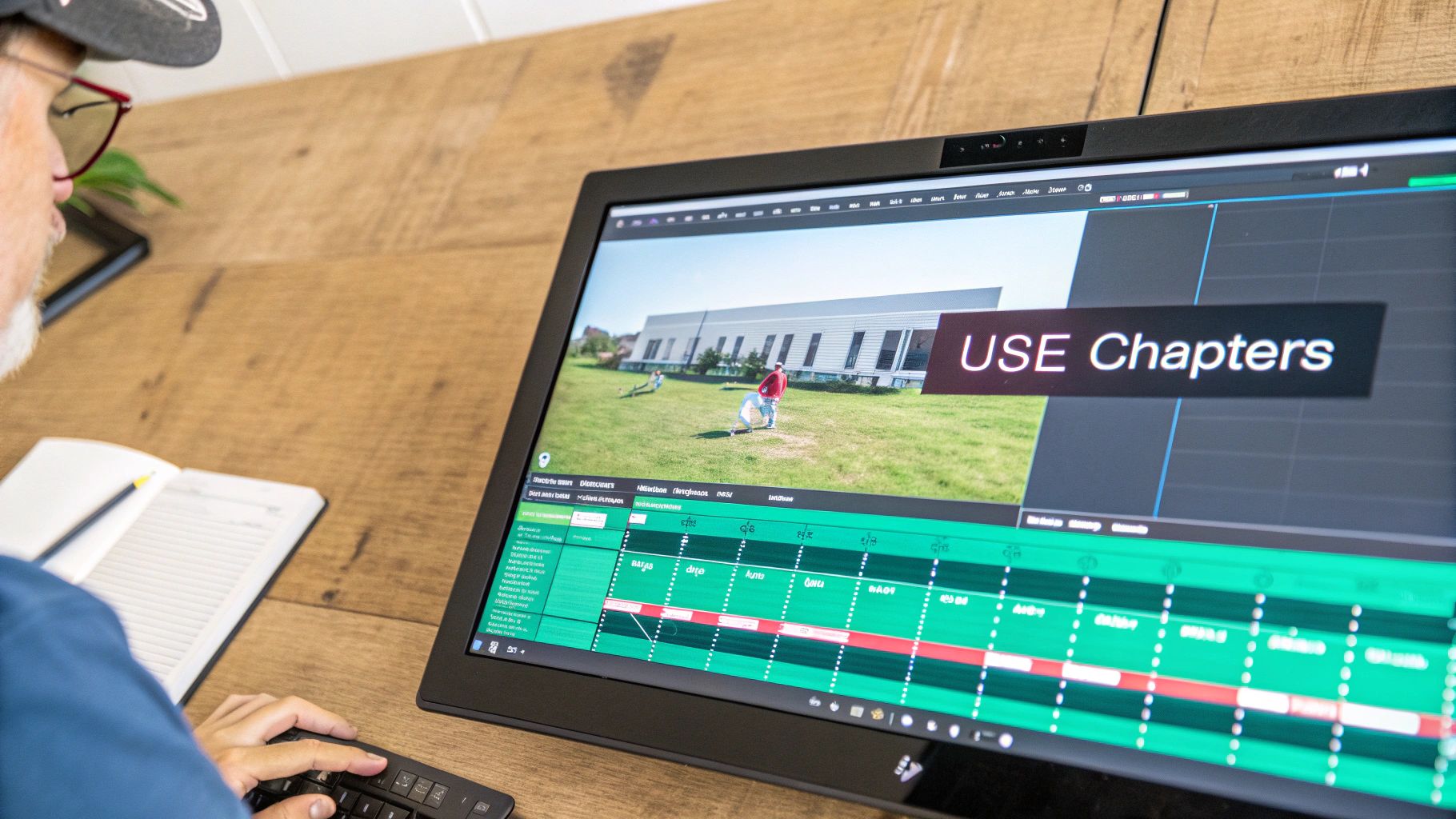
YouTube chapters, or timestamps as they're often called, are one of the most underrated features you can pop into your video description on YouTube. I see them as more than just a navigational tool; they completely change how people interact with your content, especially if you create longer videos.
Think of chapters as a clickable roadmap. They give your audience the power to find the exact moments that matter most to them, instantly. This simple act of giving viewers control is a game-changer for the user experience. Instead of endlessly scrubbing through a tutorial to find that one specific tip, they can jump right to it. That convenience is a direct line to higher viewer retention, which is a massive signal to the YouTube algorithm that your content is valuable.
Boost Retention and Please the Algorithm
The effect chapters have on retention is huge. When viewers can't find what they need, they bounce. It's that simple. We've all seen those audience retention graphs with a massive drop-off in the first minute because the video felt unstructured or slow.
Chapters are your best weapon against that initial drop-off. For context, the algorithm is obsessed with average view duration. A 12-minute video that holds 70% of its audience can easily outperform a 25-minute video that only manages 35%. Adding chapters can lead to a noticeable jump in viewer satisfaction and, in some cases, even a 15% boost in total viewing duration.
Chapters transform your video from a monologue into an interactive resource. This shift not only keeps people watching longer but also encourages them to return to your video as a reference, further boosting its authority.
For any creator making detailed guides, long interviews, or podcasts, this is a no-brainer. It's a fundamental part of a modern optimization strategy that shows you respect your audience's time.
From Manual Labor to Automated Strategy
Let's be real: manually creating chapters can be a drag, especially for long-form content. The process of re-watching your own video, jotting down times, and writing descriptive titles is a time-consuming chore that many creators just don't bother with. I get it.
This is where automation tools like TimeSkip come into play. Instead of burning hours on timestamps, you can generate SEO-driven, keyword-rich chapter titles in a matter of seconds. The tool scans your video and automatically pinpoints the key segments worth highlighting.
Here's an example of what that looks like in action. With just one click, a tool can generate all your chapters.
The screenshot shows an interface where optimized chapters are generated and ready to be copied, turning what was once a lengthy task into an instant win. This lets you get back to what you do best—creating great content—instead of getting bogged down in manual data entry. You can learn more about the specifics in our guide to mastering YouTube video chapters.
By automating this process, you ensure every single video you publish is fully optimized for viewer retention and search from the get-go. It's a strategy that turns a simple list of timestamps into a powerful tool for engagement and long-term channel growth.
Finding the Right Keywords for Your Description

Keyword research for your video description on YouTube isn't about guessing what might work or stuffing in a bunch of random terms. It's about getting on the same wavelength as your audience and using the exact language they use when they're looking for content like yours.
A fantastic—and ridiculously simple—place to start is the YouTube search bar. Seriously. Start typing a broad topic, something like "beginner gardening tips," and watch what happens. The autocomplete suggestions that pop up are a goldmine. They aren't random; they're the most popular related searches, giving you a direct peek into what viewers are actually looking for.
This little trick helps you nail down your primary keyword (the main topic) and discover a handful of long-tail keywords. These are the more specific phrases like "beginner gardening tips for small balconies," and they're incredibly valuable. Viewers searching for these are often highly motivated and know exactly what they want to find.
Integrating Keywords Naturally
Once you've got your list of keywords, the real art is weaving them into your description without sounding like a clunky robot. Your main keyword should fit comfortably within the first sentence or two. This is prime real estate—it's what everyone sees before they even think about clicking "Show more."
Getting that keyword in early immediately tells both the viewer and the YouTube algorithm that your video is exactly what they were searching for. After that, you can sprinkle your secondary and long-tail keywords throughout the rest of the description and even in your chapter titles.
The best descriptions read like a helpful, conversational summary written for a human, not a list of terms for an algorithm. YouTube is smart enough to understand context, so always prioritize clarity and value for your audience.
For instance, a chapter title could be "03:45 - Choosing the Right Pots (Gardening Tips for Small Balconies)" instead of just "Pots." This approach adds context and hones in on a specific search query. We actually explore this more in our deep dive on keywords on YouTube.
From Raw Content to Optimized Text
If you create long, dialogue-heavy videos, pulling relevant keywords directly from your own content is a powerful tactic. This is where something like a sermon transcription service can be a huge time-saver, providing the raw text you need to mine for organic phrases and ideas.
Ultimately, great keyword research is all about aligning your video with what people are actively searching for. A well-optimized video description on YouTube is a massive SEO lever. We've seen creators report as much as a 220% jump in visibility just by optimizing their descriptions and chapters. That's a huge advantage on a platform with over 2.7 billion monthly users.
The key takeaway? Write for people first. Provide real value and context, and the algorithm will reward you by connecting your video with the perfect audience.
Common Description Pitfalls (and How to Sidestep Them)
Even seasoned creators make small mistakes that can quietly sabotage a video's performance. A few simple missteps in your video description on YouTube can mean the difference between getting discovered and getting completely lost in the algorithm. Let's walk through the most common blunders I see and, more importantly, how to fix them.
One of the biggest and most outdated mistakes is keyword stuffing. This is when a description is just a laundry list of search terms, crammed together in a desperate attempt to rank higher. It’s not just awful for a human to read; YouTube's algorithm is smart enough now to see this as a red flag for low-quality content.
It doesn’t help you rank. It actually hurts you.
The Fix: Write for a person, not a robot. Pick one primary keyword and a handful of related, secondary terms. Then, weave them naturally into sentences that actually tell someone what your video is about. Your goal is to provide real context and value.
The Unclickable Link and the Snooze-Worthy Hook
Another classic error is pasting in a link that doesn't work. Just typing out www.mysite.com in the description box won’t make it clickable. With over 70% of YouTube watch time coming from mobile devices, you can bet nobody is going to manually copy and paste that into their browser.
Here’s the simple fix:
- Always, always include the
https://orhttp://at the beginning of your URL. That's what makes it an active, clickable link. - Before: Check out my website at mycoolsite.com for more info.
- After: Download my free guide here:
https://mycoolsite.com/free-guide
Just as damaging is a weak or generic opening hook. Those first couple of lines are prime real estate, but so many creators waste them with phrases like, "In this video, I'm going to talk about..." or the classic "Thanks for watching!" This does absolutely nothing to grab someone's attention in a crowded search results page.
Let's fix that:
- Before: This is a video where I show you how to bake bread.
- After: Master the perfect artisan sourdough loaf with this no-knead recipe that guarantees a crispy crust every single time.
See the difference? The second hook immediately screams value, works in keywords naturally, and makes you want to know more.
Forgetting About the Viewer's Experience
Finally, let's talk about two major user experience blunders: skipping chapters and building a "wall of text."
If you’re making any kind of tutorial, review, or long-form video, not adding timestamps is a recipe for a high drop-off rate. Viewers are impatient. They want to find the information they need now, and if you don't give them chapters to navigate, they'll just click away to a video that does.
Similarly, a giant, dense block of text with zero formatting is just plain intimidating. People scan content online; they don't read essays. A solid wall of text is unreadable and makes it impossible for viewers to pull out the key information they're looking for.
The Fix is easy:
- For any video with distinct sections, use timestamps to create chapters. It's a non-negotiable for longer content.
- Break your description into short, digestible paragraphs—no more than two or three sentences each.
- Use formatting like bullet points, bold text, and even emojis to guide the reader's eye and make your description scannable.
By avoiding these all-too-common pitfalls, you can turn your video description on YouTube into a powerful asset that works for you, helping both viewers and the algorithm understand exactly what your content is all about.
A Creator's Checklist for the Perfect Description
Consistency is the secret sauce for YouTube growth, and that goes for your workflow just as much as your upload schedule. When you have a solid system for writing your video description on YouTube, you never miss a beat. It turns a chore into a simple, repeatable process that just works.
Think of this checklist as your pre-flight inspection before hitting "Publish." Running through these points for every single video builds the kind of habits that pay off big time in discoverability and viewer engagement. It's the easiest way to make sure your description is always pulling its weight.
Your Go-To Description Checklist
Use this quick list to audit your descriptions before they go live. A quick scan is all it takes to make sure every component is locked in.
- The Hook (First 150 Characters): Does that first sentence grab you? It needs to scream value, include your main keyword, and make someone stop scrolling in search results.
- Detailed Summary: Have you given the algorithm enough to chew on? A few paragraphs of context expanding on your video's topic, sprinkled with secondary keywords, helps YouTube know exactly who to show your video to.
- Chapters (Timestamps): If your video is longer than a couple of minutes, are chapters included? Don't forget to start with
00:00and list at least three distinct segments. This is a massive win for navigation and SEO. - Strategic Links: Have you pointed viewers to other places you live online? This is your spot for social media handles, a related video, your website, or affiliate products.
- Clear Call-to-Action (CTA): Did you actually ask them to do something? A simple "Subscribe for more!" or "Download the free guide here" can make a huge difference.
- Relevant Hashtags: Got 3-5 hashtags at the end? Mix it up with a couple of broad and a few super-specific tags to connect your video to the right conversations.
Your description isn't just a summary; it's a long-term asset that keeps attracting viewers and providing value ages after you've uploaded. Treat it with the strategic importance it deserves.
A Flexible Template to Get You Started
Want to save even more time? Create a template. Just copy and paste this structure into your description box and fill in the blanks for each new video. It’s a game-changer.
[A killer 1-2 sentence hook that includes your primary keyword.]
In this video, you'll learn:
- [Bulleted list of 2-3 key takeaways or topics from the video.]
Timestamps:
00:00 - Intro to the main topic
02:15 - Key Point #1
05:30 - Diving deeper into an important detail
08:45 - Final thoughts and conclusion
Connect with me: Website: [Your Link Here] Instagram: [Your Link Here]
Subscribe for more videos just like this one!
#PrimaryTopic #SecondaryTopic #YourNiche
By getting your video descriptions right, you’re building a channel that's more robust and much easier to find. It’s one of those foundational pieces of YouTube that, once you nail it, frees you up to focus on what really matters: creating incredible content.
Ready to stop wasting time on manual timestamps? TimeSkip generates perfect, SEO-optimized chapters for your videos in seconds. Try it for free and see how much faster your workflow can be.